
Sustainable Pet Food Packaging: Choosing Film That Cuts Waste Without Making the Line Fragile
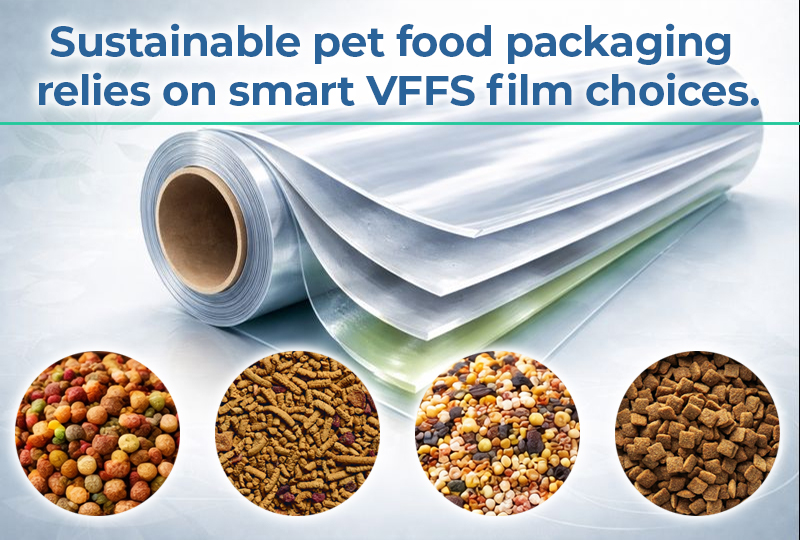
If you’re working on sustainable pet food packaging, you already know how these programs get judged. Not by a badge on the bag, but by what happens in production, whether the film runs like a normal day on the line, or whether it quietly adds scraps and operator intervention.
When film choices go sideways, sustainability stops looking like progress. It starts looking like extended dial-in time, more stoppages, and a steady loss of trust across operations. And pet food makes the consequences louder than most categories. If a structure downgrades too far, you don’t just see a few cosmetic defects. You see punctures from kibble, seal issues that show up after pallet vibration, and leaks that contaminate cases and create rework downstream.
That’s why the most practical path to sustainable pet food packaging is to focus on film performance first. Not “less material” in theory, film that tracks predictably, seals in a comfortable window, prints consistently, and holds up to the real stresses pet food bags face: abrasion, compression, vibration, and the chemistry of fats and aromas.
Where sustainable pet food packaging programs lose ground
1) Instability-driven scrap during startups and restarts
A small shift in friction, a tighter seal window, or roll-to-roll thickness variation can turn routine startups into tuning sessions that burn material fast. Pet food lines don’t always stop cleanly, either. Fines, dust, and residual product around forming and sealing areas increase cleanup friction after stops, so instability multiplies waste.
2) Downgauging that increases punctures, abrasion, and downstream damage
Pet food is rough on packaging. Kibble is abrasive. Some blends include sharp edges or hard inclusions. Bags are dragged across conveyors, case-packed, palletized, and vibrated through distribution. If downgauging reduces puncture resistance, abrasion resistance, tear strength, or seal robustness, downstream failures rise. Material savings don’t matter if total system waste goes up.
3) Barrier choices that miss the real risk
Film selection isn’t just “high barrier vs low barrier.” Pet food has real shelf-life and quality risks: moisture ingress affecting texture, oxygen exposure affecting fats, and aroma retention impacting customer experience. Underbuilt structures can fail later through quality drift or compromised integrity. Overbuilt structures can create stiffness and sealing sensitivity that your process can’t tolerate comfortably. Either way, stability suffers.
4) Films that “should run” but don’t run here
A film can be technically sound and still demand constant attention. Tension that shifts through your forming path. Friction that drifts as the roll changes. Sealing behavior that becomes sensitive to small temperature swings. Touchy lines create waste, especially in multi-SKU pet food environments where changeovers are frequent, and operators can’t afford a long settling period after every roll change.
5) Printing waste that never reaches production
If printed rolls get rejected or reprinted, that film is wasted before it ever reaches the packaging machine. In pet food, this is amplified by SKU proliferation: flavors, sizes, life-stage variants, and private label programs. Upstream print waste can quietly cancel out the material savings you gained from downgauging or redesigning the structure.
6) Late failures that don’t show up in early trials
Some issues appear after time and stress: slow leaks, seal creep, pinholes that become problems after abrasion, or packages that pass day-one trials but fail after compression and vibration. Early success isn’t the same as long-term stability. Sustainable changes need to survive real distribution handling, not just the first production run.
A film-first decision path for sustainable pet food packaging
Step 1: Choose the structure family based on risk
Film selection isn’t a sustainability vote. It’s a risky decision. What does your pet food need to survive: oxygen exposure impacting fats, moisture, and texture changes, aroma retention, grease migration, and real distribution handling, without creating waste through instability?
High-barrier laminations can be appropriate where oxygen, moisture, and grease control are critical to shelf life. Metalized structures are often used where enhanced barrier and bonding properties are needed, while still balancing runnability and cost. Oriented Polypropylene film laminations are frequently selected for strength and stiffness, but the key question is always the same: Does the structure deliver the barrier and mechanical performance you need without narrowing the seal window to the point that production becomes fragile?
If sustainability goals include recyclability or downgauging, this is where tradeoffs need to be made deliberately. The best programs don’t chase a single metric; they protect total system performance so waste doesn’t migrate from “material” to “scrap and rework.”
Step 2: Control the properties that decide whether the film runs consistently
Once you’ve chosen a structure, the next question is whether it will behave the same way every time you run it. Three variables tend to decide that.
Coefficient of friction (COF) matters because small shifts in friction show up quickly as tracking drift, tension instability, and increased operator intervention. COF is commonly evaluated using standards such as ASTM D1894, but the operational point is simple: stable lines don’t rely on luck. They rely on film behavior that stays within a controllable band.
Thickness consistency influences forming repeatability, print behavior, and sealing stability. When thickness varies more than expected, the process window shrinks, especially in sealing, where small shifts can produce intermittent defects. Checking thickness before and after production helps keep material behavior predictable.
Sealing performance should be tested under defined conditions: temperature, dwell, and pressure, so you have a realistic expectation of how the film behaves before it hits the packaging machine. Seal strength testing is often referenced to recognized standards such as ASTM D882, but again, the operational goal is what matters: confirm a seal window that supports repeatable production, not just “it can seal in a lab.”
These aren’t abstract checks. They’re the variables that decide whether a film settles quickly on a VFFS line or demands constant small corrections to keep it running.
Step 3: Treat printing as part of the sustainability conversation
Printing is one of the biggest sources of preventable waste in flexible packaging. When color drifts, registration shifts, or defects slip through, you pay for it in rejected rolls and reprints long before the film reaches production.
Well-managed rollstock programs treat print control as part of waste reduction. Inline color measurement (often via spectrophotometry) helps catch drift early. Offline inspection can identify defects before a roll ever reaches the packaging machine. The operational payoff is tangible: fewer roll surprises, fewer last-minute workarounds, and fewer situations where production is forced to “make it work” with film that shouldn’t have shipped.
Step 4: Confirm the film fits the product and the equipment reality
Film isn’t just a material choice; it’s a system choice. Structure, bag geometry, and composition need to align with the product and how your equipment is actually set up to run.
In practice, that means more than swapping in a new spec and hoping it behaves. It means pressure-testing the basics under production-relevant conditions. Does the film seal reliably at the temperature and dwell window your VFFS machine is designed for? Does stiffness match your forming set and bag style? Does friction behavior align with your web handling and pulling belts? And for pet food specifically, does the structure hold up to abrasion and compression without turning minor handling into downstream failures?
When film selection and equipment reality are evaluated together, sustainable changes are more likely to run like normal production, not like an ongoing experiment.
The Unified Flex advantage in film-driven sustainability
For sustainable pet food packaging, waste reduction only holds when film performance stays predictable roll after roll and shift after shift. Unified Flex’s rollstock approach focuses on value-added package development and quality controls that keep film behavior stable, so sustainability shows up as less scrap, fewer restarts, and fewer downstream failures, not just a lighter structure on paper.
That includes disciplined checks around thickness consistency, sealing behavior under defined conditions, mechanical performance tied to real handling stress, and print quality controls that reduce upstream roll waste so more of what you buy actually makes it to production. The practical objective is simple: protect production stability while reducing total waste across the system.
Conclusion: Sustainable pet food packaging has to run like production
In pet food, sustainability works when it lowers total waste without adding instability. That starts with selecting a film structure that matches real risk, barrier needs, grease and aroma considerations, and distribution handling, then controlling the variables that determine whether the film behaves consistently in production: COF, thickness consistency, sealing performance, and print control.
Validate these choices under realistic compression, vibration, and handling conditions so the pack holds up beyond day-one trials. When film tracks are sealed in a comfortable window, waste reduction becomes repeatable. That’s when sustainable pet food packaging scales across SKUs without turning production into a constant adjustment cycle.