Bag Types
Blogs

How Does the RS-4 Handle Different Liquid Viscosities Accurately?

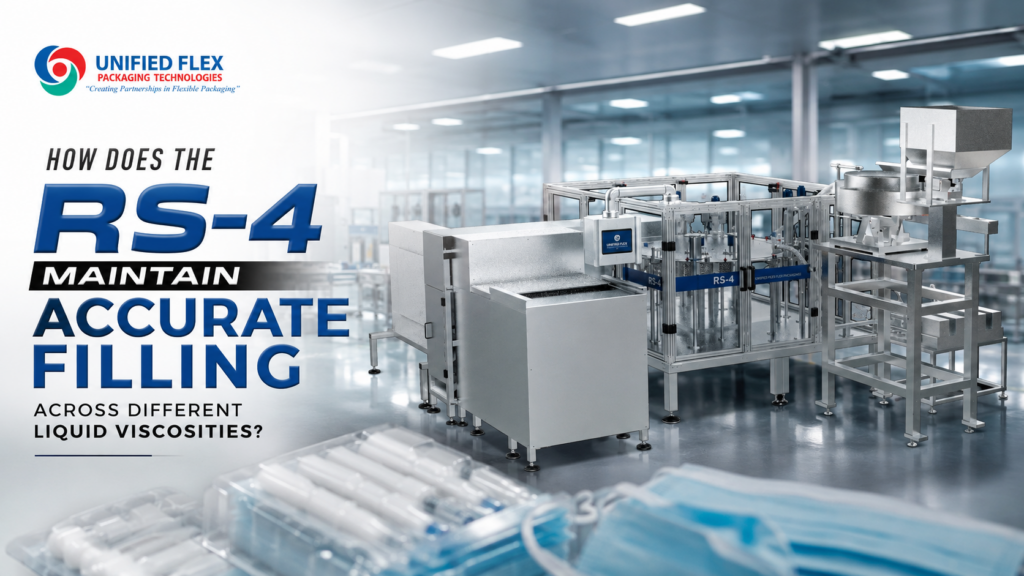
Unified Flex RS-4 rotary filling machine maintaining accurate liquid filling across different viscosities in a high-speed production environment for medical and pharmaceutical packaging
Switching from thin juices to thick sauces or lotions throws most fillers off balance — drifting weights, product giveaway, and constant tweaks follow. The RS-4 Spouted Pouch Filler & Capper from Unified Flex handles this range with servo-controlled pistons that adjust stroke, speed, and motion to match each liquid’s flow. Four independent filling heads deliver up to 80 pouches per minute while maintaining tight volumetric accuracy for beverages, shampoos, detergents, and even particulate-laden products. Precision rotary indexing, “No Pouch – No Fill” logic, and quick tooling changes keep waste low and OEE high across multiple SKUs on one machine.


How Does the AP-180 Maintain Sterile Packaging at High Speeds?

Unified Flex AP-180 automatic pouch filling machine maintaining sterile integrity while packaging medical devices like syringes at high speed in a cleanroom environment
Sterile barrier failures hit hard in medical device lines — recalls, downtime, and patient risk follow. The AP-180 Auto Pouch Bagger from Unified Flex tackles this with rotatable horizontal seal jaws that maintain even pressure and dwell time across every cycle. Full form-fill-seal automation reduces manual handling and contamination points, while stainless steel contact parts simplify sanitation. Tool-less changeovers and stable PLC control keep seals consistent at up to 40 pouches per minute for syringes, diagnostic kits, IV components, and more. Built for repeatable sterile integrity, not just speed.

Can the AP-140 Manage Thick Shampoo Formulations Efficiently?

Auto Pouch Bagger AP-140 by Unified Flex packaging thick blue shampoo into pillow-style pouches on a high-speed production line
Thick shampoo got your packaging line stuck in slow motion? The Auto Pouch Bagger AP-140 from Unified Flex handles 3,000–15,000 cP viscosities at full speed. Its pneumatic horizontal seal jaws deliver clean, consistent seals while PLC synchronization keeps film advance, filling, and sealing in perfect rhythm — up to 40 sachets per minute. Rotatable jaws switch between 3-side and 4-side pouches fast. Stainless steel parts and tool-less changeovers slash downtime. Built in Canada with readily available USA components, this modular VFFS system pairs seamlessly with piston fillers for accurate dosing and reliable output on demanding conditioning and sulfate-free formulas.

How Growing Demand for Disposable ECG Electrodes Is Changing Packaging Priorities 

Medical electrodes sealed in a 3 side seal sachet package for sterile medical device packaging applications.
As the market for disposable ECG electrodes continues to expand, manufacturers are rethinking how packaging supports product quality, traceability, and distribution efficiency. This article explores the evolving role of packaging in medical electrode applications and examines why 3-side seal sachets remain a widely used format for balancing protection, information display, and operational practicality.

How Pharmaceutical Packaging Machines Maintain Dosage Accuracy and Consistency

Pharmaceutical packaging machine AP180 with holographic dosage precision graphics showing ±0.5% accuracy and 100% consistency, surrounded by nutraceutical products.
Pharmaceutical packaging machines maintain dosage accuracy and seal consistency in nutraceutical production. The MSP 440 multilane stick pack system solves Ashwagandha powder challenges, cutting fill variance to ±1.8%, stabilizing seals, and reducing changeover times.

Struggling with Turmeric Packaging? Here’s Why Stick Packs Are Taking Over 

Turmeric stick pack pouring powder into a cup, showing convenient turmeric packaging format
As turmeric demand grows, packaging is becoming a key differentiator. This blog explores the challenges of handling turmeric and why stick packs are emerging as a practical, scalable solution.

Why More Brands Are Turning to Stick Packs for Ashwagandha Powder Packaging 

Stick pack packaging for ashwagandha powder displayed alongside loose powder, highlighting single-serve convenience
Ashwagandha powder presents unique packaging challenges due to its fine, inconsistent nature. This blog explores how stick pack packaging addresses these issues by improving portion control, reducing waste, and supporting more consistent production, while also highlighting what it takes to make that format work effectively in real-world applications.

Can Stick Pack Packaging Machines Transform the Way Sauces Reach Consumers?

Can Stick Pack Packaging Machines Transform the Way Sauces Reach Consumers
Stick pack packaging machines are changing sauce distribution with precise portion control, reduced waste, and compact design. They support efficient production while meeting consumer demand for convenience, portability, and consistent quality.

Matcha Packaging Formats: How to Protect Product Integrity Across Every Use 

Different matcha packaging formats including sachets, stick packs, and pouches displayed on matcha powder
Matcha is highly sensitive to oxygen, moisture, and light, making packaging format a critical factor in maintaining product quality. This blog explores how different formats, single-serve, multi-use sachets, and bulk packaging, manage exposure over time, and how those differences affect consistency across the product lifecycle.

Why Is Web Width and Bag Size Critical in Coffee Packaging Efficiency?

Industrial coffee packaging scene with a stainless steel rotary pouch packaging machine in the background, slightly out of focus. In the foreground, several coffee bags of different sizes and widths are arranged on a reflective metal surface. The bags include brown, white, black, and gold finishes with coffee bean graphics and labels such as “Coffee,” “Organic Coffee,” and “Espresso.” Roasted coffee beans are scattered around, alongside burlap sacks filled with beans and rolls of packaging material. The setting appears to be a modern packaging facility with soft lighting, blurred conveyor belts, and stacked boxes in the background, emphasizing production scale and efficiency.
Web width and bag size play a key role in coffee packaging, affecting machine speed, material use, and production consistency, while helping maintain freshness and reduce operational costs.