
The Cost of Bad Packaging Fit: How Small Functional Failures Erode Millions in Margin
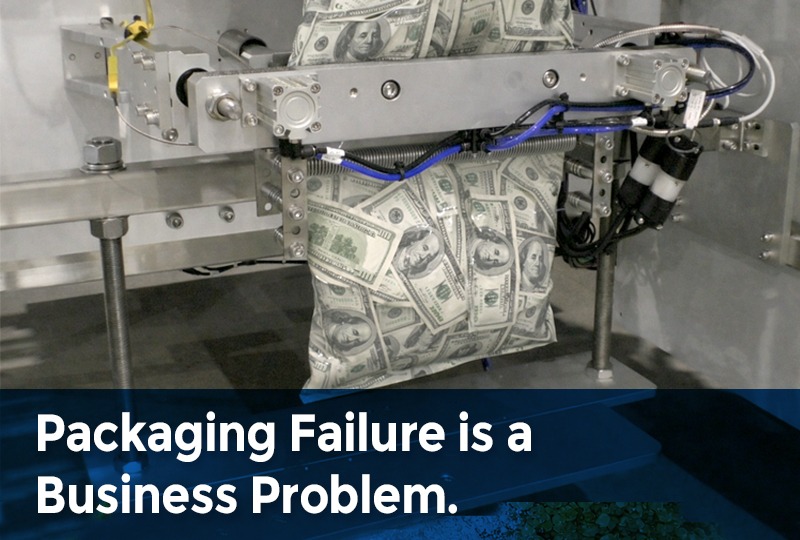
There’s a particular kind of loss that rarely shows up in financial review meetings. It doesn’t appear as a single line item, and it never arrives with drama. Instead, it comes disguised as dozens of small, ordinary problems across the business, nothing alarming on its own, yet collectively responsible for millions in unrealized margin. These losses are hidden within the quiet accumulation of packaging failures: the seal that weakens under vibration, the pouch that slowly collapses on the shelf, the laminate that stiffens just enough to misbehave during forming.
Because each failure looks minor and familiar, teams normalize them. A bit of rework here, a slower cycle there. A slightly higher deduction this quarter. A modest uptick in returns. But taken together, these symptoms reflect the same underlying truth: the packaging was never fully aligned with the realities of the product, the supply chain, or the way customers interact with it. Functional failures don’t look catastrophic. They look routine. And that’s why they quietly erode margins without resistance.
*This article is general information for packaging professionals and should be applied in line with your product requirements, internal quality procedures, and any applicable regulatory expectations.
Table of Contents
Functional Failures Distort the Economics of an Entire P&L
Before packaging failures ever damage a pallet, they distort financial assumptions. A film that behaves inconsistently forces teams to build a buffer into production planning. Throughput forecasts become padded “for safety.” Scrap budgets inflate. Distribution centers carry more overage than necessary. Inventory turns slow because no one trusts the predictability of output.
This distortion matters. When packaging performance fluctuates from shift to shift, the business loses the ability to accurately model COGS. Variance becomes chronic. Cost per unit drifts upward without a single responsible incident. It’s not that the packaging is expensive; it’s that the uncertainty it creates is expensive. That nuance is often missed until total cost-to-serve reviews make the pattern impossible to ignore.
Why Packaging Fails: Material Behavior, Not Operator Error
Most functional failures originate in the physics and chemistry of materials, not in the way operators run equipment. Films relax over time as polymers adjust to temperature. Laminate layers expand at different rates. Barrier coatings develop microfractures from flexing. A sealant layer may perform perfectly at one dwell time but degrade after extended vibration. These mechanisms aren’t visible at the line level, but they define real-world performance.
Failure modes such as creep, seal fatigue, adhesive layer shear, and COF drift often begin microscopically. A bag that slumps after stacking isn’t “bad luck”; it’s the predictable outcome of a structure that was never tested under the specific compressive loads of the supply chain. Packaging doesn’t fail randomly. It fails exactly where its materials are pushed beyond the conditions they were quietly vulnerable to.
Production Doesn’t Reveal Failures; It Absorbs Them
The first environment that should reveal instability is production, yet production often compensates for it instead. Machinery adapts to minor inconsistencies through automated corrections. Operators make instinctive adjustments to temperature, pressure, or tension. The line keeps moving, but at the cost of efficiency.
Functional failures show up here as small, chronic inefficiencies:
- slight misregistration that requires continuous monitoring
- fragmentation in cut quality
- seal inconsistency that raises scrap by half a point
- increased downtime from lane imbalance
Each one feels solvable. And each one is solvable, just not at the point where the symptoms appear. By the time production feels the friction, the root cause is already baked into the material.
The Supply Chain Is the Ultimate Truth Serum
Even the most stable-looking package can unravel during distribution. Multi-axis vibration from trucking fatigues seals in ways no vibration table fully predicts. Trailer heat softens certain polymers, altering stiffness ratios. Pallet compression forces material into new shapes. Corner pressure in mixed-load shipments stresses weak points that manufacturing never exposed.
This is where small instabilities become expensive realities. One batch deforms. One pallet leaks. One seal line fails under sustained movement. By the time packaging failures surface here, the cost is already magnified, with full product write-offs, repacking labor, expedited replacement freight, and retailer penalties stacking quickly. These costs rarely get coded under “packaging failures,” but that’s exactly what they are.
Shelf Behavior Reveals Failures, No Testing Protocol Predicts
Retail shelves introduce their own stressors: light exposure, airflow, sustained upright pressure, repeated shopper handling, uneven surfaces, and long stand-times after partial use. Packaging that behaved well during production and shipping may begin degrading weeks later, in ways no QC test anticipated.
The most common shelf-level failures aren’t catastrophic. They’re structural:
- stand-up pouches that tilt forward
- pillow bags that lose tension
- sachets that curl at corners
- stick packs that slump in trays
To a retailer, this looks like inconsistency. To a shopper, it looks like low quality. In reality, it’s a material’s mechanical properties revealing themselves under long-duration stress.
Consumers Experience Functional Failures as Annoyance, Not “Defects”
Consumers don’t articulate packaging failures in technical terms. They simply react emotionally. A tear notch that misbehaves becomes “annoying.” A resealable closure that doesn’t align becomes “cheap.” A bag collapsing mid-use becomes “messy.” These reactions are subtle but devastating to repeat purchase behavior.
The psychology is straightforward: when a product creates friction during everyday use, the brand becomes associated with hassle, not value. No ad campaign can offset that erosion. And because consumers rarely complain formally, the brand loses loyalty without realizing why.
Failures Persist Because Organizations Are Built to Miss Them
Functional failures are rarely anyone’s job to catch. Procurement optimizes price. Operations optimize speed. Logistics optimizes stability. Design optimizes shelf appeal. Quality ensures compliance. No function owns the full lifecycle. That fragmentation guarantees failures will repeat because the feedback loops are fractured.
The business ends up treating symptoms individually instead of understanding that they’re all manifestations of one root issue: packaging that wasn’t engineered for the realities of its journey.
What Good Packaging Fit Actually Requires
Good packaging fit is not simply “stronger materials” or “better seals.” It’s the deliberate matching of structure to forces, environments, and behaviors:
- mechanical fit with the filling and forming process
- distribution fit with vibration, compression, and temperature cycles
- retail fit with standability and shape retention
- consumer fit with opening behavior, ergonomics, and durability over time
When packaging is engineered with these layers in mind, it becomes resilient—not reactive.
Unified Flex’s Role: Packaging Built to Prevent the Failures That Drain Margin
Unified Flex approaches packaging with a manufacturing mindset rather than a marketing one. The films are built to remove the variables that typically cause small failures in production and distribution, seal inconsistency, friction drift, thickness variation, or barrier instability. That means controlling the fundamentals during extrusion, verifying mechanical behavior through tensile and seal-strength testing, and checking friction and thickness so the film behaves predictably at speed.
Color integrity and print stability are managed with the same discipline, not for aesthetics, but because inconsistency in printing often signals inconsistency in film performance. By validating materials under the same temperature, pressure, and dwell conditions they will experience on actual lines, the packaging is designed to hold its shape, hold its seal, and hold its behavior across environments, not just at the moment of forming.
It’s not about making packaging “impressive.” It’s about removing the small structural surprises that quietly inflate cost, disrupt schedules, and weaken trust. The goal is simple: packaging that behaves the way a business needs it to, every time.
Conclusion: Functional Failures Don’t Break the Business—They Undermine It Quietly
The packaging issues that cost the most rarely show up as dramatic defects. They surface as slow inefficiencies, rising deductions, unstable pallets, and small consumer frustrations that never get traced back to packaging at all. That’s why they’re so expensive, because they drain margin invisibly, across functions that were never designed to diagnose them.
When packaging is built to perform in the real world rather than in controlled tests, those quiet failures stop appearing. Lines run the way they were modeled, freight moves without surprises, shelves stay orderly, and consumers stop encountering the friction that erodes loyalty.
The financial impact isn’t theoretical; it’s operational stability, predictable cost structures, and fewer points of unexpected loss. Strong packaging fit doesn’t call attention to itself. It simply removes the hidden drag that holds growing brands back.