
Flexible Packaging Film: How to Approve Changes Without Creating New Problems
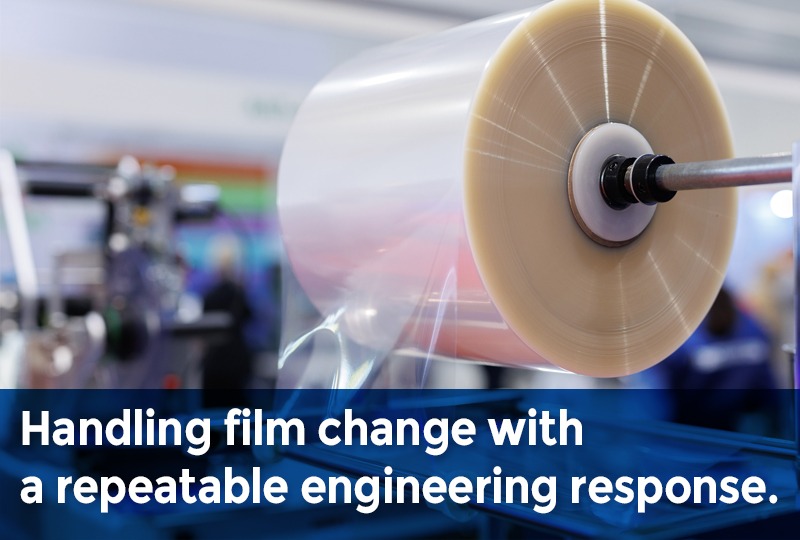
In rollstock packaging, change is constant. Film lots turn over, suppliers substitute resins, and printed versions replace plain ones. COF gets adjusted to improve machinability, operations push for higher speeds, and procurement looks for additional sources to protect supply. None of that is unusual. What gets expensive is treating those shifts like paperwork instead of engineering, until the line starts reporting back in the only language it has: leaks, tracking issues, long recoveries after splices, and waste that never shows up on anyone’s forecast. This blog is a practical way to keep change moving while protecting performance: a simple method to classify film changes, match them to the right level of re-check, and document decisions with evidence instead of assumptions.
*This article is general information for packaging professionals and should be applied in line with your product requirements, internal quality procedures, and any applicable regulatory expectations.
Table of Contents
Why is flexible packaging film change control different from “film qualification”
Flexible packaging film change control differs from film qualification because it solves a different problem at a different point in the lifecycle. Qualification proves the package can run under defined conditions. Change control protects performance later, when something shifts: a new film lot, a supplier change, a print added, COF drift, or a speed increase, while the line is already in production. And production reality comes with uptime pressure, scrap costs, customer expectations, and limited tolerance for open-ended trials. So, the goal isn’t to retest everything. It’s to re-check what the specific change can realistically affect, and to do it in a way that supports a clear decision: approve, hold, or escalate.
Step one: identify which interface the change touches
Most film-related changes land in one (or more) of three places. If you name the interface first, the re-check becomes obvious.
1) Handling interface (film ↔ web path).
This is where friction behavior, stiffness, gauge profile, and winding quality show up. Changes here usually appear as tracking drift, new wrinkle signatures, sensitivity at higher speeds, or longer recoveries after splices.
2) Sealing interface (film ↔ seal system).
This is where sealant-layer behavior, heat response, and tolerance to real-world contamination show up. Changes here usually appear as new leak modes, weaker seals, or a process that becomes suddenly sensitive to small adjustments.
3) Print/coating interface (film ↔ graphics).
This is where “we only changed artwork” turns into a performance change: surface behavior, stiffness, registration stability, and splice quality variability. If the printed build is different, treat it as a potential interface change until it proves it runs the same.
Your decision system doesn’t need more sophistication than this. It just needs consistency.
Step two: classify the change by risk, not by how it’s described
The most dangerous changes are the ones that sound small.
A supplier can call it “equivalent” and still change friction behavior. A purchasing change can look “spec-matched” and still arrive with a different gauge profile. A print change can be “cosmetic” and still alter how the web behaves at speed.
A practical risk lens is to ask one question: can this change alter web behavior or seal behavior? If the answer is “yes,” it deserves a planned re-check. If the answer is “no,” document why and keep moving.
Common changes that often deserve attention:
- COF or slip behavior changes (handling risk)
- Thickness/gauge variability changes (handling + forming risk)
- Sealant layer or structure changes (sealing risk)
- Coatings, metallization, or print build changes (print/coating risk)
- Speed target increases (process change that amplifies film sensitivity)
The point isn’t to alarm anyone. It’s to avoid being surprised by predictable physics.
Step three: Use a re-check ladder so the response fits the change
This is what prevents teams from bouncing between two bad defaults: testing nothing and hoping for the best, or re-qualifying everything and grinding progress to a halt.
Level 1 — Quick re-check (low risk or limited time).
The purpose here is simple: confirm the change didn’t introduce a new problem. That means looking for anything that wasn’t there before, new defect patterns, longer recovery after routine events, or a process that suddenly feels more sensitive to normal variation. The most efficient way to prove that is to test the moments that usually expose weakness: a restart, a roll change/splice recovery, and a run across the real speed band.
Level 2 — Partial re-check (when the change can plausibly move handling or sealing).
This is for COF shifts, thickness variability, coatings/print builds, or any change that has a track record of creating instability. The intent is to generate enough data to decide whether you’re still operating in the same “safe region” as before, without running a full program.
A small planned check around baseline conditions, plus the same event moments (restart, roll change, speed ramp), is usually enough to tell you whether you’ve moved the process.
Level 3 — Full re-check (when the interface is truly different, or Level 1/2 reveals new failure modes).
Structure changes, barrier changes, sealant changes, or repeated historical issues fall here. This level isn’t about being cautious for its own sake; it’s about avoiding the cost of discovering a new failure mechanism during production.
This ladder is also what makes your approvals defensible: you can show that the response matched the risk.
Step four: run the minimum checks that catch most regressions
A re-check only matters if it gives you evidence you can act on. The highest-value checks are the ones that help you separate “film behavior shifted” from “line condition shifted.” In practice, a small set of rollstock checks catches most regressions early.
- COF evaluation to understand friction behavior that impacts high-speed handling and can drive equipment disruptions when COF changes.
- Pre- and post-production thickness testing using a mechanical micrometer to confirm thickness consistency that affects stretch, durability, and run stability.
- Heat-seal testing under specific temperature, dwell time, and pneumatic pressure, with sealing strength measured according to ASTM 882.
- Tensile strength testing, with compliance to strength characteristics in accordance with ASTM 882.
- For printed film: inline high-resolution spectrophotometers to monitor color data, and an offline high-speed inspection machine that checks printed film quality and splices out inconsistencies in printing quality.
These checks don’t replace what happens on the packaging line. They do something more targeted: they reduce uncertainty when you’re deciding whether a change is material-driven and whether it’s likely to shift web handling or sealing behavior.
Printed film deserves its own sentence in your change process
If your program moves from unprinted to printed, or changes coatings/metallization, treat it as an interface change until proven otherwise. The reason is simple: print and coatings can alter surface behavior and stiffness, and they introduce new failure opportunities tied to inspection and splicing quality. If the line is sensitive, those “small” differences show up quickly as downtime and recovery issues.
The best way to keep this manageable is to attach printed-film changes to your re-check ladder, not to your intuition.
Speed changes are changes, whether anyone calls them that or not
When you increase speed, you’re not just turning up output; you’re tightening the process. Effective dwell shifts, web stability becomes less forgiving, and small differences in COF or gauge variability start to show up as tracking sensitivity, wrinkle changes, or weaker recovery after events. And when the line does stumble, at a roll change or restart, the cost of that stumble rises fast because scrap accumulates quickly at higher throughput.
That’s why “same film, higher speed” should trigger at least a Level 1 re-check by default. It isn’t bureaucracy. It’s acknowledging that you changed the operating conditions that decide whether the film runs consistently.
The change-control template that makes approvals faster
If you want change control to feel like acceleration instead of friction, keep the record simple and repeatable:
What changed and why? Which interface is likely impacted? Which re-check level applies? What does “no regression” mean for this line (seal integrity, web handling stability, and recovery after events)? Who signs off?
That’s enough to prevent the most expensive pattern: spending a week debating root cause after production has already paid for the learning.
The takeaway
Flexible packaging film will change. The advantage comes from handling that change with a repeatable engineering response: identify the interface, match the re-check effort to the risk, and verify performance in the moments that expose fragility. That’s how you approve changes confidently, without turning every film update into a new project, and without letting “equivalent” become an expensive surprise.