
Magnesium Hydroxide Powder Packaging: Why Stick Pack Format Reduces Risk in Unit-Dose OTC Production
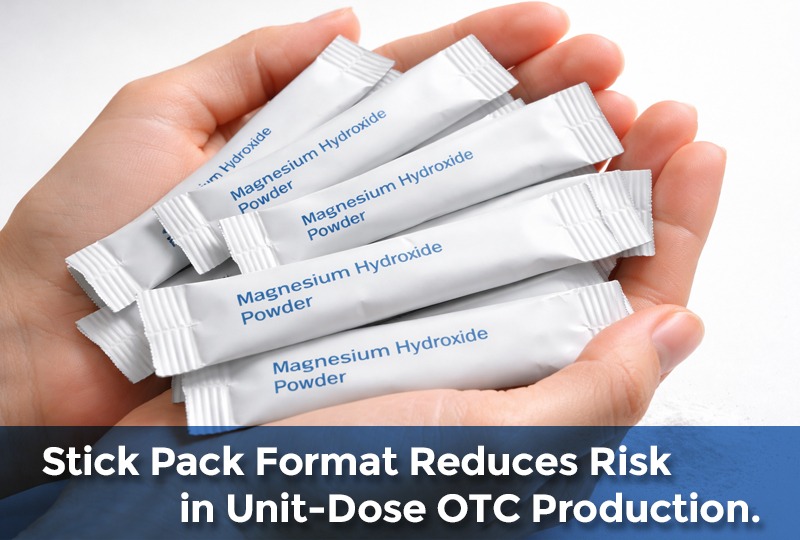
Magnesium hydroxide powder packaging is not a secondary design choice. In OTC laxative and antacid production, it is a process stability decision.
Fine powders amplify small mechanical weaknesses. When packaging format is misaligned with product behavior, the result is predictable: fill-weight variability, seal contamination, dust accumulation, increased cleaning intervals, and preventable downtime. Over time, those variables erode throughput, margin, and confidence in the line.
For plant engineers and operations managers, the core question is simple: which packaging format reduces variability rather than magnifying it?
For unit-dose magnesium hydroxide, stick pack geometry frequently provides the most mechanically stable solution.
Table of Contents
Understanding the Processing Behavior of Magnesium Hydroxide Powder
Magnesium hydroxide powders used for laxatives and antacids are typically fine and cohesive. In production, that translates into behavior that is sensitive to hopper head pressure, vibration, and environmental conditions. Bulk density can shift during a run. Powder can aerate or compact. Discharge rates may not remain perfectly uniform.
These behaviors create three operational pressure points.
First, density drift influences fill accuracy in volumetric systems. Even well-calibrated equipment requires stable material presentation to maintain consistent weight across shifts.
Second, fine particulate can migrate toward sealing areas. Seal integrity depends on clean interfaces; when fines enter the seal zone intermittently, defects become harder to predict and isolate.
Third, dust generation affects sanitation intervals and maintenance exposure. In regulated environments, more frequent cleaning increases downtime and documentation workload.
None of these issues is unique to magnesium hydroxide, but the fine particle profile of this material makes them more visible in unit-dose production.
How Packaging Geometry Influences Seal Integrity and Dose Stability
Packaging format is often discussed in terms of marketing or convenience, but for fine powders, it also influences process risk by shaping the powder’s path into the seal area. Wider sachets and pouches create a larger internal cavity, which can allow more lateral powder movement after discharge and before the transverse seal is formed. At higher speeds, where web acceleration, entrained air, and static effects are more influential, fine particles are more likely to migrate, and if they reach the seal interface, they can reduce seal consistency.
Wider geometry also increases the length/area of seal that must remain free of contamination to maintain repeatable seal strength. This does not mean wide formats cannot run well; with appropriate powder handling, dust control, and sealing design, they often do. However, formats that constrain powder movement, such as stick packs, can reduce dispersion pathways and, in turn, reduce the likelihood of powder-driven seal variability in cohesive, dusty products like magnesium hydroxide.
Stick Pack Format: Mechanical Advantages in Unit-Dose Laxative and Antacid Applications
Stick pack format changes the physical conditions under which magnesium hydroxide is filled and sealed. The forming tube is narrow and vertically oriented, so the product is deposited into a confined column rather than a wide cavity.
That difference matters with fine powders.
Constrained Powder Path and Seal Stability
When magnesium hydroxide is discharged into a wide pouch, it has more lateral space to spread before the transverse seals close. The wider the internal footprint, the greater the chance that fines migrate toward the seal interface, especially at higher speeds.
In a stick pack, the confined geometry limits lateral movement. The powder travels a shorter, more controlled path from fill to seal. Because the transverse seal width is narrower, less seal interface is exposed to potential contamination.
Seal performance still depends on proper temperature, pressure, film selection, and airflow control. But by reducing the dispersion window and the exposed seal area, the stick pack format makes seal conditions easier to manage over long runs.
The practical outcome is not perfection. It is reduced variability.
Repeatable Low-Dose Filling Under Density Drift
Auger filling is commonly used for cohesive powders such as magnesium hydroxide because it provides controlled, repeatable volumetric delivery when properly designed and calibrated. Stick pack format complements this approach by directing the discharged powder into a narrow vertical column rather than a wide pouch cavity.
In wider formats, minor bulk density variation can influence how the discharged powder spreads and settles prior to seal formation. With a confined stick pack geometry, there is less internal area for redistribution before sealing occurs. While format does not eliminate density-related variation, it reduces the influence of post-discharge dispersion on final package consistency.
Multilane Scaling While Preserving Stick Pack Geometry
In stick pack systems, throughput is typically increased by adding lanes. Each lane forms the same narrow package geometry, so output scales through repetition while the per-pack forming cavity stays consistent.
From a process perspective, that matters because the fill-to-seal conditions within each stick pack lane do not change as lane count increases. The powder remains constrained within the same narrow forming tube, and the sealing interfaces operate on the same pack dimensions.
For contract manufacturers and multi-SKU operations, multilane stick pack architecture also supports lane-level isolation. If fill weight or seal quality begins to drift, the issue can often be investigated at the lane level rather than treating the system as a single, combined process. That containment can reduce troubleshooting time and keep interventions more targeted during a run.
Dust Management and Cleanability in Regulated Environments
Dust generation in magnesium hydroxide powder packaging is not simply a housekeeping concern. It affects sanitation validation, cleaning time, and wear exposure on components.
Stick pack format contributes to dust control by limiting uncontrolled dispersion during the fill-to-seal window. When paired with enclosed product feed paths and appropriate extraction, the confined geometry helps reduce powder spread within the machine frame.
In regulated OTC production, predictable cleaning intervals and manageable sanitation procedures are part of overall line performance. Format choice influences how complex those routines become over time.
The following summary outlines how these process drivers interact with packaging format in magnesium hydroxide applications.
Magnesium Hydroxide Powder Packaging: Process Drivers and Format Impact
| PROCESS DRIVER | WHAT HAPPENS ON THE LINE | WHY IT OCCURS | HOW STICK PACK GEOMETRY INFLUENCES IT |
|---|---|---|---|
| BULK DENSITY DRIFT | Fill weights may vary gradually during extended runs | Fine cohesive powders can aerate, compact, or shift under vibration and changing hopper head pressure | A narrow vertical fill path reduces the internal cavity where powder can redistribute before sealing, helping limit additional variation caused by post-discharge movement |
| SEAL CONTAMINATION | Inconsistent or weakened seals appear intermittently | Fine particles can migrate into the transverse seal interface between filling and sealing | A narrower cavity shortens the lateral distance powder can travel before sealing, reducing the probability that fines reach the seal interface |
| POWDER DISPERSION | Powder settles unevenly inside the package before sealing | Wider cavities allow discharged powder to spread laterally prior to seal formation | The confined forming tube of a stick pack limits lateral movement between discharge and sealing |
| DUST MIGRATION INSIDE THE MACHINE | Dust accumulates around sealing or forming areas over time | Fine particles become airborne during filling and air displacement inside the package cavity | A confined product path can limit lateral powder movement during the fill-to-seal window; effective dust control still depends on machine enclosure, extraction, and powder handling design |
| SEAL-AREA SENSITIVITY TO CONTAMINATION | Seal strength can vary if particles reach the sealing surface | Larger seal interfaces increase the area that must remain clean during sealing | Narrow stick pack seals reduce the exposed interface area where contamination could interfere with seal formation |
| THROUGHPUT SCALING | Process stability may change when production speed increases | Higher speeds increase web motion, airflow, and powder movement inside larger cavities | Multilane stick pack systems increase output by adding lanes while maintaining the same narrow pack geometry for each lane |
The Unified Flex Safety Net: Reducing Operational and Capital Risk
Selecting the stick pack format for magnesium hydroxide addresses process stability. Selecting the right equipment platform addresses capital risk. For most organizations investing in unit-dose packaging, this is not a small purchase. It is a significant operational decision with long-term implications for uptime, maintenance exposure, and production consistency.
At Unified Flex, stick pack systems are engineered with fine powder behavior in mind. That means configuring the dosing system, agitation, sealing approach, and dust management around the material, not adapting the material to a generic platform. The objective is predictable performance under real production conditions, not ideal lab scenarios.
Execution discipline matters just as much as design. Unified Flex follows structured engineering, build, and testing processes so that equipment is validated before it reaches the customer floor. For organizations investing significant capital into packaging automation, that process discipline reduces uncertainty between purchase order and production start.
Serviceability is part of that same risk calculation. Unified Flex designs stick pack systems using widely available, non-proprietary components sourced through established industrial suppliers. When maintenance is required, customers are not locked into a single supply channel for critical parts. Faster access to replacement components translates into shorter recovery times and more predictable uptime.
For companies evaluating magnesium hydroxide powder packaging, the real value is not only in selecting the right format. It is in partnering with a manufacturer that approaches equipment design, execution, and long-term support as a controlled, process-driven system.
When Stick Pack May Not Be the Correct Format
Stick packs tend to be the better choice when the process is limited by seal cleanliness and low-dose repeatability. If your constraints are different, they may not be the best fit. For example, if your line is primarily limited by downstream cartoning, case packing, or secondary packaging flow, changing formats may not improve overall throughput. If your magnesium hydroxide blend requires aggressive deaeration or dust control to hold weight and seals, a format with more headspace and a wider forming cavity may actually be easier to stabilize at your target speed.
Sachets and bottles can absolutely work for magnesium hydroxide. The tradeoff is that wider geometries usually demand tighter control of powder dispersion and seal-zone cleanliness. If the team is already set up to manage that, through extraction, airflow control, and sealing discipline, then alternative formats may be a practical choice. If not, stick packs often reduce the day-to-day variables that operators and maintenance teams end up chasing.
Conclusion: Format as a Risk-Control Decision
For magnesium hydroxide laxative and antacid products, the operational challenge isn’t whether the powder can be packaged; it’s whether it can be packaged consistently at scale without seal drift, dust-driven intervention, or constant adjustment. Stick pack format helps by constraining powder movement and reducing seal-zone exposure.
Unified Flex supports that stability with application-specific configuration, process-driven build and testing, and non-proprietary components that make parts access and service response predictable. In the end, that’s what buyers are paying for: controllable production and controllable downtime.