
Matcha Packaging Formats: How to Protect Product Integrity Across Every Use
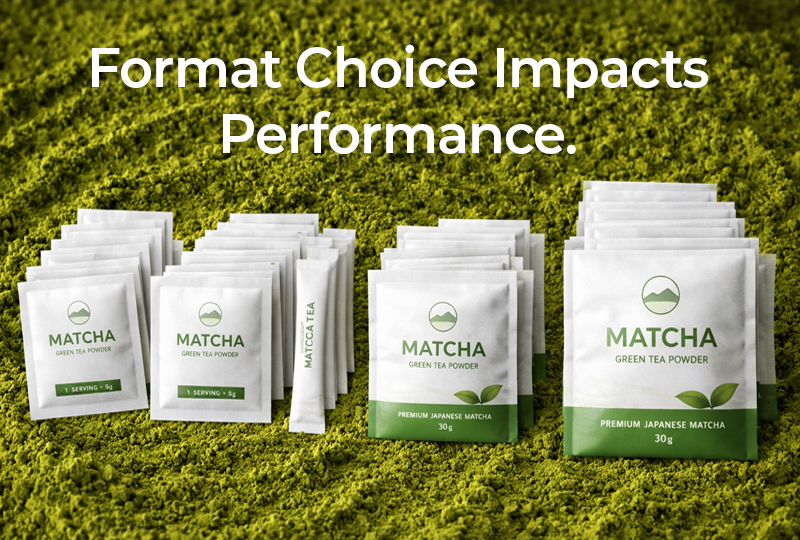
Matcha is a sensitive product. Exposure to oxygen, moisture, light, and temperature can affect its color, flavor, and texture from the moment the package is opened. Those changes build over time during storage, distribution, and repeated use.
Packaging format plays a direct role in how well quality is preserved throughout that journey. Two units from the same batch can perform differently not because the formulation changed, but because each format manages post-opening exposure in a different way. A multi-serve format introduces oxygen and moisture every time it is opened. A single-serve format limits that exposure to a single event.
In practice, the format determines how often the product is exposed, how consistently it performs over its usable life, and how much control is retained once it leaves the production environment. That is what makes matcha packaging a critical product decision, not just a packaging one.
Table of Contents
The Real Problem: Format Selection Without Understanding Product Behavior
Packaging formats are often selected based on cost, branding, or market expectations. While these factors are important, they do not reflect how matcha behaves once it is packaged and used.
Matcha is a fine, cohesive powder with a high surface area. This combination increases its reactivity to environmental conditions. Small changes in exposure, whether to oxygen, moisture, or light, can accelerate degradation. At the same time, the way the powder is contained influences how much of it is exposed at any given time.
When format selection does not account for these physical realities, performance becomes inconsistent.
Cost Optimization That Alters Exposure Dynamics
Reducing packaging material per unit often leads to larger pack sizes. While this improves material efficiency, it also increases total exposed volume once the package is opened.
A larger package introduces more headspace, meaning more oxygen is present inside the package after each opening. In addition, a greater mass of product is exposed simultaneously. Over multiple use cycles, this accelerates oxidation and creates uneven degradation between early and later servings.
Format Design Without Considering Exposure Cycles
Different formats control how often the product is exposed.
Single-serve formats limit exposure to a single event. Multi-use formats introduce repeated exposure cycles. Bulk formats increase both the frequency and magnitude of exposure.
Each of these conditions leads to different degradation patterns, which must be understood when selecting a format.
Real-World Handling as a Variable
Once opened, packaging no longer operates in a controlled environment. Storage conditions vary. Packages are opened and resealed inconsistently. Exposure duration differs from one use to another.
Formats that rely heavily on user handling introduce variability that cannot be fully controlled by the packaging itself.
Real-World Use Conditions That Override Design Assumptions
Once the product reaches the end user, control shifts.
Packaging is opened, resealed, stored in variable conditions, and handled repeatedly. A format that performs well when first opened may not maintain that performance after multiple uses.
This is where inconsistency becomes visible, not at the point of packaging, but during consumption.
What Matcha Packaging Must Control
To evaluate packaging formats properly, it is necessary to understand what must be controlled throughout the product lifecycle.
Oxygen Exposure
Oxidation directly affects both color and flavor. Even small, repeated exposure events can lead to noticeable degradation over time.
Moisture Ingress
Matcha readily absorbs moisture, leading to clumping and texture changes. This process accelerates once a package is opened and exposed to ambient conditions.
Light Exposure
Light contributes to the breakdown of chlorophyll, impacting the visual quality that consumers associate with freshness.
Exposure Frequency
Each time a package is opened, the product is reintroduced to oxygen and moisture. Over time, these exposures accumulate, making the number of openings a critical variable in product stability.
Consistency is not determined at the moment of packaging. It is determined by how well these variables are controlled throughout the product’s use.
Packaging Formats as System Components
Each format manages these variables differently. Understanding those differences is key to selecting the right approach.
| Format Type | Where It Performs Well | Where It Breaks Down | Key Dependency |
|---|---|---|---|
| Single-Serve | Maximum control over exposure | Higher material usage | Portion precision |
| Multi-Use Sachet | Flexibility across applications | Repeated exposure after opening | User handling |
| Bulk (Pillow Bag) | Material efficiency and volume | High exposure after opening | Storage conditions |
Single-Serve Formats: Eliminating Exposure Cycles
Single-serve formats such as stick packs and small sachets remove one of the most significant variables in matcha packaging: repeated exposure.
Each unit is opened once and consumed immediately. This eliminates cumulative exposure to oxygen and moisture, resulting in more consistent product performance across all units.
However, this control introduces a different requirement.
Because each portion is isolated, there is no averaging effect across multiple uses. Any inconsistency at the portion level becomes directly visible. This places greater importance on maintaining uniformity across units.
Single-serve formats provide the highest level of control at the point of use, but they require tighter consistency across the entire system.
Multi-Use Sachets: Flexibility with Exposure Trade-Offs
Multi-use sachets, including 3-side and 4-side seal formats, offer a more flexible solution.
They allow multiple servings within a single package and can be used across different channels without significant changes in format.
This flexibility, however, introduces variability.
Each time the package is opened, the product is exposed to environmental conditions. Over time, this leads to gradual degradation, which may not be consistent from the first use to the last.
The format itself does not fail, but it introduces a dependency on how the product is handled after opening.
Multi-use sachets balance efficiency and usability, but they do so by accepting controlled exposure risk.
Bulk Formats: Efficiency That Depends on External Control
Bulk formats such as pillow bags are typically selected where packaging efficiency and higher product volumes justify greater post-opening exposure. They are more viable in applications with faster product turnover and more controlled handling after opening. When unopened, they can perform effectively. Once opened, however, they introduce the highest level of exposure. The larger product volume and increased headspace accelerate oxidation, while repeated handling compounds the effect over time. In this format, the package provides the initial barrier, but long-term product stability depends far more heavily on storage discipline after opening. Bulk formats don’t inherently fail; they simply reduce the level of control the packaging system has over what happens next. Instead, that control is shifted from the packaging process to the end user.
When One Format Becomes Multiple
As operations grow, a single format is rarely sufficient.
Retail may require single-serve formats for consistency and convenience. Subscription models may rely on multi-use packaging. Foodservice environments may prioritize bulk formats for efficiency.
Operating across these formats introduces a new challenge. Each format manages exposure differently. This creates variation not only in product performance but also in how consistency must be maintained across the system. At this stage, the issue is no longer selecting a format.
It is managing multiple formats without introducing uncontrolled variability.
A System-Based Approach to Format Selection
The goal is not to identify a single “best” format. The goal is to understand how each format affects the system and where its limitations lie.
Single-serve formats reduce variability by eliminating exposure cycles. Multi-use sachets provide flexibility but depend on user handling. Bulk formats improve efficiency but rely heavily on external conditions.
Most operations will use a combination of these formats.
The objective is not to optimize one variable in isolation. It is to reduce uncontrolled variables across the entire lifecycle of the product.
Final Thought
Packaging formats do not determine consistency on their own. They define how consistency can be maintained or lost over time.
In matcha packaging, failure is rarely the result of choosing the wrong format. It is the result of selecting a format without understanding how it behaves within the system it operates in.
The question is not which format works best.
It is the format that allows you to maintain control where it matters most.