
Disposable ECG Electrode Packaging: How Operational Complexity Shapes Packaging Decisions
Disposable ECG electrodes are used every day in hospitals, sleep centers, neurological clinics, and diagnostic facilities. While much of the attention surrounding these products focuses on clinical performance, manufacturers often face a different set of challenges behind the scenes. As production grows, packaging operations must evolve alongside it.
At lower production volumes, packaging processes can appear relatively straightforward. Products are packaged, coded, inspected, and prepared for shipment without placing significant strain on the operation. As demand increases, however, packaging often becomes more than a final production step. It becomes a process that must support growing volumes, changing customer requirements, and increasingly complex production schedules.
For manufacturers of disposable EEG/ECG electrodes, packaging challenges rarely emerge because of a single issue. More often, complexity accumulates gradually as the operation expands.
Table of Contents
Growth Changes More Than Production Output
When production increases, the impact extends beyond the manufacturing line itself.
More products moving through the facility means more materials to manage, more production runs to coordinate, and more finished goods to prepare for shipment. Packaging operations that once handled a limited number of product configurations may suddenly find themselves supporting a broader range of requirements.
This shift can be particularly noticeable when manufacturers serve multiple customers. Different packaging specifications, labeling requirements, and order quantities can introduce additional variables into the process. What was once a standardized packaging operation can become a production environment that requires greater coordination and planning.
As a result, packaging teams often find themselves managing a growing number of moving parts while still being expected to maintain production schedules and support customer expectations.
Packaging Complexity Often Appears Gradually
One of the challenges with packaging operations is that complexity rarely arrives all at once.
Instead, it tends to emerge through a series of small changes.
A new product configuration is introduced. A customer requests a different packaging format. Production schedules become more compressed. Additional traceability requirements are added to the process.
Individually, these changes may seem manageable. Collectively, they can create an environment where packaging activities require significantly more oversight and coordination than before.
This is particularly relevant for disposable ECG electrodes, where product identification and traceability often play an important role in day-to-day operations. Packaging must support the accurate communication of product information while fitting into a production environment that may already be balancing multiple priorities.
The challenge is not necessarily the individual requirement. It is managing all of those requirements simultaneously.
When Packaging Decisions Become Operational Decisions
As packaging requirements become more demanding, manufacturers often begin evaluating packaging decisions differently.
The discussion shifts away from the package itself and toward the role packaging plays within the broader operation.
Questions become less focused on whether a package can hold a product and more focused on how the packaging process supports production objectives.
Can the operation accommodate changing product requirements without creating disruption?
Can packaging processes adapt as customer expectations evolve?
Can the production team support growth without introducing unnecessary complexity into the workflow?
These are operational questions, but they are often influenced by packaging decisions.
This is one reason manufacturers frequently reassess packaging systems as their operations mature. Equipment that worked well under one set of conditions may not always align with the realities of a more complex production environment.
Where Packaging Systems Fit Into the Discussion
For disposable EEG/ECG electrode manufacturers, packaging equipment is often evaluated based on how well it supports the operation as a whole.
The discussion is rarely limited to throughput alone. Manufacturers must consider how packaging systems fit within existing production processes, how easily they can support changing requirements, and whether they can continue to serve the operation as production evolves.
This is where packaging platforms designed for flexibility become increasingly relevant.
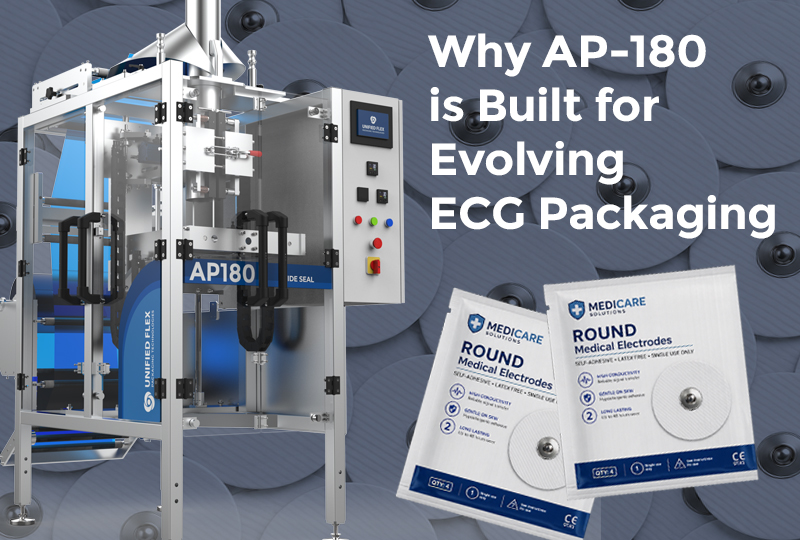
The Auto Pouch Bagger AP-180 from Unified Flex was developed as a modular vertical form fill seal system intended to support a range of packaging requirements from a single platform.
Rather than limiting manufacturers to a single package style, the AP-180 can produce 3-side seal bags, 4-side seal bags, pillow bags, and stick packs with optional tooling. This allows packaging operations to accommodate different packaging requirements without necessarily introducing additional packaging platforms into the production environment.
The system can also be integrated with auger fillers, piston fillers, volumetric fillers, and weigh scales, allowing manufacturers to configure the packaging process around the application. As production requirements evolve, this flexibility can help operations adapt without requiring a complete redesign of the packaging process.
The AP-180 supports bag sizes up to 8.5 inches wide and 11.5 inches long and can produce up to 40 pouches per minute, depending on product and package configuration. More importantly, however, it represents the type of packaging platform manufacturers often begin evaluating when operational requirements become more demanding.
In this context, packaging equipment becomes less about machine specifications and more about supporting an operation that must remain effective as business requirements change.
Why Manufacturers Look Beyond the Machine
Selecting packaging equipment is rarely just a machine decision.
For many disposable EEG electrode manufacturers, the evaluation process also includes the packaging partner behind the equipment. Packaging requirements can vary significantly from one application to another, making it important to work with a company that understands how packaging fits into the broader production environment.
At Unified Flex, projects begin with the application itself. Factors such as product requirements, packaging format, production objectives, and future growth plans are evaluated before a solution is recommended. This approach helps ensure the packaging system aligns with both current needs and long-term operational goals.
Experience also plays a role. With more than 17 years of experience in packaging automation, Unified Flex has worked with manufacturers across a wide range of industries and applications. That experience helps inform equipment recommendations, system design decisions, and project execution.
Just as important is the process behind the project. Successful packaging implementations depend on more than equipment specifications alone. Clear planning, defined milestones, communication, testing, installation, and support all contribute to project success. For manufacturers making a significant capital investment, a structured process can provide confidence that expectations, timelines, and project objectives remain aligned throughout implementation.
Ultimately, manufacturers are not simply investing in packaging equipment. They are investing in a packaging solution, a project process, and a long-term relationship that will support the operation well beyond installation day.
Packaging for Today's Needs and Tomorrow's Requirements
Packaging operations are often expected to support far more than product containment. They must function within a production environment that is continuously adapting to changing products, customers, and business objectives.
For disposable EEG/ECG electrode manufacturers, operational complexity tends to increase gradually. New requirements are added, production volumes grow, and packaging processes become more interconnected with broader manufacturing goals.
As this occurs, packaging decisions increasingly become operational decisions.
Manufacturers that evaluate packaging through this lens are often better positioned to adapt as requirements evolve. Rather than focusing solely on current production demands, they can assess how packaging systems support the long-term flexibility and efficiency of the operation.
As disposable ECG electrode production continues to expand, that perspective is likely to become increasingly important.