
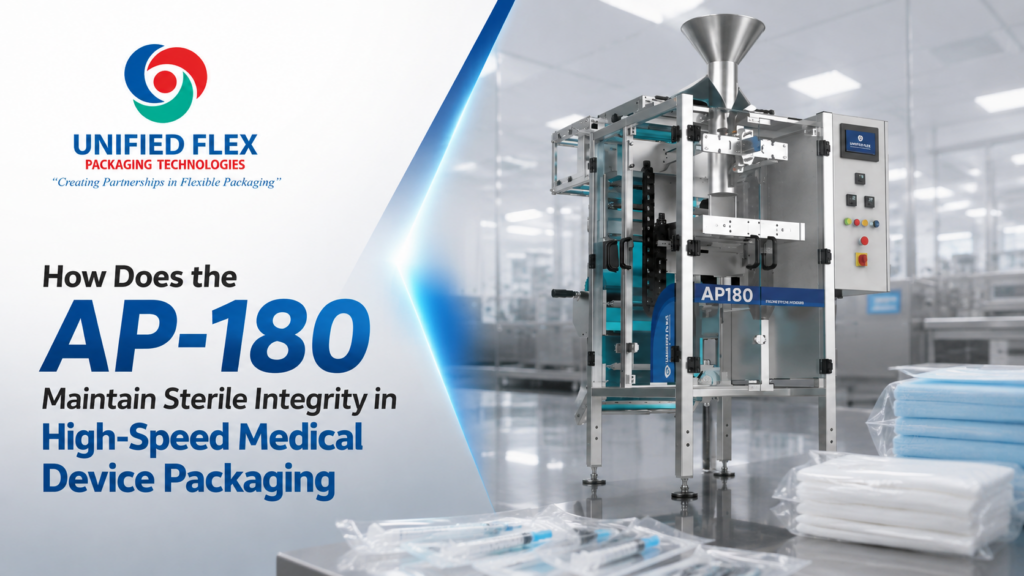
How Does the AP-180 Maintain Sterile Integrity in High-Speed Medical Device Packaging?
By Unified Flex Editorial Team | Reviewed by Packaging Engineering Specialists | June 2026
For engineers and operations managers working in medical device manufacturing, sterile integrity isn’t a checkbox; it’s a physics and process-control problem that has to be solved batch after batch, shift after shift, without a single point of failure. When sterile barrier failures occur, the consequences can include product recalls, regulatory scrutiny, production downtime, and risks to patient safety.
The FDA has repeatedly identified packaging integrity issues as a cause of recalls involving sterile medical devices, reinforcing the importance of reliable sealing and validated packaging processes.
The Unified Flex Auto Pouch Bagger AP-180, a compact vertical form fill seal (VFFS) machine, was engineered to solve this exact challenge: how do you form, fill, and seal a sterile barrier at production speed, consistently, without introducing the variability that manual or aging semi-automated lines inevitably create?
Here’s a breakdown of how it does it and why that matters to the people who spec, run, and own these lines.
Table of Contents
Why Is Sterile Integrity Critical in Medical Device Packaging?
Sterile packaging performs a much larger role than simply containing a product. It acts as a protective barrier against contamination throughout transportation, storage, and clinical use.
Packaging failures often result from small process variations rather than catastrophic equipment failures. Changes in seal temperature, pressure, dwell time, film alignment, or machine wear can gradually weaken the sterile barrier without being immediately visible during production.
For manufacturers, maintaining sterility requires controlling every critical packaging variable throughout the entire production cycle.
What Causes Sterile Barrier Failures?
Several factors can compromise seal integrity if they are not consistently controlled:
- Variations in sealing temperature
- Uneven seal pressure
- Inconsistent dwell time
- Jaw misalignment
- Film tracking errors
- Mechanical wear during long production runs
These variables create defects such as weak seals, channel leaks, and pinholes that may only become apparent during transportation or product use.
For example, during an extended production run, even a slight variation in sealing temperature or jaw pressure can gradually create intermittent seal defects that pass routine visual inspection but fail sterile barrier testing during quality validation.
The objective is therefore not simply to produce a seal, but to produce the same high-quality seal every cycle.
Which AP-180 Features Maintain Sterile Integrity?
Our medical device packaging machines combine multiple engineering features that work together to reduce process variation and maintain consistent sterile packaging.
Rotatable Horizontal Seal Jaws
One of the AP-180’s primary advantages is its rotatable horizontal seal jaw system.
Unlike conventional sealing systems that may experience uneven wear over time, the rotating seal jaws apply consistent pressure and dwell time throughout every production cycle. This minimizes process drift while producing repeatable seal geometry across extended production runs.
For engineers, this means improved seal consistency whether the machine is packaging the first pouch or the ten-thousandth.
Integrated Form-Fill-Seal Automation
The AP-180 performs pouch forming, filling, and sealing within one continuous automated process.
This eliminates unnecessary product transfers between separate machines and reduces manual handling.
By minimizing operator interaction, manufacturers benefit from:
- Lower contamination risk
- Improved process consistency
- Reduced human error
- Better production repeatability
Automation transforms sterile integrity from an inspection activity into a controlled manufacturing process.
Stainless Steel Product Contact Parts
Medical packaging equipment must support hygienic production environments.
The AP-180 vertical form fill seal machine incorporates stainless steel product contact components that resist corrosion while simplifying routine cleaning and sanitation procedures.
This construction supports long-term equipment reliability while helping manufacturers maintain clean production conditions.
Inline Coding and Traceability
Modern medical device packaging requires complete traceability throughout the supply chain.
The AP-180 supports optional integration of:
- Lot code printers
- Date code printers
- Barcode scanners
Because coding occurs directly within the packaging process, manufacturers reduce additional handling steps while improving labeling accuracy and supporting regulatory compliance.
Tool-less Changeovers
Production flexibility has become increasingly important as manufacturers package multiple medical products in shorter production batches.
Tool-less changeovers allow operators to switch between pouch formats quickly without lengthy equipment adjustments.
The result is:
- Less downtime
- Faster production scheduling
- Improved Overall Equipment Effectiveness (OEE)
- Greater manufacturing flexibility
How Does the AP-180 Reduce Contamination During High-Speed Production?
Every manual touchpoint represents another opportunity for contamination.
Traditional packaging operations often require products to move between forming, filling, sealing, coding, and inspection stations. Each transfer increases handling and process variability.
The AP-180 reduces these risks by integrating multiple packaging operations into one continuous workflow.
This approach provides several operational benefits:
- Reduced operator handling
- Shorter product exposure time
- Fewer contamination opportunities
- Consistent packaging quality
- Improved process repeatability
For operations managers, automation not only increases productivity but also creates a more controlled manufacturing environment where sterile integrity is maintained throughout production.
Which Medical Devices Can the AP-180 Package?
Medical manufacturers often package multiple product types using the same production line.
The Auto Pouch Bagger AP-180 is designed to accommodate a wide range of applications, including:
- Syringes
- Diagnostic test kits
- IV components
- Surgical instruments
- Medical powders
- Sterile swabs
- Gauze products
- Medical liquids and gels
The machine supports solid, powder, granular, and liquid products while producing pouches up to 8.5 inches wide by 11.5 inches long at speeds of up to 40 pouches per minute.
This versatility allows manufacturers to standardize packaging processes across multiple product lines while reducing equipment complexity.
How Does the Auto Pouch Bagger AP-180 Improve Production Efficiency?
Increasing throughput should never compromise packaging quality.
The AP-180 improves manufacturing performance by combining automation with process stability.
Its compatibility with auger fillers, piston fillers, volumetric cup fillers, and weigh scales allows manufacturers to integrate the vertical form fill seal machine into existing production environments without extensive redesign.
For production teams, this provides measurable operational advantages:
- Higher equipment utilization
- Faster product changeovers
- Reduced labor dependency
- Improved production consistency
- Better OEE
- Lower operating costs
Instead of adding additional manual resources as production demand increases, manufacturers can scale output through automation.
Why Does Process Stability Matter More Than Maximum Speed?
Many packaging systems are evaluated primarily on maximum output speed.
However, experienced manufacturing engineers understand that process stability delivers greater long-term value than short bursts of production speed.
A vertical form fill seal machine that produces excellent seals during commissioning but gradually loses consistency over an eight-hour shift creates intermittent defects that are difficult to detect and expensive to correct.
For example, when packaging thousands of sterile diagnostic kits or syringe components in a single shift, even minor process drift can result in inconsistent seal quality across batches, increasing inspection time, product rejects, and production delays.
The AP-180 is engineered to maintain repeatable sealing performance throughout extended production runs. Stable process parameters reduce variation, simplify validation activities, and improve confidence that every package leaving the line meets the same quality standards.
Closing Thoughts
Maintaining sterile integrity in medical device packaging requires more than high production speeds; it demands consistent process control, repeatable sealing performance, and reliable automation. The Auto Pouch Bagger AP-180 is engineered to reduce process variability, improve packaging consistency, and support scalable production while helping manufacturers protect product quality and meet the demands of regulated healthcare environments.
Looking to optimize your medical device packaging process? Contact the Unified Flex team today to discuss your application or request a free consultation to see how our medical device packaging machines can help improve efficiency, maintain sterile integrity, and support your production goals.