
Animal Feed Additives in Powder Form: Where Packaging Formats Succeed and Where They Struggle

An Engineering Review of Common Failure Modes and the Format Used to Reduce Risk
Animal feed additives used in medicated and animal health applications are frequently manufactured as fine, pharmaceutical-grade powders. Products such as Bacitracin Methylene Disalicylate are designed for precise dosing, uniform dispersion, and biological performance. They are not intended for packaging convenience. As a result, packaging performance in these applications is far less forgiving than in bulk feed or granular ingredient packaging.
In operations handling fine feed additives, recurring issues such as seal defects, inconsistent pack-out, and operator intervention are often attributed to equipment settings or sealing parameters. In practice, many of these symptoms originate earlier in the process. When packaging formats are not aligned with powder behavior and operating conditions, even well-designed equipment is forced to compensate for variability it was never intended to absorb.
Understanding where formats struggle and why simpler formats often perform more reliably is a necessary first step in reducing risk in medicated feed additive packaging.
Common Problems in Packaging Fine, Dusty Feed Additives
Problem 1: Dust migration during filling and settling
Fine feed additives such as Bacitracin Methylene Disalicylate exhibit visible airborne fines during free fall. As the product enters the package, entrained air and particle interaction create upward dust movement rather than clean, downward flow. This behavior is inherent to fine, cohesive powders and not due to poor handling.
When packaging formats introduce multiple folds, gussets, or interfaces near the top of the package, these areas become natural collection points for fines. The resulting contamination is often subtle. Instead of immediate seal failure, the impact typically appears downstream as intermittent leakage or micro-defects that pass initial inspection but fail during handling, cartoning, or storage.
Adjustments to sealing temperature or pressure may temporarily reduce symptoms, but they do not address the underlying cause. The root issue is geometric exposure to dust during the fill and settle window, not inadequate sealing energy.
Problem 2: Air entrapment and variable package density
Fine, compressible powders retain entrained air as they settle. In products like Bacitracin Methylene Disalicylate, bulk density can shift based on head pressure, agitation, and fill dynamics, even when the target weight is held within tolerance.
This variability affects downstream handling. Packages may appear acceptable at the sealing station while exhibiting inconsistent firmness, poor stackability, or excessive headspace during secondary packaging. In many operations, these conditions lead to manual compression or handling adjustments, introducing additional variability over the course of a production run.
Without a packaging format that supports predictable settling and controlled air evacuation, pack-out inconsistency becomes a recurring operational issue rather than an isolated event.
Problem 3: Seal variability driven by product behavior, not sealing parameters
As fine powders settle after filling, product mass can migrate toward the seal area before closure. This is commonly observed as variation in seal appearance, compression, or repeatability, particularly in applications where dusting and air retention are significant.
While sealing parameters are often adjusted in response, these changes treat the symptom rather than the cause. The underlying driver is the interaction between product behavior and package geometry during the final moments before sealing. When that interaction is unstable, the sealing process is forced to operate at the edge of its control window.
Problem 4: Format complexity increases sensitivity to powder behavior
Packaging formats that perform well in other applications can become liability points when applied to fine, dusty feed additives. Added features such as gussets, shaped bases, or reinforced structures increase the number of interfaces exposed to dust migration and product contact.
They also increase forming sensitivity. Over long runs or during changeovers, small variations in product behavior or film response can propagate into inconsistent pouch presentation and sealing conditions. As format complexity increases, reliance on operator adjustment typically increases as well.
Problem 5: Why downtime in feed additive packaging is rarely about speed
Packaging lines handling fine feed additives rarely fail because they are running too fast. They fail when pouch behavior becomes inconsistent. Dust accumulation, air variability, and settling behavior compound over time, leading to misfeeds, seal defects, or unplanned stops.
In medicated feed additive applications, the cost of interruption is high. A stop often involves product clean-up, seal inspection, validation checks, and re-establishing stable conditions before restarting. Over time, even minor format-driven variability can become a persistent source of downtime and rework.
Reliability in these applications depends on repeatable pouch presentation, predictable settling behavior, and stable seal conditions shift after shift.
Why Format Choice Shows Up as Scrap, Rework, and Operator Intervention
Across these failure modes, a consistent pattern emerges. Issues typically trace back to how the package manages dust near the seal, how air is released before closure, and how stable the geometry remains during filling and sealing.
The packaging format defines the conditions the rest of the system must operate within. When those conditions are unstable, downstream processes are forced to compensate.
Pillow Bag Format: Reducing Risk for Fine, Dusty Feed Additives
Simplicity as a first-order control variable
For fine, dusty feed additives such as Bacitracin Methylene Disalicylate, packaging format selection is best treated as a risk-reduction decision. These materials already introduce variability through dusting, air retention, and compressibility. Formats that add geometric complexity tend to amplify that variability rather than control it.
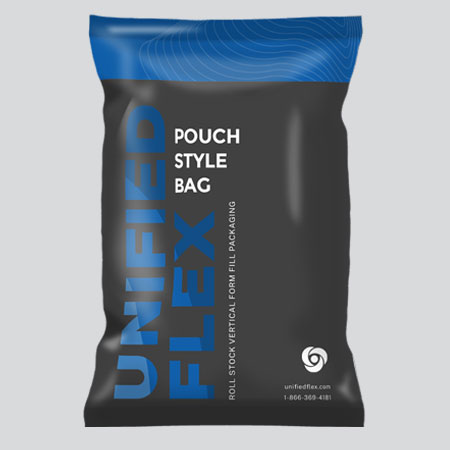
A pillow bag format minimizes structural features that interact with product movement during the fill and settle window. Compared to formats that rely on gussets, shaped bases, or multiple fold lines, a pillow bag reduces the number of internal interfaces exposed to airborne fines. Reducing those zones does not eliminate dust, but it limits the ways in which dust can interfere with sealing performance.
Predictable filling and settling behavior
Bacitracin Methylene Disalicylate does not behave like a free-flowing granular material. It drops in bulk, carries entrained air, and settles in a way that is sensitive to head pressure and upstream conditioning. In this context, the objective is not to force uniform behavior, but to allow the product to settle and de-aerate in a repeatable manner.
The vertical orientation of a pillow bag supports a stable fill profile and a predictable headspace region. This geometry allows entrained air to migrate upward in a consistent way before sealing, improving the effectiveness of de-aeration strategies implemented immediately before closure.
Fin seal construction and vertical seal consistency
Vertical seal behavior is a critical consideration in dusty powder applications. A fin seal provides a defined, continuous sealing surface with uniform pressure distribution along the length of the package. In applications involving Bacitracin Methylene Disalicylate, this consistency reduces sensitivity to minor variation in forming and film tracking.
Consistent vertical sealing also simplifies root-cause analysis. When seal geometry is repeatable, variability observed in the package is less likely to originate from structural distortion and more likely to be linked to controllable process variables.
Horizontal seal design and dust tolerance at closure
Fine feed additives generate trace fines in the seal region as a matter of course. Packaging formats must therefore be evaluated based on how well they tolerate this condition rather than assuming it can be eliminated.
Serrated horizontal seal patterns increase effective contact area and support mechanical interlock across the seal interface. Wider seal widths add margin, allowing the sealing process to remain stable even when minor dust contamination is present.
Alignment with medicated feed additive operating conditions
Pillow bag formats align well with the operating reality of medicated feed additive packaging. These applications typically prioritize consistency over maximum throughput. Production rates are moderate, product value is high, and rework or manual inspection carries a high cost.
By limiting the number of variables that must be actively controlled during filling and sealing, pillow bags reduce reliance on operator adjustment and support more stable operation over long runs.
Format selection as a system-level safety net
A pillow bag format is not a shortcut, and it does not replace proper filling method selection, head-pressure control, or dust containment design. Its value lies in reducing the sensitivity of the packaging system to the most challenging characteristics of fine, dusty powders.
For feed additives such as Bacitracin Methylene Disalicylate, this reduction in sensitivity functions as a safety net, allowing the rest of the system, filling, sealing, and downstream handling, to operate within a more forgiving window.
The Unified Flex Safety Net: Process-Driven Risk Reduction
In complex packaging applications, customization is unavoidable. Unified Flex treats customization as controlled engineering, with defined boundaries and validation so changes reduce risk rather than introduce it.
That discipline is backed by application experience. We work with challenging products and operating conditions, and we use what we’ve learned to anticipate where variability will show up and how to design around it.
From there, we tie features directly to what customers care about on the plant floor: repeatable sealing, consistent pack-out, and reduced operator intervention. The intent is measurable performance under real operating conditions, not capability on paper.
Execution is managed through a defined, process-driven project framework. For customers investing in packaging systems at this level, process is the credibility signal: it’s how they know specifications turn into outcomes when they sign off on a major purchase. Finally, long-term risk is reduced through responsive parts and service support, because uptime depends less on where equipment is built and more on how quickly issues are resolved.
Conclusion: Solving Feed Additive Packaging Problems Upstream
In feed additive packaging, many persistent production challenges originate at the format level rather than at the machine or sealing system. Dust migration, air entrapment, and settling behavior interact directly with package geometry, influencing performance long before sealing parameters come into play.
For fine, dusty feed additives such as Bacitracin Methylene Disalicylate, pillow bag formats reduce risk by limiting structural complexity, supporting predictable settling behavior, and improving seal tolerance. When format selection is approached as an engineering decision rather than a default choice, it establishes a more reliable foundation for everything downstream.
Once stable format behavior is in place, packaging equipment can be designed to preserve those conditions rather than compensate for instability, setting the stage for consistent, repeatable performance over time.