
Built for the Cold: Why Pillow Bags Define Modern Frozen Food Packaging
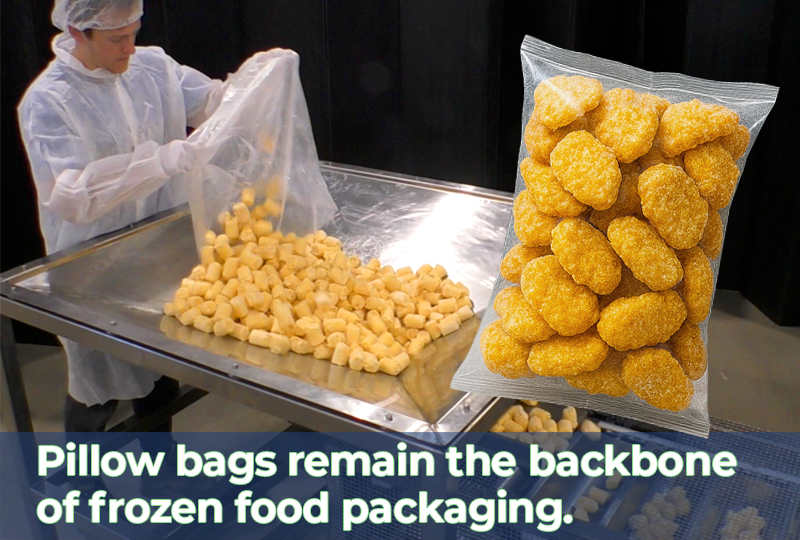
The Frozen Floor Reality
In frozen food production, the real challenge doesn’t start in the freezer; it starts before it. On the packaging floor, where products are filled at room or chilled temperatures, moisture, condensation, and time all work against consistency. A package that looks perfect when sealed must endure rapid freezing, long storage, and rough handling, all while keeping its integrity intact.
That’s where packaging becomes the difference between reliable throughput and recurring downtime. When products like IQF vegetables, diced meats, or fruit mixes move from filling to freezing, even the smallest error in sealing or film tension can result in costly defects; cracked seals, air pockets, or frost buildup.
For most frozen food manufacturers, the right packaging format must strike a delicate balance: efficient during filling, resilient through freezing, and compact in storage. That’s exactly what the pillow bag achieves, a format designed to protect product integrity without slowing production.
Challenges in Frozen Food Packaging
Running a frozen food line means managing a process that’s technically demanding and environmentally sensitive. Each product, from diced meat to sliced fruit, behaves differently under cold, humid conditions. Consistent performance depends on maintaining seal integrity, hygiene, and throughput before the product ever reaches the freezer.
Condensation and Seal Contamination
In frozen food packaging, products are filled and sealed while still cold. When this chilled product enters a warmer, humid packaging zone, condensation forms almost instantly on film surfaces and sealing jaws. Even a thin layer of moisture can interfere with heat transfer, leading to weak or incomplete seals. These failures often appear after freezing, when film contraction and trapped air expansion turn small imperfections into visible leaks or ruptures.
Product Variability and Flow Behavior
Frozen food products are rarely uniform. Diced meats, sliced fruits, and vegetable blends each flow differently through hoppers and filling systems. Irregular flow can result in uneven fill weights, product contamination near the sealing area, and increased reject rates. Each variation requires precise control of timing, pressure, and temperature to maintain consistent output.
Material Stress During Freezing
Once sealed, packages move into freezing tunnels where temperatures drop rapidly. As the contents freeze, they expand slightly while the packaging film contracts. Rigid or brittle materials can crack under this stress, causing leaks or delamination. Flexible packaging must withstand these thermal changes without losing its seal or structural integrity.
Storage and Handling Pressure
After freezing, bags are stacked, palletized, and transported through cold-chain distribution. Any weak seal or thin film area becomes a potential failure point. A cracked or leaking bag can cause moisture buildup, freezer burn, or load instability during storage and shipping.
Hygienic Design and Washdown Requirements
Frozen food operations demand frequent washdowns to meet food safety standards. High-pressure cleaning, chemical exposure, and temperature changes can wear down components not designed for these conditions. Equipment without open-frame construction or adequate drainage traps residue and slows sanitation, reducing available production hours.
Each of these challenges leads to a single conclusion: reliable sealing performance and hygienic machine design are the foundation of consistent, sustainable frozen food packaging.
Pillow Bag Packaging: The Practical Solution
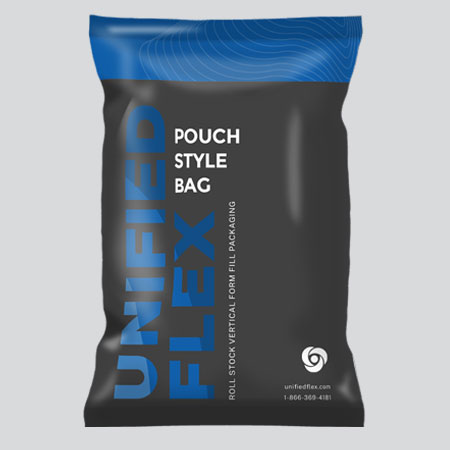
The pillow bag is one of the most dependable formats for frozen food packaging, valued for its simple three-seal design and proven performance in cold-chain environments. Its structure, one longitudinal and two transverse seals, offers balanced strength and flexibility while remaining easy to produce and handle.
Engineered to Survive the Freeze
Flexible film construction allows the bag to accommodate product expansion during freezing without cracking or stressing the seals. This adaptability helps protect the product and preserve package integrity throughout storage and distribution.
Resists Condensation Effects
With continuous seals and minimal joining surfaces, the pillow bag limits areas where moisture or residue can collect. This structural simplicity supports cleaner, more consistent seals during cold handling.
Supports Faster, Even Freezing
Its flat profile promotes uniform airflow in blast freezers, which helps frozen items reach target temperatures evenly and maintain product quality during thawing.
Compact and Adaptable
The pillow bag’s form is space-efficient and well-suited for a wide range of frozen formats, from single-serve portions to bulk packs, without requiring redesign of the packaging process.
Refined through decades of application, the pillow bag remains a practical format that balances durability with ease of production and handling.
The Economic Logic: Performance That Pays Off
Frozen food packaging affects more than product protection, it directly influences operating costs. Every rejected bag or inefficient pallet load adds up, and the pillow bag format helps minimize waste and improve efficiency throughout production and distribution.
Lower Material and Product Waste
The straightforward seal structure of pillow bags supports consistent sealing and efficient film use, which can help reduce product and material loss across frozen food lines.
Improved Cold-Chain Efficiency
Pillow bags pack densely and use space efficiently, improving pallet density and reducing cold-storage requirements. More product per load means fewer shipments and lower overall refrigeration demand.
Reduced Packaging Inventory
Flexible film rolls for pillow bags are lightweight and compact, reducing storage space and simplifying logistics compared to rigid containers.
The efficiencies gained from pillow bag packaging are reflected in measurable metrics such as yield, uptime, and line efficiency, practical advantages that matter in frozen food operations.
Sustainability That Works in Real Conditions
The pillow bag contributes to operational savings through simple design and smart use of space. Its flexible structure helps reduce material use, streamline storage, and simplify logistics without adding process complexity.
Reduced Packaging Waste
The reliable three-seal configuration minimizes sealing errors and product loss, supporting steady output and lower rework.
Better Use of Space in Storage and Transport
Because of its uniform shape, the pillow bag fits efficiently into cases and pallets. Denser loads mean fewer trips and more product per shipment, improving cold-chain utilization.
Lower Handling and Inventory Costs
Film rolls used for pillow bags take up minimal warehouse space and are easy to move and store, reducing packaging inventory requirements compared with rigid or pre-formed containers.
By combining low material demand with efficient distribution, the pillow bag supports dependable throughput and long-term cost control in frozen food packaging.
Conclusion – Packaging That Performs From Fill to Freeze
Frozen food packaging doesn’t fail in storage; it fails before it. The moment a seal is weak or moisture enters a weld, every downstream process only amplifies the issue. That’s why reliability at the packaging stage matters most.
The pillow bag endures where other formats struggle, flexible during filling, strong through freezing, compact in storage, and consistent across distribution. For modern frozen food manufacturers, it’s not just a cost-efficient choice; it’s a format built for dependable, long-term performance.
In frozen packaging, success starts long before the cold chain. The most effective solutions aren’t built to resist the environment; they’re designed to work seamlessly within it.