
Choosing VFFS Packaging Film That Runs Stable: A Plant-Ready Guide to Film Format, Runnability, and Qualification
Packaging films can make a VFFS line feel effortless or impossible. Two films can look nearly identical on a spec sheet and still behave very differently in production. One tracks cleanly, forms smoothly, holds registration, and seals consistently through a full shift. The other wrinkles at the collar, drift on registration during speed changes, build static, and turn sealing into a constant adjustment cycle.
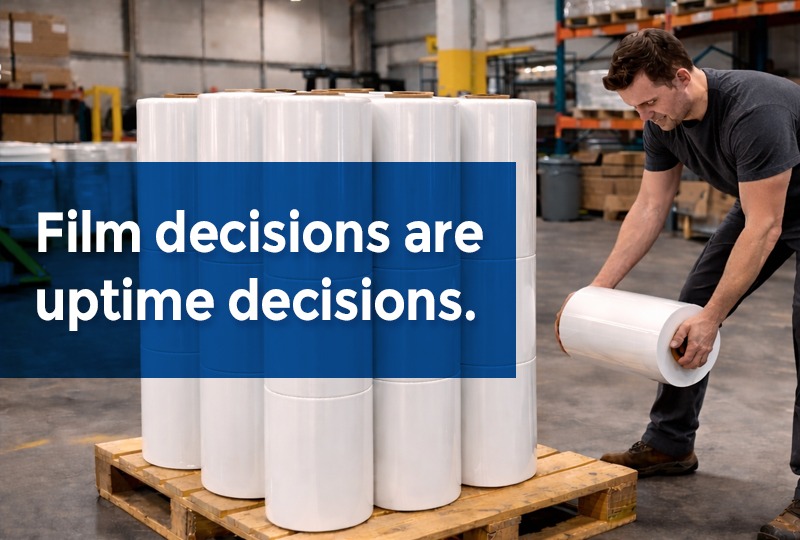
For plant and maintenance teams, that difference is not a preference. It’s uptime.
This guide focuses on selecting and qualifying VFFS packaging film with machinability in mind, so film decisions support stable web handling, predictable sealing performance, and repeatable runs across operators and shifts. Every plant’s product, film, and line setup is different, so use these criteria to narrow down options quickly, then confirm the final film choice on your line under normal production conditions.
*This article is general information for packaging professionals and should be applied in line with your product requirements, internal quality procedures, and any applicable regulatory expectations.
Table of Contents
Why film choices show up as downtime
A VFFS machine is a web-handling system first and a sealing system second. Film is pulled under tension, guided through rollers and sensors, formed around a collar and tube, sealed, and cut, often at high speed with strict tolerances. When film properties vary, the machine doesn’t “adapt” the way people do. It responds with drift: tracking changes, tension stability changes, forming friction changes, and sealing outcomes changes.
That’s why VFFS packaging film selection isn’t only about what the package needs to do on a shelf. It’s also about what the film needs to do on a line: move consistently, tolerate normal process variation, and remain stable through the stress points that cause quality losses in real production.
Start with two requirement sets: package performance and line performance
Film discussions usually begin with package requirements, barrier needs, shelf life expectations, puncture resistance, clarity, graphics, and cost. Those are legitimate drivers. But reliability comes from adding a second set of requirements: line performance.
Line performance requirements include target speed, acceptable scrap rate, how often you change over, whether you run plain or printed rollstock, and how sensitive your process is to small variations (temperature drift, friction changes, operator differences, humidity swings). A film that is excellent for barrier but too sensitive in forming friction or sealing window can increase long-term operational cost even if the material cost looks attractive.
Plants that run consistently tend to choose VFFS packaging film with a balanced mindset: package results plus process robustness.
Film format on VFFS: where “rollstock” is not one thing
Even though VFFS commonly uses rollstock, the “format” still changes runnability risk.
Plain vs printed rollstock
Plain film generally reduces control complexity because you’re not maintaining print-to-cut alignment. Printed rollstock adds a performance requirement: registration stability. That requirement amplifies the importance of web stability during speed changes, splices, and long runs. If printed film is part of your operation, film consistency and winding quality matter more than most teams expect, because any instability in web movement becomes visible immediately as registration drift.
The plant-level takeaway is simple: if you want printed film to run well, prioritize VFFS packaging film that behaves consistently under tension and doesn’t “change its mind” as the roll unwinds.
Laminated vs monolayer structures
Laminated structures are often chosen for barrier and stiffness. Monolayers are often chosen for simplified material composition or sustainability initiatives. Both can run on VFFS lines, but structure influences forming behavior, friction response, and sealing response. A stiffer laminate may form neatly but respond differently to heat exposure. A monolayer may be more flexible but more sensitive to tension drift or sealing condition changes, depending on the resin and design.
A plant-safe way to describe it: structure changes how forgiving the film is. If the film is less forgiving, qualification becomes more important.
Barrier vs non-barrier formats
Barrier requirements can constrain structural options, which can tighten the process window. If a barrier is essential, it’s worth treating qualification as a risk-managed step rather than a quick trial. If the barrier is not crucial, the plant may have more freedom to choose a film that is stable and forgiving under normal operating variation.
The Machinability Factors That Actually Decide Whether a Film Runs on a VFFS Line
When a film change goes sideways, it’s rarely because the team chose the “wrong thickness.” It’s usually because the film’s machinability characteristics were not evaluated with enough emphasis.
Coefficient of Friction (COF) and Consistency Over Time
Film-to-surface interaction influences tracking, tension stability, and forming behavior. If the friction is too high, the film can drag across contact points and wrinkle. If friction is too low, the web can slip unpredictably and destabilize registration. More important than the average friction is consistency, across a roll, across lots, and across the environmental conditions your plant sees.
This is why teams sometimes say, “It ran fine in the trial.” Trials often happen under controlled attention. Production happens under normal plant variability. Choosing VFFS packaging film that behaves consistently is a practical way to reduce that gap.
Gauge Consistency (Thickness Variation)
Small thickness variation can alter tension response and the way the film presents to forming and sealing surfaces. At higher speeds, variation shows up more obviously because the system has less time to “settle.” Even if the average thickness is correct, inconsistent gauge can translate into inconsistent forming behavior, seal appearance variation, and higher scrap sensitivity.
Winding Quality and Roll Build
Roll condition is a web-handling input. Telescoping, edge damage, uneven roll hardness, or poor roll build can introduce tracking drift and tension instability immediately. Many line issues get blamed on the machine because the symptoms show up there, but the first place to check is often the roll.
A practical operational habit: treat roll condition as part of your process control. If a problem appears right after loading a roll, it’s reasonable to suspect the roll before chasing machine settings.
Sealing window and process forgiveness
In real production, conditions drift slightly. Operators differ. Ambient conditions change. Mechanical wear is normal. Packaging film with a very narrow sealing window may be achievable, but it increases the burden on process control and operator intervention. Film with a more forgiving sealing window tends to support stable production and predictable quality.
Selecting VFFS packaging film isn’t only about “can it seal.” It’s about “can it seal consistently without constant attention.”
How to qualify VFFS packaging film in a way that reflects reality
Film qualification should mirror the conditions that break runs.
Validate at target production speed, not only at slow speed. Many issues hide at low rates and appear as you approach real throughput. Validate over time: startup, steady-state, and heat soak. Friction behavior, static, and forming interaction can shift as the system warms. If you run printed rollstock, include registration stability checks during speed changes and after splices, because those are common stress points.
Also consider operator sensitivity. If a film requires a highly specific threading technique or frequent micro-adjustments to maintain stability, it may be a poor fit for sustained production even if it can be made to run well on a good day.
Qualification is not about proving the film can run once. It’s about proving it can run predictably.
How to work with film suppliers to reduce surprises
Suppliers can support better outcomes when plants communicate in web-handling terms.
Beyond barrier and thickness, ask what ranges are typical for friction behavior, how gauge variation is controlled, what winding standards are used, and what storage/handling practices are recommended to maintain performance. Ask what similar VFFS applications the film has been used on. Ask what failure modes are most common and what practices reduce them.
The purpose isn’t to create friction with suppliers. It’s to align expectations so the selected packaging film supports both package goals and operational stability.
Managing film changes without inviting downtime
Film changes are sometimes necessary. When they happen, the operational risk goes up if the new film is more sensitive to friction variation, has a tighter sealing window, is more reactive to humidity/static, or increases registration control demands.
In those cases, plan a controlled ramp-up with realistic validation at speed and across time. Document what “stable” looks like and what conditions cause drift. That documentation protects you later, especially when the plant sees the next lot change or seasonal shift.
Closing: film decisions are uptime decisions
Every plant wants great packages. But the best package is the one you can produce consistently, at speed, with predictable quality and minimal intervention. Selecting and qualifying VFFS packaging film with machinability in mind, web stability, winding quality, friction consistency, and a forgiving sealing window reduces scrap, protects OEE, and keeps maintenance focused on prevention instead of firefighting.