
Curd & Shredded Cheese Packaging: Choosing the Right Bag Format for Distribution Performance
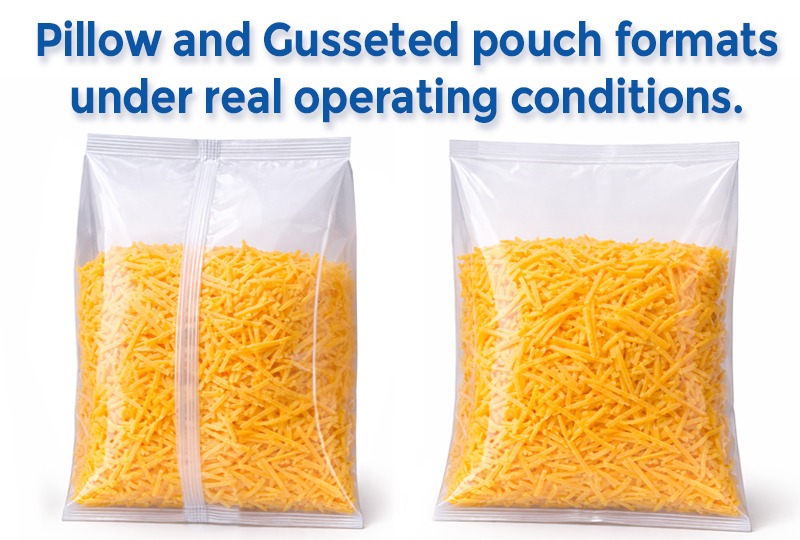
Curd and Shredded cheese packaging may appear stable at the point of fill. Weights are accurate. Seals are verified. Bags leave the line square and uniform. Performance is truly tested after palletization.
Once stacked and shipped, each bag is subjected to vertical compression and transport vibration. In flexible packaging, the product inside the bag carries that load. Whether the bag holds its geometry or begins to distort depends on how that force interacts with the product and how the base of the bag distributes pressure.
Selecting between a standard pillow bag and a pillow bag with side gussets is not simply a format preference. It is a structural decision tied directly to how shredded cheese and cheese curds behave in distribution.
Product Behavior Drives Packaging Performance
Shredded cheese consists of fine particles that settle under vibration. During transport, those particles shift into a denser configuration. The fill weight remains constant, but pressure at the base of the bag increases as the product compacts. In moderate conditions, this change is minor. Under heavier loads or longer distribution cycles, compaction becomes more visible.
Cheese curds respond differently. Their larger, irregular shapes do not settle evenly. When stacking pressure is applied, force transfers through individual contact areas rather than distributing smoothly. This makes curds more sensitive to visible deformation, particularly in heavier SKUs or taller pallet stacks. Moisture content can further reduce tolerance to sustained compression.
In shredded cheese packaging, compaction tends to be gradual and uniform. In cheese curd packaging, compression can appear uneven and localized. Those differences influence how much structural margin the bag must provide.
Where Packaging Stability Begins to Break Down
Three operating variables typically determine whether shredded cheese packaging remains stable through distribution:
Stacking Height
Each pallet layer adds compressive load to the bottom tier. As stacking height increases, the lower bags absorb greater force.
Fill Weight
Heavier fills increase the total load transmitted through the product mass. The greater the weight, the more pressure concentrates at the base.
Distribution Exposure
Longer transport distances introduce sustained vibration. In shredded cheese packaging, this increases compaction over time. In cheese curd packaging, it intensifies uneven pressure at contact points.
These variables define the structural demand placed on the bag. Format choice determines how well that demand is managed.
Shape Standard Pillow Bags in Shredded Cheese Packaging
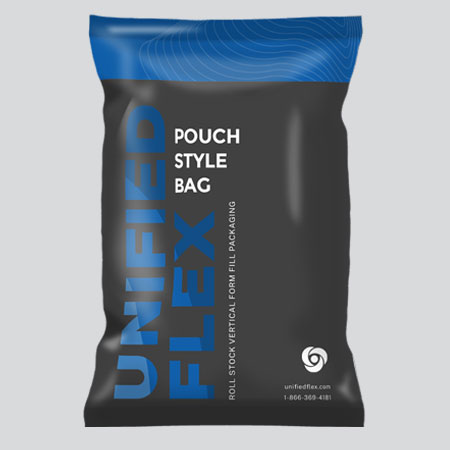
Standard pillow bags remain common in shredded cheese packaging because they are efficient and predictable. The geometry is simple, sealing is consistent, and case packing is compact.
For moderate fill weights and controlled stacking heights, pillow bags provide adequate structural performance. In these conditions, shredded cheese compacts within acceptable limits and bag geometry remains stable through typical distribution cycles.
In cheese curd packaging, pillow bags can also perform reliably when pallet loads are moderate. However, because the base footprint is narrower, compressive force is concentrated into a smaller area. As stacking height or fill weight increases, structural tolerance decreases. Curds may show visible deformation sooner under identical conditions.
Pillow bags offer operational efficiency and sealing stability. Their limitation appears when compressive demand exceeds moderate levels.
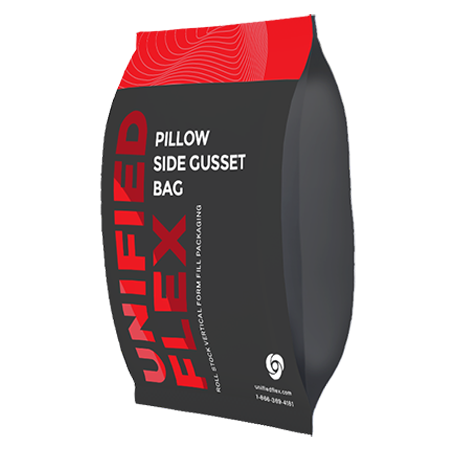
Pillow Bags with Side Gussets in Dairy Applications
Side gussets increase the width of the bag’s base. That wider footprint spreads stacking pressure across a larger area.
In shredded cheese packaging, this redistribution improves geometry retention in heavier SKUs. Compaction still occurs, but pressure is less concentrated at the base. Bags are less prone to visible distortion after extended transport or higher stacking configurations.
In cheese curd packaging, the benefit is more pronounced. By spreading load more evenly, gussets reduce the intensity of localized pressure on individual curds. This increases tolerance before visible compression appears.
Gussets do not eliminate settling in shredded cheese or fully prevent compression in curds. They increase structural margin under higher distribution stress. The trade-off is added geometry that requires consistent sealing control and slightly higher material usage.
Making the Format Decision
The appropriate format in shredded cheese packaging depends on measurable operating conditions rather than convention.
Evaluate:
- Current and projected fill weights
- Maximum pallet stacking height
- Transport distance and handling exposure
- Product sensitivity to visible compression
- Shelf-life requirements related to oxygen control
If shredded cheese packaging involves moderate weights and stable distribution cycles, standard pillow bags remain efficient and structurally sufficient.
If fill weights increase, pallet stacks rise, or cheese curds are packaged in heavier configurations, pillow bags with side gussets provide additional tolerance by distributing compressive load more effectively.
If shelf life is the primary concern, barrier film and seal integrity should be evaluated before adjusting geometry.
A Structured Approach to Dairy Packaging Reliability
Shredded cheese packaging and cheese curd packaging require more than selecting a bag style. At Unified Flex, format decisions are part of a structured, process-driven approach that begins with evaluating fill weights, pallet configurations, and distribution conditions. Solutions are configured around those variables to match product behavior rather than applied as standard templates. Our experience in particulate dairy applications allows us to connect forming geometry, sealing design, and machine configuration directly to performance outcomes. Reliable equipment design, disciplined integration, and responsive service support ensure that packaging systems continue to perform consistently under real operating stress.
Conclusion
Shredded cheese packaging performance is defined less by filling conditions and more by how the package behaves under stacking and transport. Cheese curd packaging adds additional sensitivity due to irregular geometry and moisture.
Standard pillow bags optimize efficiency within moderate load environments. Pillow bags with side gussets redistribute compressive force and increase tolerance as structural demand rises.
The right choice aligns bag footprint with product behavior and distribution reality, ensuring stable performance from palletization to retail.