
Customized Nut Packaging Film: Choosing Film That Cuts Waste Without Making the Line Fragile
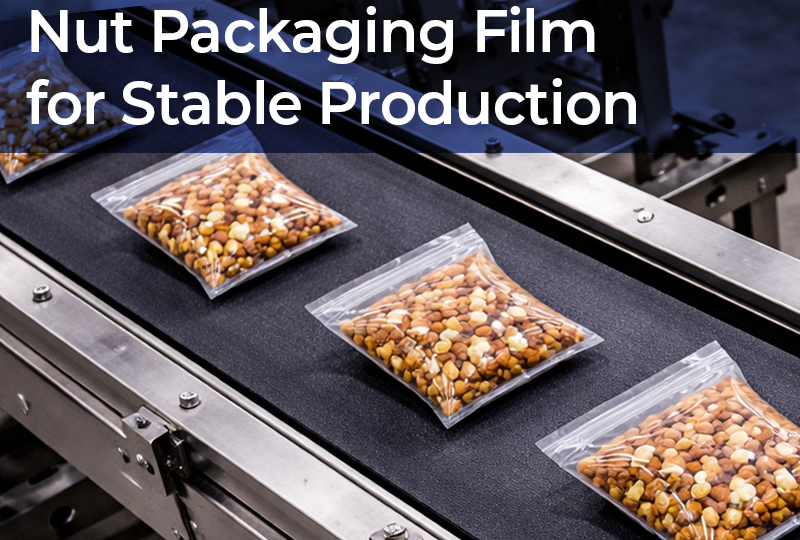
If you’re sourcing customized nut packaging film, the real test is rarely the first production run.
Most films can get through an early trial. The real question is what happens later, after long shifts, multiple roll changes, routine restarts, and repeated SKU changes, when almonds, cashews, pistachios, and trail mixes are still moving through the line, and operators expect the process to stay stable.
That is where film choice stops being a specification and starts becoming an operational decision.
When film selection goes wrong, the problem is not always obvious at first. It shows up as longer dial-in time, more tracking corrections, more seal checks, and more operator attention than the line should need. In nut packaging, those consequences are easy to expose. Dense products place load through the pouch. Mixed products settle unevenly. Roasted products bring real shelf-life risk tied to oxygen exposure. If the film structure is downgraded too aggressively, or if sealing behavior becomes too sensitive, waste does not disappear. It just moves.
That is why the most practical path in nut packaging is to evaluate film performance first. Not “less material” in theory. Film that tracks predictably, seals within a comfortable operating window, prints consistently, and holds up to the actual stresses nut packages face: internal load, vibration, compression, handling, and shelf-life demands tied to oxygen and moisture control.
Table of Contents
Where nut packaging film programs lose ground
1) Instability-driven scrap during startups and restarts
A small change in friction behavior, a narrower seal window, or roll-to-roll thickness variation can turn routine startups into tuning sessions that consume material quickly. Nut lines do not always restart under ideal conditions either. Product dust, fragments, and normal line interruption make recovery less forgiving when the film is overly sensitive.
If the structure becomes touchy, operators compensate. They make more tracking adjustments, more temperature changes, and more dwell corrections. The program may still look efficient on paper, but scrap begins to rise quietly in production.
2) Downgauging that reduces seal and mechanical margin
Downgauging can reduce resin use. It can also reduce tolerance.
Nuts are not especially difficult to package, but they do apply real mechanical stress to the pouch. Almonds, peanuts, and cashews are dense enough to transfer internal load through the pack. Trail mixes create more uneven internal pressure because ingredients settle and redistribute during filling and transport.
If the film loses too much seal or mechanical margin, small process variation becomes more expensive. A seal that looks acceptable during an early trial may become less forgiving during extended production or after distribution vibration and compression. Material reduction is not a win if total waste increases later.
3) Barrier choices that miss the actual shelf-life risk
Film selection for nuts is not simply about choosing a “high barrier” structure and moving on. Roasted nuts are vulnerable to oxidation because their oils are sensitive to oxygen exposure. Dry fruits introduce their own moisture-related considerations. Mixed snack products can bring both concerns into the same package.
An underbuilt structure can lead to flavor drift or reduced shelf life. An overbuilt structure can create stiffness, sealing sensitivity, or process instability that makes the line harder to run. In both cases, the issue is the same: the film choice did not match the real product risk closely enough.
4) Films that should run, but do not run well here
A film can be technically acceptable and still create too much work on the line.
Tension can shift through the forming path. Friction can behave differently as the roll diameter changes. Sealing performance can become too sensitive to small temperature changes. None of these issues needs to be catastrophic to create waste. In multi-SKU nut packaging environments, where changeovers are frequent, and operators cannot afford a long settling period after every adjustment, small instability adds up quickly.
5) Printing waste that never reaches production
Material waste is not limited to what happens at the packaging machine. Print quality problems can create significant waste before the roll ever reaches the line.
Nut packaging programs often include SKU variation, private label requirements, multiple pack sizes, and different retail formats. If printed rolls are rejected or reprinted because of color drift, registration problems, or visible defects, that waste can quietly offset whatever material savings were gained elsewhere.
6) Late failures that do not appear in early trials
Some problems only show up after time and stress.
A structure may pass initial sealing tests but fail later through slow leaks, seal creep, pinholing, or reduced package integrity after vibration and compression. Day-one success is not enough. Films need to survive realistic handling, storage, and distribution conditions if they are going to reduce total waste in a meaningful way.
A film-first decision path for nut packaging
Step 1: Choose the structure family based on real product risk
Film selection should begin with the actual demands of the product, not with a sustainability target in isolation.
Roasted nuts require oxygen protection to preserve flavor and shelf life. Dry fruits may require moisture stability. Trail mixes can increase mechanical demands because of uneven internal loading and product movement during handling.
This is where structured families need to be evaluated carefully. High-barrier laminations, metalized structures, and OPP-based laminations may all be appropriate depending on the product, the distribution environment, and the operating conditions of the line. The question is not which structure sounds most advanced. The question is whether it delivers the barrier and mechanical performance the product requires without making sealing or tracking more fragile in production.
If recyclability or downgauging is part of the goal, those tradeoffs should be made deliberately. Strong programs reduce total waste. They do not shift waste from material usage to scrap, rework, or product loss.
Step 2: Control the properties that decide whether the film runs consistently
Once the structure family is chosen, the next question is whether the film will behave consistently in production.
Three variables usually decide that.
Coefficient of friction (COF) matters because small changes can show up quickly as tracking drift, tension instability, and more operator intervention. Stable lines depend on film behavior staying within a controllable range.
Thickness consistency affects forming repeatability, print behavior, and sealing stability. When the thickness variation becomes too wide, the process window becomes narrower, especially at the seal.
Sealing performance should be validated under defined temperature, dwell, and pressure conditions so there is a realistic understanding of how the film behaves before it hits the line. The goal is not to prove that it can seal in ideal conditions. The goal is to confirm that it can seal repeatably in production.
These are not abstract lab checks. They are the variables that determine whether a film settles quickly on the line or demands constant correction to keep it running.
Step 3: Treat printing as part of the waste conversation
Printing is one of the easiest ways to lose material before production even starts.
Color drift, registration issues, and visible defects can force reprints or roll rejection long before the film reaches the packaging machine. Well-managed film programs treat print control as part of waste reduction, not as a separate quality issue.
That means using controls that catch variation early, reducing the number of bad rolls that reach production, and reducing the number of situations where operators are forced to work around film that should never have shipped.
Step 4: Confirm the film fits the product and the equipment reality
Film is not just a material choice. It is a system choice.
The structure, stiffness, and sealing behavior have to align with the product and with how the packaging equipment is actually set up to run. Does the film seal reliably within the machine’s normal operating window? Does it track consistently through the forming path? Does it hold package integrity when dense products create internal load or when the product approaches the seal area?
For nut packaging, these checks matter because the product will expose weak assumptions quickly. If the film and the process are mismatched, production becomes an ongoing adjustment cycle instead of a stable operating system.
The Unified Flex approach to film-driven stability
For nut packaging, waste reduction only matters if the film performs predictably during normal production.
That means evaluating more than material thickness or barrier level in isolation. It means looking at the structure as part of the full packaging system: sealing behavior, thickness consistency, print control, mechanical durability, and the operating window of the line itself.
A practical film program is one that protects freshness, supports repeatable sealing, and reduces the number of restarts, adjustments, and downstream failures that quietly add cost back into the process.
Conclusion: Sustainable nut packaging has to run like production
In nut packaging, sustainability works when it lowers total waste without making the line less stable.
That starts with selecting the right film structure for the real risks involved: oxygen exposure, moisture sensitivity, internal load, vibration, compression, and shelf-life demands. It continues with controlling the variables that determine whether the film behaves consistently in production: friction, thickness consistency, sealing performance, and print quality.
When those choices are validated under realistic operating conditions, waste reduction becomes repeatable instead of theoretical.
Ultimately, customized nut packaging film creates value only when it protects product quality without making production more fragile.