
Engineering the Right Flexible Packaging Format: A Practical Feasibility Guide to Sachets, Stick Packs, Pillow Bags, and Gusseted Pouches
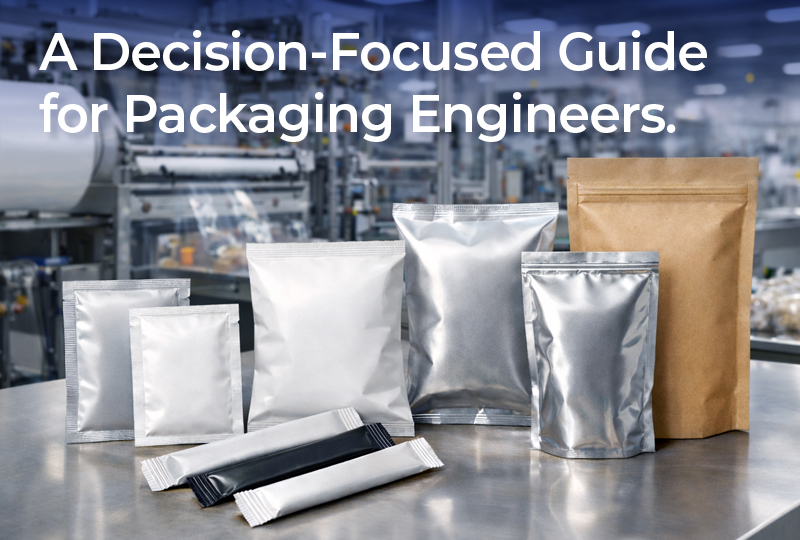
Choosing a format in flexible packaging is rarely about preference. It’s about feasibility: can the system (product + film + machine + environment + distribution) run stably without constant intervention, and can it deliver the required shelf life and performance margin? Packaging engineers already know every format can be made to work under some conditions. What matters is identifying which format will work for this product, on this equipment, at this rate, with the least risk of late-stage surprises.
This guide is written to support practical decision-making. It uses the same logic most engineering teams apply in real projects: define constraints, narrow options early, validate the highest-risk interfaces first, then scale with controlled variables.
Table of Contents
Start With Feasibility Gates (Before Anyone Commits to a Format)
A useful decision process in flexible packaging begins with three gates. They’re quick, but they prevent expensive wrong turns.
Gate 1: Product behavior under dosing and settling.
The question is not “Can we fill it?” but “Can we fill it cleanly and repeatably at target rate?” Powders that fluidize, cling, or dust heavily will challenge seal cleanliness. Granules can rebound into seal zones during acceleration. Liquids can surge, foam, or string at cutoff. Hygroscopic products can change flow properties while you run, especially if the plant environment isn’t tightly controlled. If you can’t describe the product’s behavior in terms of flow, dusting, compressibility, or viscosity response, format discussions are premature.
Gate 2: Process tolerance on the line.
Every format has a different tolerance for variation in tension, temperature recovery, and dosing cutoffs. If you need a wide operating window across operators and shifts, some formats will give you more margin. If you need high speed and tight registration, your choices narrow. This gate is about matching operational reality to format sensitivity.
Gate 3: Distribution and storage stresses.
If the product ships through hot/cold cycling, high humidity, or heavy compression stacking, packaging geometry and seal robustness become primary constraints. A format that looks fine at the sealer may fail after vibration, compression, or temperature cycling. This gate ensures you design to the lifecycle, not just the moment of sealing.
Once these gates are clear, the format decision becomes much less subjective.
Map Product Behavior to Format Fit (The Fastest Way to Narrow Options)
Instead of listing “pros and cons,” it’s more useful to treat each format as a tool optimized for certain product behaviors and operating constraints in flexible packaging.
Sachets: Best When Clean Cutoff and Seal Margin Can Be Maintained
3-side and 4-side seal sachets are often a strong choice when doses are small, line layouts are compact, and the product can be introduced into the package without repeatedly contaminating the seal area. They can work well for powders and granules that flow predictably and for liquids that cut off cleanly without stringing. The key feasibility question is whether the top seal area stays clean over time, especially when humidity changes, static builds, or the filler’s dynamics shift during warmup.
Sachets also tend to make seal performance visible early. That can be an advantage: if your objective is to validate sealing layer performance and contamination tolerance quickly, sachets provide fast feedback. Where teams run into trouble is when powder behavior is variable and the process relies on “operator finesse” to keep seals clean. If the process needs constant correction, the format is signaling low tolerance margin.
Stick Packs: Best When Portion Control and Vertical Flow Stability Matter
Stick packs are often selected when portion control, pack density, and consistent vertical product flow are important. Flowing powders and low-to-moderate viscosity liquids tend to be good candidates when the dosing system can achieve stable, repeatable cutoff and the web handling system can maintain tracking consistency.
The feasibility focus for stick packs in flexible packaging is not whether they can run; it’s whether they can run across all lanes with consistent seal energy and alignment. If your process requires multi-lane operation, early validation should confirm lane-to-lane stability in heat delivery, pressure, and cut location. When those fundamentals are stable, stick packs are efficient and scalable. When they aren’t, teams sometimes chase symptoms using tension or temperature changes that mask the underlying variability rather than removing it.
Pillow Bags: Best When Robust Throughput and Broad Product Tolerance Are Required
Pillow bags are often the baseline workhorse format because they offer a relatively forgiving forming geometry and can accommodate a broad range of product types and fill weights. If your operation needs throughput, flexible changeover, and a format that tolerates normal day-to-day line variability, pillow bags often provide the widest practical operating window.
From a feasibility perspective, pillow bags shift the engineering focus toward forming quality and seal stability under real motion. The common engineering question is whether the film forms smoothly over the forming geometry without persistent wrinkling or inconsistent tension signatures that later show up as seal variation. If the forming and web handling are stable, pillow bags typically scale well in flexible packaging programs.
Gusseted Pouches: Best When Package Stability and Compression Performance Drive Requirements
Pillow bags with side gusset pouches are often chosen when packout efficiency, stack stability, and volume handling can’t be achieved with a simple pillow geometry. They are well-suited for heavier fills, products that benefit from a larger footprint, or cases where distribution compression is a major stressor.
The feasibility focus is on fold and seal interface control. Gussets introduce additional forming interfaces and overlapping film regions. That’s not a negative; it just shifts where early validation should concentrate. Engineers should confirm that fold formation is consistent at speed and that sealing energy is uniform across all seal interfaces, especially where layers overlap. If fold consistency is stable, gusseted formats can perform very well in storage and distribution within flexible packaging systems.
What to Validate First (So You Don’t Discover Fatal Issues Late)
Engineers get the most value by validating the highest-risk interfaces early. In most flexible packaging feasibility work, three early validations prevent the majority of late-stage redesigns.
1) Seal window characterization (temperature × dwell × pressure).
This is not a single “good setting.” It’s an operating window that remains acceptable across normal line variation. A useful outcome is a boundary: below this energy input you see weak bonds; above it you see distortion, seal thinning, or unacceptable cosmetic change. That window should be validated using actual product exposure, not empty-film test seals.
2) Contamination tolerance and cutoff behavior.
For powders, the practical question is whether the dosing and settling profile keeps particulate out of the seal area through a full run, including warmup, speed changes, and minor pauses. For liquids, the question is whether cutoff introduces stringing, droplets, or foam that migrates into the seal area. Many format “failures” in flexible packaging are actually dosing-to-seal timing mismatches. Validating this early makes the format decision clearer and prevents unnecessary film changes.
3) Quick distribution screening.
Before long shelf-life studies, a short screening, vibration, compression plus temperature cycling often reveals whether seals and structure have sufficient margin. This doesn’t replace a full qualification, but it surfaces the failure mechanisms early enough to adjust format, film, or process without restarting the entire project.
Barrier and Stiffness Engineering: Treat Shelf Life and Machinability as Coupled Variables
Barrier targets are central in flexible packaging, but barrier performance must be achieved without undermining machinability. Engineers often see the tradeoff quickly: higher barrier structures can narrow sealing windows or increase stiffness beyond what a forming geometry will tolerate at speed.
A useful way to frame barrier and stiffness is to link them directly to risks:
If the product is hygroscopic, moisture ingress risk usually drives the material choice and may justify higher barrier structures even if sealing requires more precise control. If the product is aroma sensitive, aroma barrier must be evaluated along with seal integrity because micro-leaks can dominate performance in real distribution. If oxygen sensitivity is high, seal quality and seal uniformity often matter as much as the nominal barrier layer.
Stiffness should be evaluated in terms of whether the film forms consistently without introducing wrinkles, fold memory issues, or tension instability. For engineers, the most practical question is whether the chosen structure supports stable forming and stable sealing at the target rate, with the expected environmental variation on the floor.
Machine Compatibility Checks That Prevent “It Ran in Trials, But It Won’t Hold Production”
Feasibility in flexible packaging often collapses at the interfaces between film handling, forming geometry, sealing jaws, and dosing equipment. Engineers can reduce risk by confirming a few fundamentals before scaling.
Forming geometry must match film behavior. If the film does not track cleanly or form with persistent wrinkles, those defects will propagate into the seal area. Sealing jaw design must match the sealant layer and the expected contamination conditions. Web tension and tracking stability must be adequate for the format: narrower styles generally demand tighter control. Dosing equipment alignment and timing must match the format’s sealing cadence so the product doesn’t enter the seal zone during cutoff and settling.
These checks are not about perfection; they’re about ensuring the system has enough margin to run across shifts and normal operational noise.
Unified Flex’s Role in Feasibility Work (Reducing Variables, Supporting Engineering Decisions)
At Unified Flex, we partner with engineering teams by providing rollstock that can support feasibility and scale-up work. Our stated capabilities include COF evaluation to ASTM D1894, pre- and post-production thickness testing, heat-seal testing under defined temperature, dwell time, and pneumatic pressure conditions, and tensile strength testing. We also list additional checks such as solvent residue detection, microbial detection, peel strength detection, seal strength detection, and pressure & drop properties detection. For printed rollstock, we use inline high-resolution spectrophotometers for color measurement and an offline high-speed inspection machine that checks printed film quality and splices out inconsistencies in printing quality. On the materials side, we produce application-matched films, including metallized and non-metallized options and co-extruded LLDPE/HDPE films, and we describe shelf-life expectancy as being measured by calculating oxygen and water vapor flow through packaging materials. The intent is to provide consistent material inputs so engineering teams can evaluate forming, sealing, and line performance with fewer film-related variables.
What “Right” Looks Like in Practice
In flexible packaging, the format decision is only as good as what happens after the first successful trial. The goal is to choose a format that remains stable when the run stops and starts, when the room humidity shifts, when a new roll goes on, and when production speed moves to its real operating range. That’s why feasibility should end with confidence in the system, not just a clean sample.
A format is usually the right one when three things remain true throughout normal operating variability: the product consistently clears the seal area without requiring constant intervention, the sealing window is broad enough that small changes in temperature, dwell, or pressure do not create new defects, and early lifecycle stress checks, vibration, compression, and temperature cycling, do not reveal a different failure mechanism than the one you tuned for on the line. When those conditions are met, teams stop spending time “protecting the package” and start spending time improving capability and throughput.
That’s the practical definition of choosing the right format in flexible packaging: the option that meets shelf-life and handling requirements while giving engineering and operations enough process margin to run predictably, recover quickly, and scale without reopening the format decision.