
Format Matters: Why the Right Flexible Packaging Pouch Improves Category Navigation
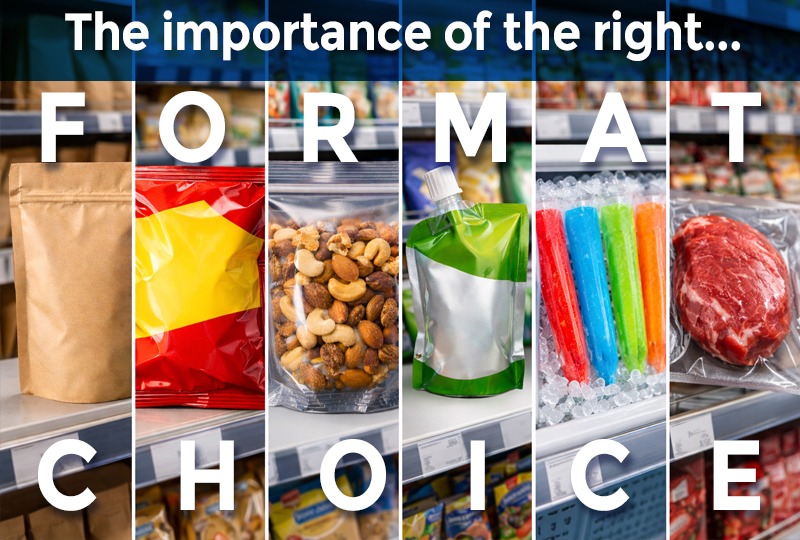
If you spend time walking on a retail floor, you’ll notice something interesting: the conversation usually revolves around price points, adjacencies, facings, and promotions. What rarely gets as much attention is the one element that quietly organizes the entire aisle, the packaging structure. The shape of a package doesn’t just hold the product; it creates the rules of how that category behaves. That’s why the most effective merchants increasingly see format choice as a navigation strategy, not a packaging decision. According to Ipsos, 72% of shoppers say packaging design often influences their purchase decisions, a reminder that the structure of flexible packaging pouches is doing far more heavy lifting in the aisle than most people realize.
The truth is simple: structure guides the shopper, supports store teams, and establishes the visual and physical logic of a category. When the format is wrong, everything downstream gets harder. When it’s right, the aisle feels effortless.
*This article is general information for packaging professionals and should be applied in line with your product requirements, internal quality procedures, and any applicable regulatory expectations.
Table of Contents
Flexible Packaging Pouch Structure as the Architecture of a Category
The look and feel of an aisle comes down to the shapes on the shelf. Build a category with upright flexible packaging pouches, and it behaves one way; fill it with low-profile bags, and it behaves another. Packaging geometry dictates blocking, shelving stability, and the way a shopper’s eye moves across a set. And retailers feel the consequences immediately. Something as simple as a bag slouching forward can create the illusion of an out-of-stock item even when inventory is sitting right behind it. Poor structural performance doesn’t just disrupt shelf presence; it contributes to broader planogram compliance problems. According to IHL Group, issues like misaligned facings, distorted blocks, and items that don’t hold their intended position help drive nearly $156.9 billion in lost retail sales worldwide.
Stand-up pouches naturally create a vertical rhythm that organizes shelves into clear tiers. Pillow-style bags, lighter and more pliable, create wide billboards that encourage horizontal product comparison. Flat rectangular formats with three- or four-sided seams slip neatly into rows that stay aligned longer. All of these flexible packaging pouch structures have legitimate merchandising value, but they behave differently, and that behavior is what makes or breaks shelf clarity. The format isn’t a passive object; it’s a tool that shapes how the category reads from six feet away.
Operational Clarity: Why Store Teams Depend on Predictable Geometry
Store teams don’t struggle with packaging because of branding; they struggle because of how it behaves. Formats that hold their shape make stocking and fronting faster, which keeps shelves looking full and makes your product easier to find. When a stand-up pouch snaps back to its footprint, your brand stays visible instead of slouching out of sight.
Pillow bags can be efficient upstream, but on the shelf they slump or tip forward, forcing teams to fix the set repeatedly. Manufacturers feel this too: products that won’t hold their position lose facings, lose visibility, and quietly lose sales. Retailers who track labor closely see the same pattern: stable structures stay in view longer, giving brands more consistent exposure.
The backroom matters as well. Flat 3-side or 4-side sealed bags stack cleanly and protect product; stick packs need disciplined displays, or they scatter and get overlooked. And digital planograms only work when packages behave as expected. For manufacturers, this means packaging geometry is more than a format choice; it’s a direct lever on shelf presence, scanability, and real-world product performance.
Shopper Behavior: The Cognitive Side of Packaging Structure
Retailers know that shoppers aren’t rational in the aisle. They’re quick, intuitive, and operate on visual instincts. Harvard Business School researcher Gerald Zaltman estimates that 95% of purchase decision-making happens in the subconscious mind, driven by rapid pattern recognition rather than deliberate comparison. Shape, not copy, is the first signal the brain interprets.
Shoppers learn to associate certain structures with certain product types and quality cues. An upright pouch signals something modern or premium; a pillow bag feels familiar and value-forward; a slim stick pack telegraphs portion control and mobility before anyone reads a single word.
These structural cues help shoppers navigate. They create mental shortcuts that tell the brain, “this is the energy section,” “these are the healthy snacks,” or “this is the value tier.” Structure becomes the cognitive breadcrumb trail that guides shoppers long before conscious reasoning kicks in.
How Formats Interact to Create or Break Aisle Logic
Packaging formats influence each other on the shelf. Tall stand-up pouches create a clean vertical rhythm, but that rhythm collapses when low-profile bags or stick packs beside them vary too much in height. The result is an aisle that looks uneven, even when inventory is healthy.
Flat sealed pouches form tight horizontal rows that help shoppers compare SKUs quickly. But one oversized or irregular pack can break that billboard effect and disrupt the flow. Eye-tracking research shows shoppers rely on these simple vertical and horizontal patterns to navigate; when the pattern breaks, so does findability.
That’s why format choice is strategic. Manufacturers who align their structures with the shelf’s natural geometry help their products stay visible and easier to shop.
Real Retailer Impact: Conversion, Shelf Life, and Labor Time
Good structure pays dividends across the business. When packages stand, stack, or align more reliably, shelves stay full-looking longer, reducing the false out-of-stock cues that quietly erode sales. Geometry also affects shrink: bags that flop or compress are more prone to damage, while formats that retain their shape protect the margin the same way proper shelving or case sizing does.
Operationally, predictable packaging reduces the number of touches required to keep a category shoppable. Replenishment teams can locate SKUs faster, rotate products more efficiently, and maintain cleaner facings with far less intervention. And the stakes are real: inventory- and shelf-execution failures, the same issues that packaging structure can help prevent, cost North American food retailers an estimated 5.9% of total retail sales, according to IHL Group. In a labor environment where every minute matters, packaging that consistently holds its footprint becomes an operational advantage, not just a design preference.
Flexible packaging pouches add sustainability benefits as well. Their lighter weight reduces material use, improves shipping efficiency, and optimizes warehouse utilization. Retailers who think holistically about packaging geometry, considering cube, footprint, and shelf behavior as part of a single system, typically see improvements across cost, operational simplicity, and overall shopper experience.
Unified Flex’s Role: Subtle, Upstream Expertise
Most retailers interact with packaging when it arrives in cases, but the performance of that format is determined much earlier, in the rollstock itself and in the precision of how it’s converted, formed, and sealed. That’s where our upstream expertise matters. At Unified Flex, we treat rollstock not as a commodity but as a controlled engineering input. Every structure we produce is built on rigorous material science: customized polyethylene blends, co-extruded films, and high-performance structures designed with the right OTR and WVTR profiles for the product. We validate every roll with extensive food-safety testing, consistent thickness measurement, COF control, tensile and seal-strength verification, solvent-residue checks, and inline color-management using high-resolution spectrophotometry. This level of control ensures that a stand-up pouch actually holds its footprint; a pillow bag resists slouching, and a flat pouch stacks cleanly across the replenishment cycle. When rollstock behaves predictably on the shelf, there are fewer weak seals, fewer print shifts, and fewer shape failures. It’s because the material quality, engineering inputs, and process controls upstream were aligned with how the shelf truly works.
Conclusion: Structure Is Strategy
Packaging format is not an aesthetic decision. It’s a navigation tool, an operational lever, and a psychological cue that shapes how shoppers move through a category. When retailers choose formats intentionally, pairing upright structures where they need vertical hierarchy, or flat sealed bags where they need comparison clarity, the aisle becomes easier to shop and easier to maintain.
The most effective merchants don’t treat structures as decorations. They treat it as a strategy. In a retail environment where every second of shoppers’ attention and every labor minute counts, the right format creates clarity, confidence, and conversion. And in categories powered by flexible packaging pouches, structure is often the quietest and smartest, a competitive advantage a retailer has.