
From Scroll to Shelf: Creating a Packaging Experience That Wins Online and In-Store
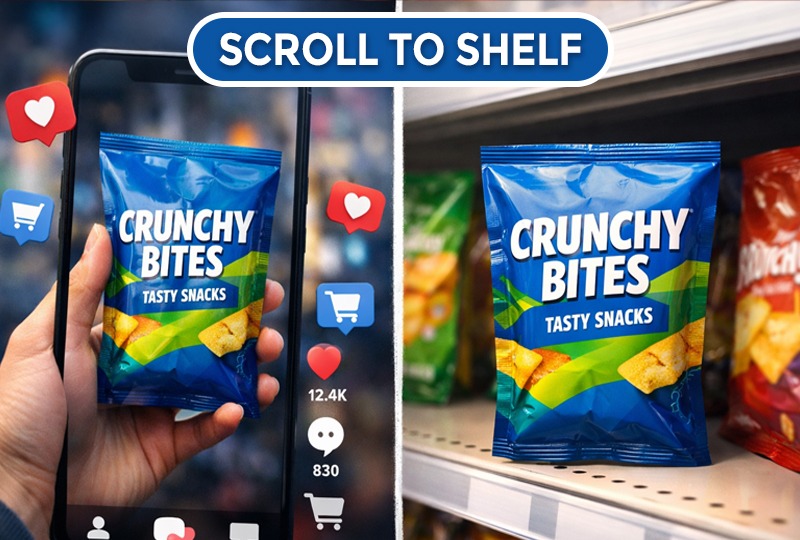
Scroll. Stop. Stare. Swipe. Click. Cart. Shelf. Pantry.
If you map the real consumer journey, packaging isn’t a touchpoint; it’s the connective tissue. It’s the one brand asset that travels through every stage of discovery, evaluation, and repeat purchase. And in a world where social media drives trends, and retail still drives volume, the brands winning today aren’t the ones with the prettiest designs. They’re the ones who’ve mastered the packaging experience, the invisible handshake that works online and in-store with equal charisma.
Marketers used to treat packaging like a final deliverable. Now it behaves more like a campaign: it must perform under algorithmic pressure, retail lighting, user-generated content, pantry realities, and sustainability scrutiny. And if it fails in any one of those environments, the consumer moves on, quietly, permanently, and usually with zero feedback.
Welcome to the new era of packaging, where the scroll is the audition and the shelf is the callback.
*This article is general information for packaging professionals and should be applied in line with your product requirements, internal quality procedures, and any applicable regulatory expectations.
Table of Contents
1. Packaging in the Scroll Age: Your First Impression Is 120 Pixels Wide
Let’s start where brand discovery actually happens, the thumb scroll. TikTok, Instagram, and YouTube have become the new front door for product discovery among younger shoppers. Social-commerce research shows that Gen Z and Millennials now lead product discovery on social platforms (Bazaarvoice). And when they move to buy, Amazon becomes the next stop; 56% of U.S. consumers begin their product searches on Amazon (Jungle Scout).
That means your packaging must survive two ruthless environments:
- The thumbnail
- The UGC (user-generated content) close-up, often filmed with shaky hands and bad bathroom lighting
Today, packaging isn’t really being seen; it’s being compressed, cropped, and judged in fast-motion scroll behavior. Research shows people spend as little as 1–2 seconds looking at content in mobile feeds before scrolling past, barely enough time for a package design to register at all (CareerArc).
And here’s where UGC throws a plot twist:
- UGC outperforms branded content in engagement and conversion across multiple formats (Backlinko).
- Consumers also perceive user-generated content as significantly more authentic, about 2.4× more authentic than brand-created content.
In other words, the real packaging experience is whatever your customer films, not whatever your designer exports.
2. The Shelf: Where Packaging Has to Actually Prove Itself
After the scroll comes the shelf, where packaging stops auditioning and starts performing.
Retailers understand this intimately. Recent research from IHL Group and Brain Corp shows that 67% of major U.S. retailers deal with daily or weekly shelf issues, from poor shelf accuracy to broken planogram execution, all of which directly erode brand trust and drive lost sales. Packaging structure plays a quiet but significant role in those failures. If your stand-up pouch leans even a little, it reads as “out of stock.” If a pillow bag slumps, it breaks, blocking. If sachets curl, they disrupt visual rhythm and distract shoppers.
And shoppers notice it more than most brands think. Studies of in-store behavior show that visual consistency strongly influences trust, quality perception, and purchase intent, especially when products sit side-by-side on competitive shelves. When packaging collapses, warps, or loses its shape, consumers read it as a proxy for product quality, even if your formula is flawless.
You can have a killer digital presence, stunning UGC, and paid media that make people salivate, but if your packaging fails in the aisle, consumers assume the brand behind it isn’t trustworthy.
Yes, packaging must look good.
But more importantly, it must stay good once it hits the aisle.
3. UGC: The New Packaging Test Your Design Team Isn’t Preparing For
Five years ago, packaging only had to survive transit. Today, it has to endure something far more unpredictable: being filmed from every angle by every type of shopper, in every possible lighting condition. User-generated content has turned consumers into accidental packaging auditors. They squeeze the product, drop it on the counter, toss it into backpacks, rip it open with one hand while recording with the other, and create ASMR-style “peel and pour” videos that expose every texture, sound, and flaw. They review your product while walking, cooking, commuting, multitasking, and often in the emotional chaos of real life.
And the judgments come instantly. A crinkle that sounds too loud becomes “cheap.” A pouch that collapses mid-use becomes “annoying.” A zipper that breaks becomes “never buying again.” Even slight color shifts between batches suddenly spark comments about inconsistency. UGC doesn’t politely observe your packaging; it interrogates it.
This matters because shoppers increasingly trust real user footage to decide what to buy. TikTok, Reels, and YouTube Shorts have turned packaging into content, and packaging performance into social proof, or social failure.
For marketers, the uncomfortable truth is this: you no longer control how your packaging behaves in the wild. Customers do. Algorithms do. Search feeds do. Every unfiltered video becomes a permanent part of your brand story, shaping perception long after the campaign assets have faded.
If you want to know how your packaging is really performing, don’t check your mood board; check TikTok. That’s where the packaging experience reveals itself, unedited and very, very real.
4. The Usage Stage: Loyalty Lives in the Pantry, Not the Funnel
Marketers are great at designing packaging for the glamorous moments, unboxings, flat-lays, and lifestyle shoots. But loyalty lives in the mundane moments:
- The half-asleep breakfast pour
- The rushed school lunch prep
- The post-gym protein shake
- The “why can’t I open this with one hand” frustration
Harvard Business School professor Gerald Zaltman estimates that around 95% of our purchase decision-making happens in the subconscious mind, which is exactly where everyday friction in the packaging experience does its damage.
A tear notch that fails?
A reseal that slowly stops resealing?
A spout that leaks?
A pouch that won’t stand mid-use?
Those aren’t “packaging issues.”
They’re brand issues, because consumers don’t separate the two.
The packaging experience decides whether the second purchase ever happens.
5. Sustainability: Less Confetti, More Credibility
Marketers know sustainability sells, but greenwashing gets you roasted on social media.
Gen Z isn’t reading sustainability paragraphs; they’re looking for proof:
- Slimmer profiles
- Less excess material
- Simpler structures
- Visible restraint
The data is clear:
- A joint study by First Insight and the Baker Retailing Center at the Wharton School found that 75% of Gen Z say sustainability matters more than brand name when making purchasing decisions.
- 62% of consumers say they are willing to change their purchasing habits to reduce environmental impact.
Your packaging doesn’t need a sustainability manifesto.
It just needs to look like you made an effort, and hold up to scrutiny when people film it. Reduction beats recycling claims every time.
6. Consistency: The Invisible Trust Builder
Consistency is one of the strongest signals a brand can send, and packaging is where consumers judge it fastest. Small variations, a color shift, a pouch that settles differently, a laminate that feels off, don’t trigger complaints, but they do shape perception.
And because the same package now lives everywhere, TikTok, Amazon thumbnails, grocery shelves, kitchen counters, any inconsistency gets amplified across channels.
When packaging behaves predictably in every environment, the brand feels reliable. When it doesn’t, consumers may not know what changed, but they register the difference — and trust softens. Consistency isn’t a design detail anymore; it’s part of the packaging experience.
Unified Flex’s Approach to Consistent Packaging Foundations
When brands need their packaging to look consistent across retail shelves, e-commerce thumbnails, and UGC, every part of the process matters, from design and materials to product behavior and how it all runs on the line. At Unified Flex, we work closely with clients to build a dependable, well-engineered material foundation that supports the packaging experience they’re aiming for.
We develop rollstock with consistency at the center, using high-quality resins and proven film structures that help packaging hold its shape, its color, and its overall presence.
Color accuracy is controlled through inline spectrophotometry, print quality is monitored throughout production, and every roll is tested for friction, thickness, sealing performance, and strength to help it behave predictably under normal line conditions.
The result is straightforward: reliable rollstock that helps brands show up the way they intended, whether the package ends up on a shelf, in a pantry, or in a customer’s unfiltered review.
Conclusion: Packaging Isn’t a Container; It’s the Experience People Share
The packaging experience is now social, shoppable, and fully public. It appears on TikTok before it reaches a shelf, gets judged in an Amazon thumbnail before it hits a cart, and lives in the everyday reality of kitchens, bags, and bathrooms.
Smart brands understand the new sequence: the scroll sparks interest, the shelf confirms credibility, everyday use builds (or breaks) loyalty, and UGC exposes every moment in between.
Packaging is the only brand asset consumers touch, tear open, drop, praise, and critique without hesitation. When it works, it creates fans. When it doesn’t, people quietly move on.
Winning today isn’t digital-first or retail-first; it’s creating packaging that performs everywhere the consumer does. That’s the modern packaging experience, and the brands mastering it are the ones pulling ahead.