
How Do Packaging Machines Help Maintain Consistency Bag After Bag?
In high-volume production, consistency is not a “nice to have.” It is a measurable engineering outcome. Every bag that leaves a packaging line must meet the same standards for weight, seal integrity, appearance, and functionality, regardless of whether it’s the first bag of the shift or the fifty-thousandth.
Packaging machines, particularly modern vertical form fill seal (VFFS) systems, are designed to remove variability from the process. They do this by controlling the mechanical, thermal, and operational variables that human-dependent packaging cannot reliably manage.
Understanding how machines achieve this consistency requires looking beyond surface-level automation and into the engineering principles behind them.
Consistency Starts with Controlled Film Handling
One of the most common sources of variation in bag quality is film movement. Inconsistent tension, misalignment, or slippage directly affects bag length, seal placement, and aesthetics.
Packaging machines maintain consistency through:
- Precision-engineered film unwind systems
- Servo-driven belts or rollers
- Closed-loop tension control
These systems ensure that the packaging film feeds at a controlled, repeatable rate. Sensors continuously monitor position and alignment, correcting deviations in real time. As a result, every bag is formed at the same length, with seals placed in the same location, even during speed changes or long production runs.
This level of control is not achievable manually and is a foundational reason machines outperform hand or semi-automated packing when consistency matters.
Repeatable Bag Forming Through Engineered Geometry
Bag shape consistency depends heavily on the forming collar and forming tube. Poorly machined components introduce wrinkles, uneven edges, and dimensional variation.
Well-designed automatic packaging machines use:
- Precisely machined forming collars
- Product-specific forming tubes
- Rigid mounting systems to prevent deflection
From an engineering perspective, these components ensure that film deformation happens the same way every cycle. Once the geometry is validated for a specific bag style and film structure, it does not change unless intentionally adjusted.
This repeatability is especially critical for applications where downstream processes, such as cartoning, case packing, or palletizing, rely on uniform bag dimensions.
Seal Integrity Is a Function of Process Control
Sealing is where inconsistency becomes costly. Weak seals lead to leaks, contamination, product returns, and recalls. Over-sealed packages damage film and reduce shelf appeal.
Packaging machines address this by tightly controlling:
- Seal jaw temperature
- Dwell time
- Pressure
- Jaw alignment
Modern vertical form fill seal machines use precision heaters, thermocouples, and control algorithms to maintain stable sealing conditions. Once validated, these parameters remain consistent bag after bag, regardless of operator or shift.
For demanding applications such as liquids, powders, or contaminated seal areas, technologies like ultrasonic sealing further enhance consistency by sealing through product residue without relying on heat alone.
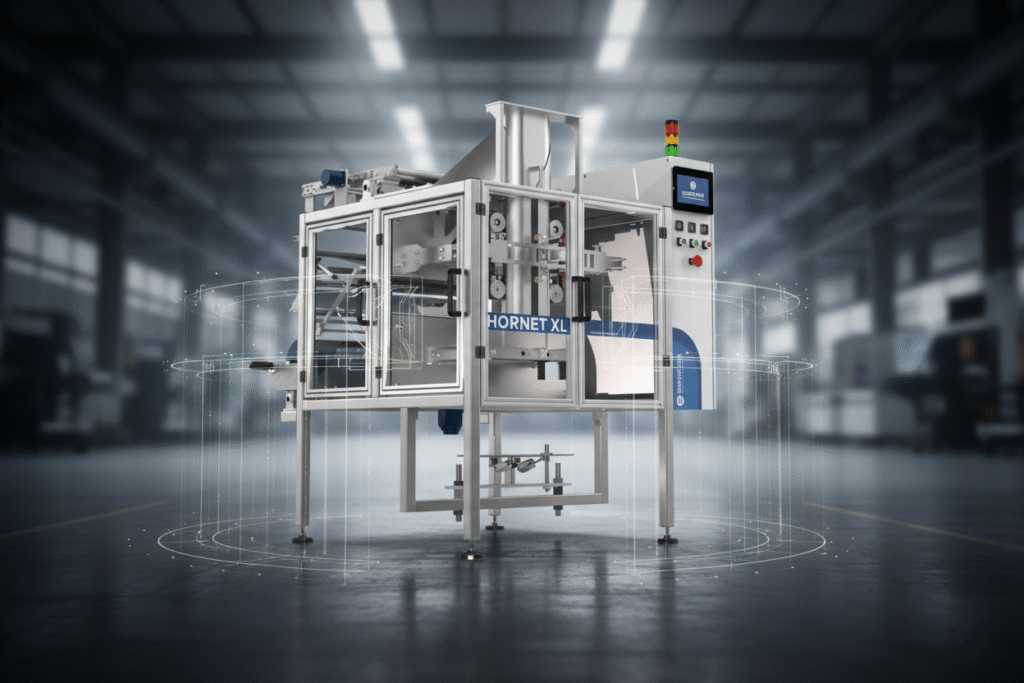
For larger bags, machines like the VFFS Vertobagger Hornet XL ensure that seal integrity is never compromised. With automated feeding, weighing, bagging, and sealing, it delivers consistent quality even at high speeds, making bulk packaging efficient and reliable.
Accurate Filling Reduces Bag-to-Bag Variation
Weight and fill consistency are critical not only for regulatory compliance but also for customer trust. Underfills risk penalties; overfills erode margins.
Automatic packaging machines integrate with filling systems such as:
- Auger fillers for powders
- Multi-head weighers for solids
- Piston or pump fillers for liquids
These systems are synchronized with the bagging cycle to ensure the same fill volume or weight is delivered every time. Feedback loops allow the machine to compensate for product flow variability, density changes, or environmental factors.
Unlike manual filling, machines do not fatigue, rush, or improvise. The result is statistically tighter fill tolerances across the entire production run.
Automation Eliminates Operator-Dependent Variability
Human operators introduce variability even when well trained. Differences in timing, force, judgment, and attention all affect output.
Packaging machines reduce this dependency by:
- Automating critical functions
- Using recipe-based controls
- Limiting manual intervention
Once a recipe is selected, the machine automatically sets film pull length, sealing parameters, fill timing, and speed. Operators are no longer responsible for “dialing in” the process each shift.
From an engineering standpoint, this transforms consistency from a skill-based outcome into a system-based outcome, one that is repeatable across operators, facilities, and production schedules.
Changeovers Without Drift
Frequent changeovers are a reality in modern manufacturing. The challenge is maintaining consistency after the changeover.
Well-designed packaging machines support:
- Tool-less or quick-change components
- Indexed mounting points
- Stored parameter sets
This ensures that when a machine is switched from one SKU or bag size to another, it returns to a known, validated configuration, not an approximation. Reduced setup variability directly translates into fewer startup rejects and faster stabilization.
Mechanical Rigidity Supports Long-Term Stability
Consistency is not just about control systems; it is also about structural integrity.
Packaging machines built with:
- Rigid frames
- High-quality bearings
- Properly aligned drive systems
maintain performance over time. Flex, vibration, and wear introduce a gradual drift in bag quality. Robust mechanical design minimizes these effects, keeping output stable not just for weeks, but for years.
This is why long-term consistency is closely tied to machine build quality and serviceability, not just initial performance specs.
Diagnostics and Feedback Prevent Degradation
Even the best systems degrade without visibility. Modern packaging machines incorporate diagnostics that monitor:
- Seal temperature stability
- Motor loads
- Sensor feedback
- Cycle timing
These systems detect deviations before they become visible defects. From an engineering reliability perspective, this allows maintenance to be proactive rather than reactive, preserving consistency across extended production runs.
Consistency Is an Engineered Outcome
Packaging consistency is not achieved by chance, nor by marketing claims. It is the result of deliberate engineering decisions across mechanics, controls, automation, and process design.
Automatic packaging machines maintain consistency bag after bag by:
- Controlling variables humans cannot
- Eliminating guesswork through automation
- Enforcing repeatable, validated processes
For manufacturers, this consistency protects brand reputation, reduces waste, improves efficiency, and ensures compliance. For engineers, it represents a system doing exactly what it was designed to do every cycle, every shift, every bag.
Unified Flex Machines: Precision and Consistency in Every Bag
Achieving bag-to-bag consistency requires more than good intentions; it demands machines engineered for reliability. With experience supporting packaging operations across food, pharmaceutical, personal care, and industrial applications, Unified Flex designs automatic packaging machines that directly address the root causes of variability: film handling, forming accuracy, filling precision, and seal integrity.
Our range includes:
- Vertical Form Fill Seal Machines: Efficiently form, fill, and seal flexible bags for solids, liquids, and granular products. Perfect for both startups and large-scale industrial runs.
- Stick Pack Machines: Deliver slim, single-serve packages with speed and precision.
- Sachet Machines: Produce consistent 3-side and 4-side seal sachets for food, pharmaceuticals, personal care, and more.
- Stand-Up Pouch Bagging Machines: Ensure accurate filling and sealing of convenient, consumer-friendly pouches.
- Spouted Pouch Fillers & Cappers: Precisely fill and cap liquids and viscous products, maintaining quality and shelf appeal.
- Popsicle Packaging Machines: Specialized solutions for frozen products, keeping seals intact and presentation ideal.
By integrating these machines into your production line, manufacturers can eliminate operator variability, maintain repeatable quality, and scale production without compromising consistency, turning engineered processes into reliable outcomes, bag after bag.
Backed by engineering-driven design and real production insight, Unified Flex machines are built to perform reliably throughout the full lifecycle of the packaging line.
Contact us for expert guidance on achieving bag-to-bag consistency.
Bottom Line
Unified Flex automatic packaging machines ensure bag-to-bag consistency by combining precision film handling, engineered forming collars, controlled sealing, and accurate filling systems. Automation eliminates operator variability, while quick changeovers and rigid mechanical design maintain quality across SKUs and over time.
By integrating these machines into production lines, manufacturers gain precise control over the packaging process, reduce defects and waste, and achieve reliable, repeatable results for every bag, enhancing efficiency and protecting brand reputation.
Get in touch today and see how precision packaging can transform your line!