
Pet Food Packaging in Bulk Applications: Where Formats Succeed — and Where They Struggle

An Engineering Review of Common Failure Modes and the Formats Used to Address Them
As pet food manufacturers scale into bulk products, packaging performance becomes less forgiving. Increased fill weights, wider SKU ranges, and longer shelf-life expectations introduce mechanical and process constraints that are rarely visible in smaller or lighter applications.
In many bulk pet food packaging operations, recurring issues such as downtime, seal variation, and rejected packages are often attributed to equipment settings or operator intervention. In practice, these symptoms frequently originate earlier, at the packaging format level. When the pouch structure is not aligned with product behavior and operating conditions, even well-designed equipment is forced to compensate for limitations it was never intended to solve.
Common Problems in Bulk Pet Food Packaging
Problem 1: Structural instability under high fill weights
Bulk pet food products place sustained mechanical load on the package throughout the fill and seal cycle. As fill weights increase, pouches without a well-defined base can deform before sealing is complete. This deformation is often observed as inconsistent pouch alignment at the sealing station or instability during transfer.
Once deformation occurs upstream, sealing conditions become more difficult to control. Variability introduced at this stage tends to propagate downstream, increasing reliance on guides, corrections, or operator adjustment.
Problem 2: Inconsistent pouch opening at larger sizes
As pouch dimensions increase and films become thicker or stiffer to meet durability and barrier requirements, achieving consistent opening becomes more challenging. In bulk pet food packaging, partial or asymmetric opening is often observed during startup, changeover, or speed increases.
When opening consistency varies, the product may enter a pouch that is not fully presented, increasing the likelihood of spillage or contamination near the seal area. These events are often intermittent, making them difficult to correct solely through parameter adjustments.
Problem 3: Seal variability influenced by product settling
Dry pet food products tend to settle rapidly after filling. In heavier formats, this settling can shift a significant portion of the product mass toward the seal area before sealing is completed.
This condition is commonly observed as a variation in seal appearance, compression, or repeatability. While sealing temperature and pressure are frequently adjusted in response, the underlying cause is often structural rather than thermal.
Problem 4: Format assumptions break down as SKU diversity increases
Bulk pet food operations often manage products with varying densities, particle sizes, and flow characteristics. Packaging formats selected around a narrow product profile may behave inconsistently when applied across a broader SKU range.
As SKU counts increase, format-related variability often appears during changeovers, requiring additional adjustments to maintain consistent performance. Over time, these adjustments can become a persistent source of inefficiency.
Problem 5: The real drivers of downtime in bulk pet food packaging
Bulk pet food packaging lines don’t typically fail because they’re running “too fast.” They fail when pouch behavior is inconsistent, especially over long runs. Heavier fills place more stress on pouch stability, opening, and sealing, and those small variations can accumulate into misfeeds, seal defects, or unplanned stops.
What makes bulk applications especially unforgiving is the cost of interruption. A stop isn’t just a pause. It can mean product clean-up, rechecks at the seal, re-establishing pouch presentation, and confirming the line is back in a stable state before restarting. Over time, even minor format variability can become a recurring operational drag.
In medium-volume bulk pet food packaging, reliability comes down to repeatability: stable pouch presentation, consistent opening, and dependable sealing conditions shift after shift, not just during the first ten minutes of a run.
Why Format Choice Shows Up as Downtime, Scrap, and Rework
If you look closely, the failures usually trace back to three things: stability under weight, repeatability of opening, and how cleanly the top of the pouch stays out of the product path before sealing. That’s why format choice matters, because it defines the conditions the rest of the line has to live with.
With that in mind, the next sections break down how Box Pouch, Doy Rim Style, and Doy Style formats tend to influence those conditions in bulk pet food packaging.
Box Pouch: base stability and load management
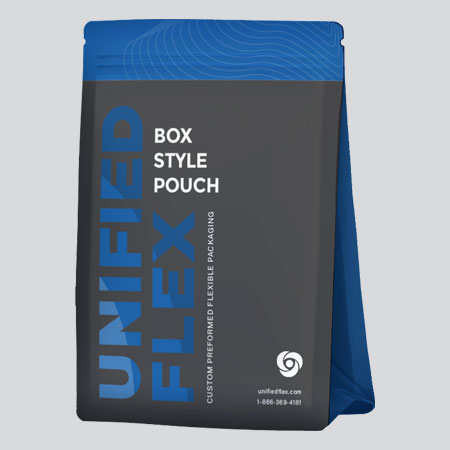
Box Pouch formats are often selected in bulk pet food packaging because base geometry becomes a first-order variable as fill weights increase. A defined, flat base provides a larger, more stable footprint, which helps the pouch maintain its shape and orientation as product mass accumulates during the fill cycle.
From an engineering standpoint, the advantage is not simply “standing up better.” It’s reduced sensitivity to load-driven distortion. When the base carries weight more evenly, the pouch body is less likely to twist or deform before sealing, which supports more consistent pouch positioning through filling, sealing, and initial downstream handling. In bulk applications, where even small shifts can affect seal-area alignment, this additional stability can help reduce upstream variability that the rest of the system must manage.
Doy Rim Style: pouch presentation and opening repeatability
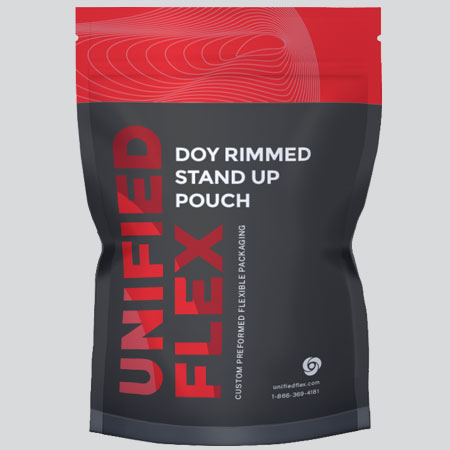
Doy Rim Style pouches are typically considered when opening behavior becomes inconsistent at larger sizes or with stiffer film structures. The reinforced rim and base geometry influence how the pouch presents to the opening station, creating a more repeatable engagement surface for opening mechanisms.
In bulk pet food packaging, opening variability often shows up during startup, after changeovers, or as speeds increase, especially when film stiffness varies between lots or suppliers. A rim structure can reduce sensitivity to these conditions by supporting more consistent pouch presentation and helping the opening process stay within a controllable operating range.
The practical impact is fewer partial-opening events. Reducing partial openings helps limit product spillage and lowers the likelihood of product reaching the seal area, without relying solely on repeated parameter tuning to compensate for film and pouch variability.
Doy Style: predictable behavior when operating conditions are controlled
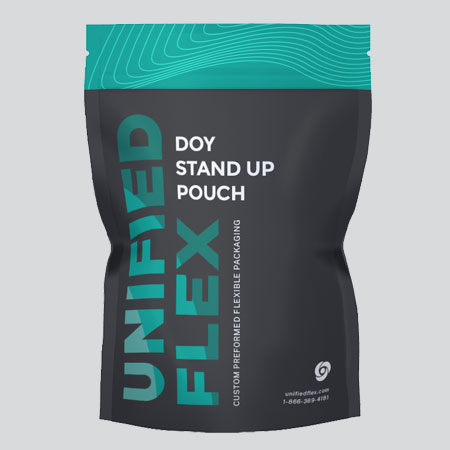
Doy Style pouches offer a simpler geometry that can perform consistently when operating conditions are well defined. In bulk pet food packaging, they’re often evaluated in applications where product behavior is understood, film structure is stable, and the process window is not being stretched by frequent SKU changes or wide format variation.
Their relative simplicity can be an advantage for process control. With fewer structural variables influencing how the pouch opens and holds shape, it can be easier to establish and maintain consistent settings across runs. That said, the suitability of a Doy Style pouch depends on application requirements, particularly where fill weight and stability expectations increase, so it’s most effective when those conditions are known and managed.
Controlled customization: aligning format behavior with product characteristics
Pet food products vary widely; density, particle size distribution, dustiness, and flow behavior can change significantly from one SKU to the next. Those differences influence how the product enters the pouch, how quickly it settles, and how the pouch behaves between fill and seal. In many bulk pet food packaging environments, some level of format adaptation is necessary to maintain repeatability.
Customization, in this context, is best approached as a controlled engineering process rather than simply “making it fit.” Adjustments may involve changing pouch dimensions, selecting base geometry, or choosing film structure to align the pouch’s behavior with product characteristics. The objective is not to create unique designs for every SKU, but to define ranges where performance is consistent and predictable.
When customization is evaluated through structured testing, it reduces the need for trial-and-error adjustments during production and supports better changeover stability as product and packaging variables evolve.
System-level format selection: supporting reliability as production scales
Pouch format decisions influence more than the look and feel of the package. Stability, opening repeatability, and structural rigidity affect how the entire packaging system performs over time, including how sensitive the line is to variation, how easily problems can be diagnosed, and how consistently the process holds during scale-up.
Selecting a format that behaves predictably under load helps reduce mechanical stress across filling, sealing, and handling operations. It also supports more consistent troubleshooting because fewer variables are introduced upstream. In bulk pet food packaging, this matters: as throughput increases, small inconsistencies can turn into recurring downtime, scrap, and operator intervention.
Format selection doesn’t eliminate operational risk, but it can materially reduce the amount of variability the system must absorb—making it a practical, early lever for improving long-term reliability.
The Unified Flex Safety Net: Process-Driven Risk Reduction
In bulk pet food packaging, format choice sets the conditions, but execution determines whether the line holds them. Unified Flex reduces project risk in five ways: we treat customization as controlled engineering (not improvisation), we apply application experience from bulk and difficult-flow products, and we tie format features to observable outcomes like opening repeatability and seal consistency. We run projects through a defined, process-driven approach with evaluation and validation steps that mirror how mature manufacturers manage capital projects. And we support long-term uptime with responsive service and parts availability because speed of support matters more than where a machine was built.
Conclusion: Reducing Risk in Pet Food Packaging Starts Upstream
In bulk pet food packaging, many persistent production challenges originate at the format level rather than the equipment level. Structural instability, inconsistent opening, and seal variability are often symptoms of packaging formats that are not fully aligned with product behavior and operating conditions.
Box Pouch, Doy Rim Style Pouch, and Doy Style Pouch formats address these challenges through load distribution, controlled opening behavior, and structural stability. When format selection is approached as an engineering decision, supported by disciplined process and experience, it reduces operational risk before machinery is even specified.
For bulk pet food packaging operations, solving problems upstream establishes a more reliable foundation for everything downstream.