
Sauces and Condiments Packaging: Why Sachets Are a High-Performance Single-Serve Format
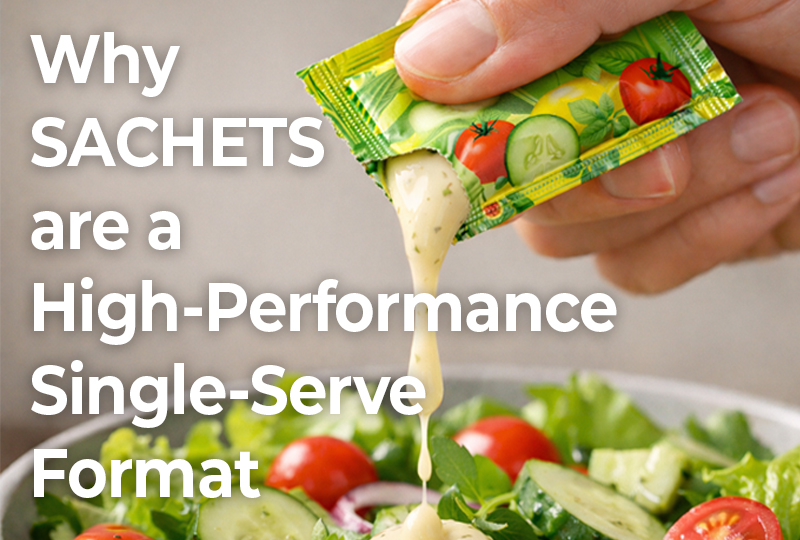
In sauces and condiments, packaging isn’t just a container. It’s a control point. It keeps portions consistent, protects product through storage and distribution, and shapes the consumer’s first interaction, smooth and clean, or messy and frustrating. Because condiments are used fast and handled casually, the format gets tested in ways most packaging never does. A carton of single-serve packets will be dropped, squeezed, stored in mixed temperatures, tossed into kits, and torn open with one hand while someone’s doing three other things.
That’s why sauces and condiments packaging is less about what looks good in a mock-up and more about what holds up in real use. The best format performs when conditions aren’t perfect: demand spikes, orders travel, storage space is tight, and the person opening the pack doesn’t have time to be gentle.
3-side and 4-side seal sachets continue to earn their place in single-serve programs because they’re built around those realities. They deliver a defined portion, keep the product enclosed until use, and fit naturally into high-volume channels like QSR, foodservice, delivery, travel, and sampling. The real question isn’t whether sachets are common; it’s what makes a sachet program reliable. That starts with understanding the format.
Why Sachets Fit Single-Serve Condiment Reality
3-side and 4-side seal sachets work when the channel demands fast, standardized use. They’re common in QSR, cafeterias, travel, catering, sampling, and meal kits because the format supports three requirements that those channels share: controlled serving, protected product, and efficient distribution.
Standardized serving without behavior management
A 3-side and 4-side seal sachets turns portion size into a design decision rather than a training challenge. That’s useful when a condiment is meant to complement the food, not dominate it, and when consistent servings protect both flavor intent and cost assumptions.
Product stays enclosed until the moment of use
Single-serve packaging reduces exposure during storage and handling. For high-touch environments, that separation is a practical advantage: product integrity depends less on how carefully it’s handled and more on the package doing its job.
Efficient to pack, stage, and distribute
3-side and 4-side seal sachets are compact, lightweight, and easy to include in multipacks and kits. In programs that ship condiments as an accessory to a larger product (takeout meals, boxed lunches, subscription kits), that physical efficiency often matters more than people expect.
What Makes Sachets Technically Suitable for Sauces
The reason sachets can be reliable in sauces and condiments packaging is that the format can be tailored, through film structure and seal design, to the specific stresses that sauces create.
Sauces vary widely in flow and behavior
Thin liquids (like soy sauce) challenge micro-seal weaknesses because they migrate easily. Thick sauces (like BBQ or mayo-based blends) create different risks, including smearing and uneven squeeze-out. Particulates (herbs, pepper flakes, minced garlic) introduce another layer: they can influence how the product settles, how it dispenses, and how consumers perceive texture when squeezing a small pack.
A sachet format works best when it’s specified around these behaviors, not around a generic “sauce is sauce” assumption.
Barrier performance is product-dependent
Some condiments are sensitive to oxygen exposure (flavor changes, discoloration), some to moisture transmission (texture or stability shifts), and some to light, depending on ingredients. Film structures can be designed to target the right protection profile for the SKU and shelf-life requirement.
The important principle: choose barrier properties to match what the product actually needs, then validate through shelf-life testing under the storage conditions the market will impose.
Sachet Design Choices That Drive Real-World Performance
If you want sachets that hold up in distribution and feel easy to use, these are the format-level choices that matter most.
Seal layout: 3-side seal vs 4-side seal
Sachets are commonly built as either a 3-side seal (often using a fold as one edge) or a 4-side seal (sealed on all edges). Both can work for sauces and condiments. What changes is how the pack presents, how stress distributes around the perimeter, and how consistent the final geometry is across production.
For many programs, the decision is less about “which is superior” and more about what fits the product viscosity, the desired appearance, and the handling conditions.
Seal width and integrity: durability lives at the edges
For condiments, the seal is the structural system. Seal geometry and consistency determine how well the pack survives compression in cases, vibration in transit, and temperature swings in storage.
Because sauces can be oily or viscous, seal area cleanliness matters to long-term reliability. Format specs should treat seal design as a performance feature, not a cosmetic border.
Package geometry: squeeze-out should be predictable
Consumers don’t want to wrestle with a sachet. Shape and internal “path” matter because they affect how the product moves when squeezed. A well-proportioned sachet supports controlled dispensing; a poorly proportioned one leads to sudden bursts, uneven flow, or leftover product trapped in corners.
Openability: tear behavior is part of the product experience
If a sachet is hard to open, the format undermines the sauce. Tear notch placement and material behavior influence whether it opens cleanly, tears sideways, or creates a messy squeeze point. In single-serve condiments, opening is the first interaction, so “opens well” should be a requirement, not a hope.
Matching Sachets to Common Sauce and Condiment Use Cases
One reason sachets stay relevant is that they scale across multiple channels while keeping the consumer experience relatively consistent.
Foodservice and QSR
Sachets are well-suited to high-volume environments where speed and uniform servings matter. They also stage easily at prep areas, condiment stations, and drive-thru assembly lines.
Delivery, catering, and meal kits
The format’s compactness and containment make it an efficient add-on to a larger order. Sachets also reduce the risk of a shared container spilling inside an enclosed bag, a problem that tends to trigger refunds and complaints disproportionately.
Sampling and retail variety packs
Sachets allow brands to introduce new flavors, create trial experiences, or bundle assortments without changing the core product packaging line. The format supports small-footprint merchandising and controlled portions for first-time users.
Common Format Mistakes That Create “Bad Sachets”
Most sachet problems originate in specification and validation, not in the concept of sachets itself.
Mistake 1: Treating film selection as a commodity decision
Film choice affects barrier, durability, print quality, and opening behavior. Choosing solely on unit cost often causes downstream problems that cost more than the savings.
Mistake 2: Overlooking the channel’s handling reality
A sachet that survives a short internal trial may fail after weeks of warehouse storage, long-distance freight, or exposure to heat/cold cycles. Validation should reflect the worst reasonable conditions, not the best.
Mistake 3: Not testing openability with real users
Lab tests don’t always predict how a customer will tear a sachet at speed, with wet hands, or while holding food. Consumer handling tests catch issues early, before they become reviews, complaints, or brand damage.
A Practical Checklist for Spec’ing Sachets in Sauces and Condiments Packaging
If you’re defining a sachet program, these are the questions that keep decisions grounded:
- What is the product behavior (thin, thick, particulate, oily, acidic), and what failure modes are most likely?
- What barrier protection is actually required for the target shelf life and storage environment?
- What handling stress will the sachets experience in the channel (bulk bin, kitting, delivery, travel)?
- What portion size matches real consumption patterns and avoids over/under-serving?
- Can the package be opened cleanly and dispensed predictably without mess?
Answering these questions early prevents the most common “we chose sachets and regret it” outcomes.
Closing: Sachets Are Still a Smart Format When You Specify Them Like They Matter
3-side and 4-side seal sachets aren’t a nostalgia format. They’re a disciplined format, built for controlled servings, protected product, and efficient distribution. In sauces and condiments packaging, they remain a strong option because they match how condiments are actually used: quickly, casually, and in places where mess and inconsistency become expensive.
When sachets underperform, it’s usually not because the format is wrong. It’s because the format was treated as simple. The brands that get sachets right treat film, seals, geometry, and openability as performance decisions, and validate them against real handling conditions.
That’s how sachets stay small, quiet, and reliable, the way good packaging should be.