
Sustainable Condiments and Sauce Packaging: Choosing Film That Cuts Waste Without Turning the Line Into a Science Project
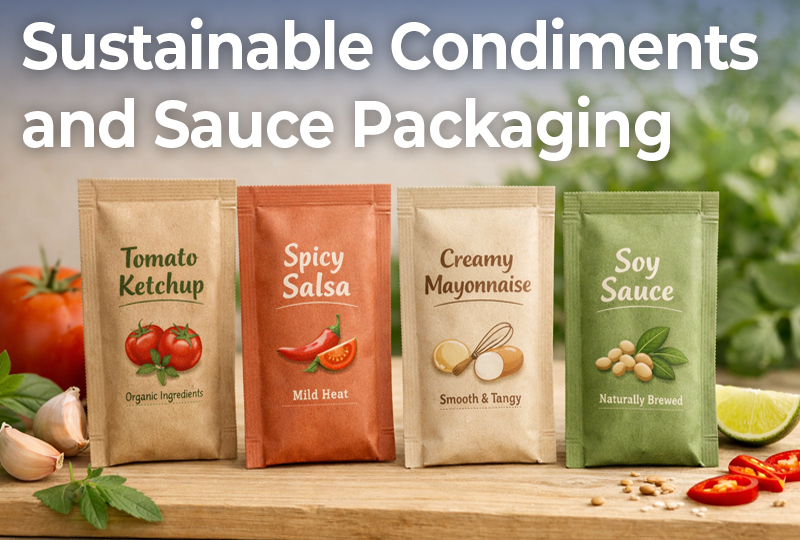
If you’re working on sustainable condiments and sauce packaging, you already know how these programs get judged. Not by a claim on a sell sheet, but by what happens in production, whether the packaging film runs like a normal day on the line, or whether it quietly adds startups, scrap, and operator intervention.
When film choices go sideways, sustainability stops looking like progress. It looks like extended dial-in time, more stoppages, and the slow loss of trust that makes the whole program feel fragile. And sauces and condiments make the consequences louder than most categories. A small integrity issue doesn’t stay small. It leaks into cartons, contaminates cases, and turns a packaging problem into cleanup and rework.
That’s why the most practical path to sustainable condiments and sauce packaging is film performance first. Not “less material” in theory, film that tracks predictably, seals in a comfortable window, prints consistently, and holds up to the chemistry and distribution handling your products actually face.
Where sustainable condiments and sauce packaging programs lose ground
1) Instability-driven scrap during startups and restarts
A small shift in friction, a tighter seal window, or roll-to-roll thickness variation can turn normal startups into tuning sessions that burn material fast. With sauces and condiments, stops often mean cleanup and resets, so instability multiplies waste.
2) Barrier choices that miss the real risk
Underbuilt structures can fail later due to integrity issues, quality drift, or seals that don’t hold under compression. Overbuilt structures can create stiffness and sealing sensitivity that your process can’t tolerate comfortably. Either way, stability suffers.
3) Printing waste that never reaches production
If printed rolls get rejected or have to be reprinted, that film is wasted before it ever reaches production. In multi-SKU and private-label condiment programs, the upstream print waste can cancel out the material savings you gained from downgauging.
4) Films that “should run” but don’t run here
A film can be technically sound and still demand constant attention: tension that shifts through your forming path, friction that drifts as the roll changes, or sealing that becomes sensitive to small temperature swings. Touchy lines create waste.
5) Downgauging that increases downstream damage
Compression in corrugated, pallet stacking, vibration, drops, if a lighter structure reduces puncture resistance, abrasion resistance, tear strength, or seal robustness, downstream failures rise. Material savings don’t matter if total system waste goes up.
6) Late failures that don’t show up in early trials
Some issues appear after time and stress, such as slow leaks, seal creep, and integrity loss after handling and compression. Early success isn’t long-term stability.
A film-first decision path for sustainable condiments and sauce packaging
Step 1: Choose the film structure based on risk
Film selection isn’t “high barrier vs low barrier.” It’s what your sauce or condiment needs to survive: oxygen, moisture, light, chemicals, shelf life, and distribution handling, without creating waste through instability.
High-barrier film laminations
High-barrier film laminations combine multiple layers of film to protect products from moisture, oxygen, light, and other contaminants. They’re available in foil or clear laminations and are ideal where a high barrier is required from oxygen, moisture, and chemicals to support longer shelf life. For demanding programs, maximum durability matters, and custom poly film extrusions for excellent sealing help keep sealing performance reliable. When higher performance is required, options such as Alox coating, PVDC, HDPE, and EVOH custom extrusions can be selected to match the risk.
Metalized film laminations
Metalized film laminations incorporate a layer of metal (usually aluminum) within the film structure. These laminations provide excellent barrier properties that prevent moisture, oxygen, and light from impacting freshness and integrity, and they’re known for excellent barrier and bonding properties. Depending on requirements, structures may use metalized BoPET films, metalized BOPP films, or metalized polyester films.
OPP film laminations
OPP film laminations are known for clarity, strength, and high tensile properties, along with excellent barrier properties, moisture resistance, and heat-sealing capabilities. These structures typically use BOPP films and high-strength BOPP films, often paired with CPP films. They’re chosen for their good dimensional strength and stiffness, with resistance to tear and abrasion, while remaining a cost-effective option for many sauce and condiment applications.
Step 2: Control the properties that decide whether the film runs consistently
Once you’ve chosen a structure, the next question is whether the film is going to behave the same way every time you run it. Three variables tend to decide that.
Coefficient of Friction (COF) is monitored and controlled, often using standards like ASTM D1894, because small shifts in friction can quickly show up as web-handling issues: tracking drift, tension instability, and more operator intervention than you planned for.
Thickness consistency is checked before and after production to keep the material within a tight band. Consistent thickness supports more predictable forming, steadier printing behavior, and more stable sealing.
Sealing performance is tested under defined temperature, dwell time, and pneumatic pressure conditions, with seal strength measured to recognized standards such as ASTM 882. That gives you a practical expectation of how the film should perform before you ever load it on a packaging machine.
These aren’t abstract lab checks. They’re the variables that decide whether a film settles quickly on a VFFS line, or whether it needs constant small corrections to keep it running.
Step 3: Treat printing as part of the sustainability conversation
Printing is one of the biggest sources of preventable waste in flexible packaging. When color drifts, registration shifts, or small defects slip through, you pay for it in rejected rolls and reprints long before the film reaches production.
That’s why print control matters as much as print capability. In well-managed rollstock programs, you’ll typically see inline high-resolution spectrophotometers monitoring color in real time so drift is caught early, not after an entire roll is printed. You’ll also see offline high-speed inspection that checks printed film quality and splices out inconsistencies before the roll goes to the packaging machine.
When those controls are in place, sustainability improves in a way operations can actually feel: less upstream waste, fewer roll surprises, and fewer last-minute workarounds on press or at the line.
Step 4: Confirm the film fits the application and the equipment
Packaging film isn’t just a material choice; it’s a system choice. Structure, bag geometry, and composition all need to align with the product and how your equipment is set up to run.
In practice, that means more than swapping in a new spec and hoping it behaves.
It means pressure-testing the basics:
Does the film seal reliably at the temperature and dwell window your vertical form fill seal machine is designed for?
Does the stiffness and thickness profile match your forming set and bag style?
Does friction behavior align with how your web handling and pulling belts actually operate?
When film selection and equipment reality are evaluated together, sustainable changes are far more likely to run like normal production, not like an ongoing experiment.
The Unified Flex advantage in film-driven sustainability
For sustainable condiments and sauce packaging, waste reduction only holds when the film runs predictably, roll after roll, shift after shift. Unified Flex’s rollstock approach focuses on value-added package development and quality controls that keep film performance predictable, so sustainability shows less scrap, fewer restarts, and fewer downstream failures.
That includes disciplined checks around thickness, sealing behavior under defined conditions, mechanical performance tied to real handling stress, and print quality controls that reduce upstream roll waste, so more of what you buy actually makes it to production.
Conclusion
For sauces and condiments, sustainability works when it lowers total waste without adding instability. That starts with choosing the right film build for the product and channel, then controlling the variables that determine whether the film behaves consistently in production, COF, thickness consistency, sealing performance, and print control. Validate those choices under realistic handling and compression so the pack holds up beyond day-one trials.
When the packaging film runs consistently and seals reliably, waste reduction becomes repeatable. That’s when sustainable condiments and sauce packaging scale across SKUs without turning production into a constant adjustment cycle.