
Tea Powder Packaging Machines for Matcha: Maintaining Repeatability in Controlled Production
Matcha packaging rarely fails in obvious ways. A tea powder packaging machine may run, pouches may be produced, and output may meet expectations at the start of a run. Fill weights are within range, seals look consistent, and the system feels under control. The difficulty shows up over time.
As production continues, small variations begin to surface. Fill weights drift slightly. Seal performance becomes less predictable. Operators adjust, and the process returns to range. Nothing has failed. But the system is no longer holding steady on its own.
In matcha packaging, the challenge is not getting a tea powder packaging machine to run. It is maintaining consistent results without turning normal production into continuous correction.
Matcha Behavior Under Production Conditions
Matcha is a fine, cohesive powder with a high surface area. These properties influence how it behaves during filling, settling, and sealing.
During production:
- Minor changes in bulk density affect how material feeds into the dosing system
- Fine particles can become airborne during filling, especially in confined forming areas
- Powder may shift within the pouch cavity before sealing, depending on motion and timing
Seal formation introduces an additional constraint. If the product is not settled consistently at the moment of sealing, the likelihood of particles reaching the seal interface increases.
These behaviors are not defects. They are inherent to fine powders. The challenge is maintaining control as they occur repeatedly under slightly different conditions.
Where Variability Appears in Matcha Packaging
In practice, variability shows up as small but persistent inconsistencies.
Dosing Drift
A run may begin with stable fill weights, only for those weights to drift slightly over time. The variation may remain within tolerance, but adjustment frequency increases to maintain it.
Seal Inconsistency
Most pouches appear acceptable, but occasional variation in seal quality begins to appear. These inconsistencies are often intermittent and not tied to a single parameter.
Operator Intervention Increases
As small variations accumulate, the process requires more attention. Operators spend more time monitoring and correcting rather than observing.
Inconsistent Setup Between Runs
A setup that worked previously does not always behave the same way on the next run. Even under similar conditions, the process may require re-adjustment to reach acceptable performance.
These are not isolated issues. They are recurring patterns that indicate a system that runs, but does not consistently return to the same operating condition.
Why Repeatability Becomes the Limiting Factor
In many matcha packaging environments, production involves shorter runs, product changes, or on-demand output.
Under these conditions, consistency is not defined by a single stable run. It is defined by how reliably the system returns to that same state.
This is where many operations encounter limitations.
A machine may perform adequately during one run, but not return to the same condition on the next. The issue is not capability; it is repeatability.
The impact is practical:
- More time spent on setup and adjustment
- Increased operator involvement
- Greater variability in output
- Reduced confidence in process consistency
At this stage, the constraint is not speed. It is the ability to reproduce the same result, run after run, with minimal correction.
Engineering Priorities in Matcha Packaging Systems
Maintaining repeatability requires controlling a small number of critical variables.
Dosing Stability
The system must support consistent material delivery, even when minor variations in powder behavior occur.
Seal Control
Seal performance depends on a clean, consistent interface and stable sealing conditions. Variability here is often a result of timing and product distribution.
Process Synchronization
Film movement, filling, and sealing must remain coordinated across cycles. Small timing differences can influence both fill distribution and seal quality.
Setup Repeatability
The system should return to a known operating condition with minimal variation between runs. This reduces reliance on repeated adjustment.
Maintainability
Fine powders accumulate over time. Systems that allow straightforward cleaning and component access are easier to keep within stable operating conditions.
How a Tea Powder Packaging Machine Fits into Controlled Matcha Production
In matcha packaging, equipment is typically evaluated based on how the process needs to operate, not just what the machine is capable of.
For operations working with shorter runs, product variation, or on-demand production, the requirement is maintaining a process that can be set up, run, and restarted without extensive adjustment.
This is where a tea powder packaging machine designed for controlled production becomes relevant.
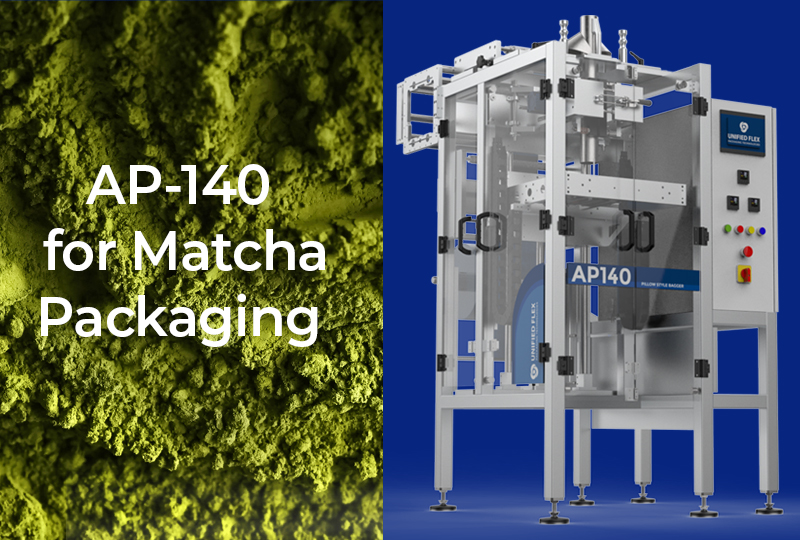
The AP-140 sits within this category. It is a narrow web system intended for smaller-scale production environments, where flexibility and manageable operation are part of the requirement. It can be paired with different filling methods, including auger, piston, and volumetric fillers, allowing the dosing approach to be selected based on how the product behaves.
Because it operates within a defined production range, the focus remains on maintaining stable process conditions rather than extending output beyond what the material and setup can reliably support.
In matcha applications, this type of tea powder packaging machine is not used to eliminate variation. It is used to keep the process within a range where variation can be managed without continuous correction.
AP-140 Control Map for Matcha Packaging
| WHAT TEAMS EXPERIENCE | WHY IT HAPPENS IN MATCHA PACKAGING | HOW THE SYSTEM IS CONFIGURED IN RELATION TO THIS CONDITION |
|---|---|---|
| Fill weights drift during runs | Minor bulk density variation influences how powder feeds into the dosing system | Can be paired with auger or volumetric fillers, allowing the dosing approach to be selected based on material behavior |
| Occasional seal variation appears | Powder movement and settling can affect conditions at the seal interface | Uses a pneumatically actuated horizontal sealing system, defining how pressure is applied during seal formation |
| Adjustment frequency increases | Process sensitivity becomes more visible as material behavior and timing interact over time | Operates within a moderate production range (up to 40 bags per minute), where process conditions remain more manageable |
| Setup varies between runs | Short runs and restart conditions introduce variation in setup and material response | Setup can be carried out without extensive reconfiguration, allowing the system to return to an operating condition between runs |
| Maintenance interrupts production | Fine powder accumulates within the system during operation, requiring periodic cleaning and servicing | Uses standard, off-the-shelf components, allowing routine maintenance and replacement without specialized sourcing |
Conclusion
Matcha packaging does not typically fail because of a single issue.
Variability develops through repeated interactions between material behavior, process timing, and operating conditions. These effects are gradual, but they increase the level of intervention required to maintain consistency.
The goal is not to eliminate variation. It is to operate within a system where variation remains manageable without continuous correction.
For matcha applications, the value of a tea powder packaging machine is not defined by how fast it runs, but by how consistently it returns to stable operation, and how much adjustment is required to keep it there.