
How Eco-Friendly Packaging Machines for Pasta, Beans, and Rice Are Changing the Future of Dry Goods
Sustainability Beyond Buzzwords
Sustainability in packaging isn’t about slogans anymore, it’s about measurable performance. For producers of pasta, beans, and rice, that means cutting waste, saving energy, and extending machine life without sacrificing speed or seal integrity.
The packaging process for dry staples is uniquely demanding. These products vary in shape, density, and dust behavior. They generate fine particles that can disrupt seals, shift weight distribution, and strain mechanical parts. Traditionally, improving efficiency meant running faster; today, it means running smarter.
That’s where a new generation of eco-friendly packaging machines for pasta, beans, and rice comes in. Built around precision motion, optimized material use, and compatibility with sustainable films, these systems prove that performance and responsibility can coexist.
The Hidden Waste in Dry-Staple Packaging
In every packaging plant, sustainability begins where waste ends, and in dry-goods packaging, waste isn’t always visible.
Material waste happens in millimeters, in bag length variations, misalignment, and sealing drift. When each package uses slightly more film than it should, that loss compounds over thousands of cycles.
Energy waste hides in inefficiencies, heaters that stay on when idle, drives that run continuously, or mechanical systems that lack servo control.
Product waste stems from inconsistent dosing or damaged seals that allow moisture ingress and spoilage. Even minor seal defects can force entire batches into rework or disposal.
And then there’s time waste, every unscheduled stop, every calibration drift that slows throughput. None of this is sustainable, not for business, and certainly not for the environment.
The answer lies in engineering precision into every stage of the packaging process.
Engineering a More Sustainable Packaging Process
Modern eco-friendly packaging machines for pasta, beans, and rice take a systems-based approach to sustainability. They combine mechanical accuracy, intelligent motion, and adaptable sealing technology to create measurable efficiency, not through shortcuts, but through control.
1. Energy Efficiency Through Servo Motion
Traditional constant-drive systems consume power even when idle. In contrast, servo-driven architectures use energy only when motion occurs, such as pulling film, sealing jaws, or dosing products. This simple change has a profound effect: less idle energy use, lower mechanical wear, and consistent cycle timing.
Each servo motor independently controls a function — film pulling, sealing, cutting, or filling — ensuring every movement aligns precisely with the next. This eliminates overdraw on the film roll and prevents excess heating at the jaws. Over time, those micro-savings translate to lower energy costs and longer machine life.
The result isn’t just sustainability, it’s process stability. Fewer rejected packs, smoother operation, and optimized power draw per cycle.
2. Optimized Film Handling and Registration
Film waste is one of the biggest environmental costs in dry-staple packaging. Modern systems address this through smart registration and feedback control.
Photo-mark sensors and encoder-based film measurement track every movement in real time, ensuring bag lengths are exact and cuts stay consistent. Self-aligning pulling belts and automated back-seal adjustment maintain even film tension across high-speed runs, reducing wrinkling, tracking drift, and miscuts.
For long, repetitive production cycles, such as rice or pasta packaging, this precision directly reduces material waste. Every roll yields more finished packs, with less trim and fewer rejects.
In sustainability terms, this is one of the most practical wins: fewer resources used, more value produced.
3. Longevity Through Modular Construction
In packaging machinery, longevity is the quiet engine of sustainability.
Modern equipment is designed with open-frame modular construction, meaning components can be accessed, replaced, or upgraded without retiring the entire machine. Tool-less forming collar changes make cleaning and changeovers faster, while standardized modules allow integration of new filling systems or sealing assemblies as needs evolve.
This design philosophy reduces downtime and extends lifecycle value. It also prevents obsolescence, the waste no one talks about. When a machine can evolve with production requirements instead of being replaced, sustainability becomes built-in, not added on.
4. Compatibility with Recyclable and Thin Films
The transition to recyclable packaging is happening quickly, but not every machine can handle the change. Recyclable mono-material films (like PE/PE or OPP/CPP) require tighter heat control, faster response times, and balanced tension to seal properly.
Eco-friendly packaging systems are engineered to manage those demands. Advanced sealing technology — from heat to ultrasonic and poly-jaw options — enables consistent seals across thinner gauges and newer film compositions.
This adaptability allows processors to meet sustainability targets without sacrificing performance or uptime. They can run lighter materials with confidence, knowing the sealing integrity, shelf life, and product protection remain intact.
5. Validated Consistency for Measurable Impact
The final step in sustainability is proving it. Every component in an efficient packaging system, barrier layer, sealant, and drive mechanism is tested to ensure consistency.
Oxygen and moisture barrier tests confirm product protection. Peel and burst tests verify seal strength under different conditions. Even friction and tension tests are conducted to maintain stable film tracking through forming collars and sealing jaws.
Once validated, these parameters are locked into the machine’s control interface, meaning temperature, dwell time, and tension stay constant across shifts and operators. The outcome is predictable performance, reduced waste, and confidence that every bag produced meets the same standard of quality.
That’s sustainability you can measure, not just declare.
Process Efficiency Is the New Sustainability Metric
Sustainability in packaging is often reduced to the material conversation, paper versus plastic, recyclable versus compostable. But the real gains come from process optimization.
When packaging lines run with minimal waste, low idle energy, and fewer mechanical failures, their environmental impact shrinks dramatically. Efficient systems use less film, less energy, and fewer spare parts over their lifespan, and that’s where engineering and ecology align.
This shift is already visible in the evolution of dry-staple packaging equipment. Servo coordination, modularity, and reliable sealing technologies aren’t just features; they’re sustainable design principles at work.
Unified Flex: Eco-Efficiency Across Every Scale
At Unified Flex, sustainability isn’t a marketing claim; it’s an engineering principle applied across every machine we build. The design philosophy is consistent: use energy only when needed, minimize material waste, and extend equipment life through modularity and control precision.
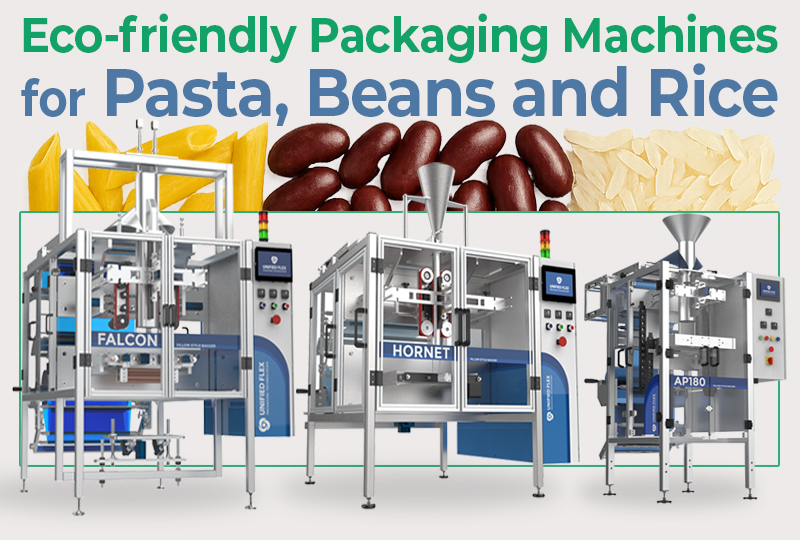
The AP-180 delivers efficient, entry-level automation for smaller production lines. Its modular design and stainless-steel contact parts reduce material waste, while pneumatic sealing provides consistent performance. With PLC control and a 7-inch HMI touchscreen, the system enables precise setup and dependable operation using less energy and maintenance effort.
The Vertobagger Hornet supports sustainable operation through precision engineering and efficient motion control. Its servo-driven belts and horizontal sealing reduce film waste and energy use by maintaining consistent tension and seal quality. Built with durable components and digital temperature controllers, it minimizes scrap, shortens changeovers, and extends service life, delivering reliable, repeatable performance with less resource consumption.
The Vertobagger Falcon is built for long-term reliability and efficient operation. Its #304 stainless-steel frame supports easy sanitation and extended equipment life, while servo-driven film pulling and pneumatic sealing maintain consistent performance with minimal film waste. Tool-less forming collar assembly changeovers and simple maintenance help keep energy use and downtime low, making day-to-day production both steady and resource-efficient.
Designed and built for 24/7 production, the Vertobagger 2.0 is an energy-efficient automatic bagging machine capable of high-speed operation with GREEN (biodegradable) film structures. It features six servo motors digitally geared in synchronous motion through Ether-CAT technology, delivering precise and consistent performance. Robust and built for life, its materials are engineered for long service and reliable operation in continuous use.
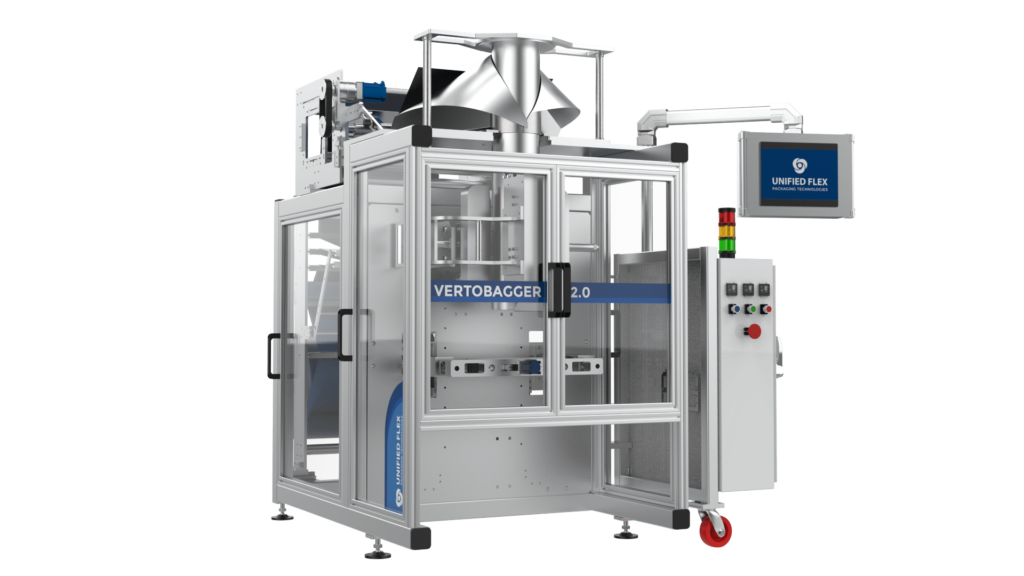
From compact to industrial, each machine reflects the same purpose: reduce waste, conserve energy, and deliver reliable packaging for pasta, beans, and rice with measurable sustainability built in.
Conclusion: Engineering the Future of Eco-Friendly Packaging
For pasta, beans, and rice producers, sustainability isn’t a separate goal anymore; it’s part of every production decision. Efficiency, durability, and material adaptability now define what it means to be environmentally responsible.
Modern eco-friendly packaging machines for pasta, beans, and rice bring that vision to life. By combining servo efficiency, modular longevity, and film flexibility, they turn sustainability into an engineering discipline, measurable, repeatable, and scalable.
In the end, sustainability isn’t just the future of packaging. It’s the result of doing everything, every seal, every motion, every bag, with purpose and precision.