
Bulk Pet Food Packaging Machines Fail Quietly — Until They Don’t
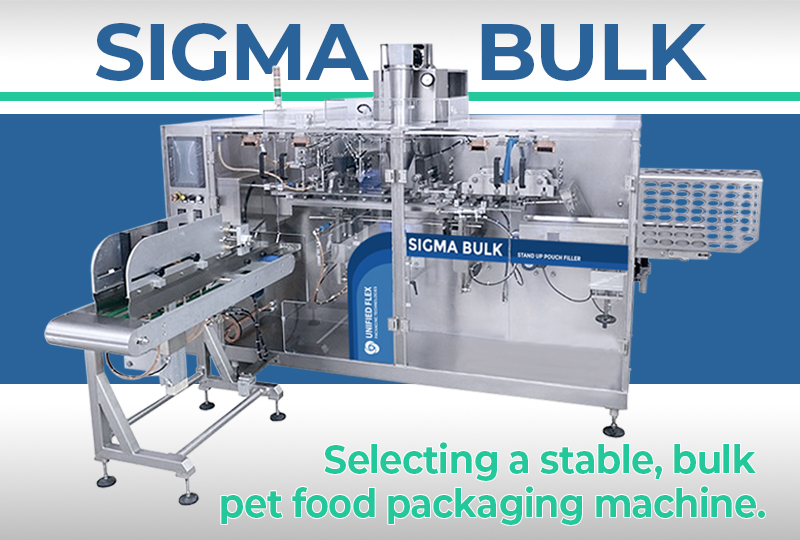
Box pouches, Doy Rim Style, and Doy Style pouches are widely used in bulk pet food packaging for practical reasons. They stack well, stand cleanly on the shelf, and can carry large fill weights without resorting to rigid containers. When the line is stable, the packaging almost disappears from the operation. The pouch opens, product drops, the seal closes, and production moves on.
But the pouch format itself is rarely where the biggest losses come from.
In bulk pet food packaging, the real test begins once product mass is introduced. As the product enters the pouch, the package quickly becomes a load-bearing structure. From that point forward, the machine is no longer handling an empty pouch; it is managing a pouch under increasing internal load through opening, filling, settling, and sealing. That transition is where small variation turns into real cost: alignment drift before sealing, seal inconsistency that shows up after handling, longer changeovers, and slow restarts that quietly erode output.
This is why selecting a bulk pet food packaging machine is less about whether it can run preformed pouches, and more about whether it can keep the process predictable once real product behavior enters the picture.
Bulk Pet Food Is Not One Product on the Line
“Pet food” covers a wide range of materials that behave very differently during packaging. Dry kibble and pellets are dense and abrasive. Treats are often irregular and can fracture under handling. Freeze-dried products tend to be lightweight and fragile. Powdered toppers and supplements introduce dust and flow variability. Blended products with inclusions settle unevenly and can shift during sealing.
These differences matter because they influence how the pouch opens, how product moves during filling, how quickly it settles, and how sensitive the seal area becomes to contamination. A stable bulk pet food packaging machine can maintain consistent pouch handling and sealing conditions across these common product families, validated with the actual pouch, product, and fill method being run.
Where Bulk Pet Food Packaging Lines Tend to Lose Stability
1) Pouch alignment shifts as product mass builds during filling
Preformed pouches enter the machine lightweight and easy to control. As filling begins, product mass increases rapidly and load transfers to the pouch base, grippers, and seal zone. If the pouch is not supported consistently through this transition, alignment can change before sealing is complete.
The result is rarely an immediate stop. More often, it appears later as uneven seal compression or packages that look acceptable at discharge but fail after handling or case packing.
2) Opening inconsistency that compounds downstream
Consistent opening is critical before any product enters the pouch. Larger pouches and stiffer films reduce the margin for error, and opening inconsistency becomes more visible when running dusty products or powders, where even minor spills near the seal area increase cleanup and scrap.
Partial or asymmetric opening does not always trigger alarms, but it changes how the pouch is presented during filling and sealing, creating conditions for intermittent defects.
3) Seal variability driven by settling behavior
Many bulk pet food products settle quickly once filling is complete. Dense kibble blends, mixed inclusions, and products with a wide particle size distribution do not always settle the same way from cycle to cycle. During the short window before sealing, internal product mass can shift toward the seal area.
If the pouch is not held consistently during this phase, the seal environment changes. Adjusting temperature or dwell time may mask the symptom, but the underlying issue is mechanical stability during the fill-to-seal transition.
4) Changeovers that reset the learning curve
Bulk pet food lines often run multiple pouch sizes and product types. When changeovers are not repeatable, each SKU change introduces variability that must be tuned out again. The cost is not just the stop itself, but the extended period after restart when the line needs additional adjustment before returning to steady output.
5) Medium-volume production that still punishes downtime
Bulk pet food operations frequently sit between low-speed specialty lines and ultra-high-speed snack packaging. Output rates may be moderate, but product weight, cleanup requirements, and bag value make downtime expensive. In this environment, reliability and recovery matter more than marginal speed gains.
What Stable Bulk Pet Food Packaging Machines Do Differently
Bulk pet food lines rarely struggle because teams make poor decisions. They struggle when machine architecture does not absorb normal variation in product behavior, film properties, and operating conditions. Stable systems are designed to manage that reality.
Controlled, linear pouch handling as product mass increases
Once filling begins, the pouch must remain stable as internal load builds. Machines designed for bulk applications prioritize controlled, linear pouch movement that supports the pouch consistently from pickup through sealing, minimizing unnecessary transitions while the pouch is under load.
The DOY Sigma Bulk uses servo-driven linear pouch movement with a defined pickup, open, fill, and seal sequence, designed for preformed pouches carrying bulk product loads.
Reliable pickup, opening, and verification before filling
Opening problems are easiest to prevent before the product enters the pouch. Stable systems verify pouch presence and opening condition before filling, reducing the likelihood that product enters an improperly opened pouch.
The DOY Sigma Bulk combines mechanical pickup, vacuum-assisted opening, and bag detection before filling, supporting consistent opening behavior across pouch sizes and film structures.
Firm pouch control through the fill-to-seal window
Seal quality depends heavily on what happens before the jaws close. As the product settles, the pouch must be held firmly enough to maintain consistent geometry at the seal zone.
Strong gripper fingers, position sensors, and controlled jaw engagement help maintain stability as internal product mass changes, reducing seal variability caused by pouch movement during settling.
Flexibility across fillers and product behaviors
Bulk pet food portfolios evolve. Recipes change, particle sizes vary, and fill methods may shift between auger, combination scale, volumetric, piston, or pump systems. Stable machines are designed to integrate with a range of fillers without requiring a complete redesign of the packaging system.
Pouches are opened to receive product from a dosing machine, which may include auger fillers, combination scales, piston fillers, volumetric cup fillers, or continuous pumps, depending on the application.
Repeatable changeovers that support mixed product portfolios
Quick changeover matters, but repeatable changeover matters more. Stable bulk pet food lines are designed so adjustments can be made consistently across pouch sizes and formats, reducing the amount of tuning required after each restart.
The Sigma Bulk is designed for easy and repeatable bag size changeovers, helping limit variability as SKUs and product types change.
The Unified Flex Approach to Stable Bulk Pet Food Packaging
Bulk pet food lines rarely fail all at once. They drift, after restarts, after changeovers, after long runs, when small variables are allowed to stack up. Unified Flex reduces that risk by focusing on how the pouch, product, and machine behave together under real operating conditions.
Customization is treated as controlled engineering work, supported by evaluation and testing. Application experience with bulk, settling, and dusty products informs system configuration. Design decisions are tied to observable outcomes on the line, not assumptions on paper. Projects follow a defined, process-driven approach because serious manufacturers expect structure when investing in capital equipment. And once installed, uptime is protected through practical service and non-proprietary spare parts that are straightforward to source.
Conclusion: A Bulk Pet Food Packaging Machine Is a Stable Decision
Bulk pet food packaging machines rarely fail on day one. They fail later, after product mass, settling behavior, and routine interruptions have had time to expose variation.
That’s why selecting a bulk pet food packaging machine should start with the failure modes you are trying to avoid, not just the pouch format or target output. Prioritize controlled pouch handling as product mass is introduced. Protect the seal environment during settling. Make changeovers and restarts repeatable. And validate performance with the actual pouch, product, and fill method you plan to run.
When the process stays stable, the line gets quieter: fewer interventions, less cleanup, and fewer downstream surprises. Packaging does what it is supposed to do, run reliably in the background.