
Why Does Cheese Packaging Equipment Lose Seal Stability?
If you run shredded cheese or cheese curds on a vertical form fill seal (VFFS) line, the first day is rarely the problem.
The real test comes later, after extended shifts, after multiple changeovers, when the film roll changes, when production targets are pushed, and the line must still maintain seal integrity and bag presentation without constant adjustment.
That’s where cheese packaging equipment proves its value.
Shreds and curds are mechanically simple products to fill, but they are unforgiving of inconsistency. Shredded cheese carries fines that can migrate toward the seal area. Curds are irregular and can load the pouch unevenly. Over thousands of cycles per hour, small variations in forming alignment, film indexing, or seal engagement begin to matter.
At that point, the question is not peak speed. It is repeatability. A stable VFFS system must reproduce the same pouch geometry and seal event cycle after cycle, under sustained production conditions.
Application Reality: What Cheese Actually Requires
Shredded Cheese
Shredded cheese is lightweight and free-flowing. During filling and vibration, fines can shift within the pouch. In many retail applications, nitrogen flushing is integrated to manage oxygen levels. That requires coordination between product drop, gas displacement, film positioning, and horizontal seal engagement.
When that sequence remains consistent, the process runs predictably. When timing varies, the effective sealing window becomes narrower. Minor variation that is insignificant during startup becomes more noticeable during extended production.
Film indexing consistency also plays a role. Bag length variation affects seal placement and headspace control. At moderate output levels, small variation may not be visible. Under sustained production, dimensional consistency becomes more important.
Shredded cheese does not require specialized handling systems. It requires consistent forming, indexing, and sealing across repeated mechanical cycles.
Cheese Curds
Cheese curds introduce a different mechanical profile. Their irregular geometry results in less uniform internal distribution within the pouch. Internal loading can vary from cycle to cycle depending on how the product settles during filling.
Forming stability therefore becomes more visible. If forming alignment shifts, pouch geometry changes. With curds, those changes tend to appear more clearly in finished bag presentation.
Seal engagement consistency is equally important. Horizontal seal timing and pressure must remain repeatable to maintain uniform closure, particularly when internal distribution varies slightly.
Cheese curds do not fundamentally change the VFFS process. They increase sensitivity to forming and sealing repeatability.
How Performance Changes in Real Production
When cheese packaging equipment begins to lose stability, the change is typically gradual.
Forming Alignment
The forming collar and related components establish pouch structure before sealing. If alignment shifts due to vibration, wear, or incremental mechanical movement, pouch geometry changes subtly. Seal parameters may remain unchanged, but the physical interface between film layers differs slightly from cycle to cycle.
Film Indexing
Film pulling systems are designed to maintain consistent bag length. Over extended runs, small indexing variation can influence seal placement and registration. Dimensional consistency affects presentation and downstream handling.
Seal Engagement
Horizontal sealing depends on consistent timing and pressure. As cycle frequency increases, repeatability becomes more significant than peak closing speed. Minor variation in engagement can reduce tolerance to product near the seal area.
Operator Adjustment
One of the clearest indicators of reduced stability is increased operator intervention. Dwell time is extended. Temperature is adjusted. Film tracking is corrected more frequently. These adjustments maintain production, but they signal that the operating window has tightened.
In high-cycle cheese applications, stability depends on mechanical consistency under repetition.
What those drift signals point to is not a single setting issue; it’s the capacity for repeatable control under sustained cycling. Speed ratings are useful references, but they don’t describe how the system behaves over full shifts with real film variation, changeovers, and normal process noise. That’s why throughput should be treated as an operating range decision: select a platform and throughput tier that can hold forming geometry, indexing length, and seal engagement consistently at your required production rate, without relying on constant operator correction.
Bringing Repeatability Back Into the Process Window
Once operators are compensating, more tracking corrections, more seal tweaks, more “watch it closely after the roll change”, the issue is no longer product handling. It’s control margin.
In shredded cheese and curd packaging, the machine has to repeat three events with minimal drift: forming geometry, film indexing length, and the horizontal seal engagement. If any one of those becomes inconsistent across long runs, the process window narrows. That’s when a line can still “hit output” but stop feeling stable.
This is where cheese packaging equipment should be evaluated by architecture, not by a demo clip. Not because speed is irrelevant, but because stability is what keeps speed usable after a month of production reality.
A VFFS Solution for Shredded Cheese and Curds: Repeatability First, Then Throughput Tier
By the time a cheese line requires frequent operator correction, tracking nudges, seal tweaks, dwell changes, the limiting factor is no longer “setup.” It’s repeatability under sustained cycling.
Shredded cheese and curds both amplify the same mechanical requirement: the machine must hold forming geometry, film indexing length, and horizontal seal engagement consistently over long runs. If any of those three drift, the process window tightens and the line becomes more sensitive to normal variation (film roll change, small shifts in product behavior, routine restarts).
That is why the practical “solution” for cheese packaging is a VFFS platform designed to maintain alignment and motion consistency under repetition, then selecting the throughput tier that fits the production requirement.
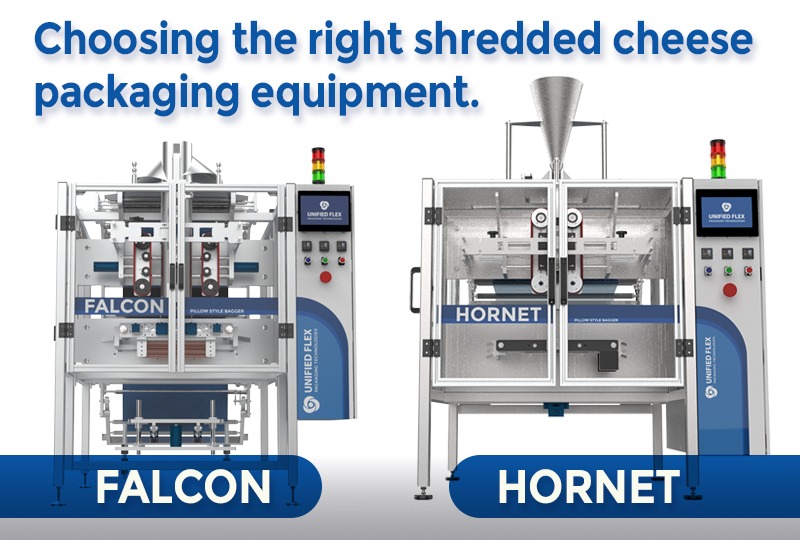
Unified Flex’s Vertobagger platform supports shredded cheese and cheese curds using the same fundamental VFFS approach (forming, film handling, and sealing executed as one repeatable cycle). Within that platform, two throughput tiers are available:
Vertobagger Hornet: Servo-Driven Sealing for Repeatable Cheese Runs
Vertobagger Hornet is a VFFS system capable of producing up to 80 pouches per minute. It is built with servo-driven horizontal sealing and servo-controlled film pulling. From an engineering standpoint, this electronically controlled motion architecture supports consistent seal timing and precise bag length control, enabling stable, repeatable performance across extended production runs.
Vertobagger Falcon: VFFS Platform for Shredded Cheese and Curds
Vertobagger Falcon is a VFFS system that runs up to 100 pouches per minute, depending on pouch size, film structure, and product characteristics. From an engineering standpoint, this configuration pairs servo-controlled film handling with a mechanically actuated seal engagement method intended for repeatable sealing behavior under sustained cycling.
Both machines are applied to the same cheese reality: maintaining consistent pouch geometry and seal integrity when the process is running continuously, not just during a short trial. Final sustained throughput and configuration are validated against the specific pouch size, film properties, product behavior, and (when used) nitrogen flushing conditions.
Making the Selection Without Guesswork
The right way to evaluate cheese packaging equipment is to treat it like a repeatability problem, not a brochure problem. Shredded cheese and curds will both punish drift over long runs, so the evaluation needs to focus on what actually determines stability:
- Does pouch geometry stay consistent after roll changes and extended shifts?
- Does bag length and seal placement remain repeatable over time?
- Does the horizontal seal engagement stay consistent without constant tuning?
- How quickly does the line recover after changeovers and restarts?
This is why application validation matters. Film structure, pouch length, product behavior, and gas flushing (when used) define the real process window. A responsible equipment selection proves stability under those conditions instead of assuming it from a rating.
Conclusion: Stability Is the Output That Matters
Shredded cheese and cheese curds don’t typically create packaging problems because they are hard to fill. They create packaging problems because they expose whether a VFFS line can hold repeatability under sustained cycling.
Once operators begin compensating, more tracking corrections, more seal tweaks, more dwell adjustments, the process window has tightened. At that stage, improving performance is less about chasing peak speed and more about restoring control margin: stable forming geometry, repeatable film indexing, and consistent seal engagement across long production runs.
That is the purpose of choosing the right cheese packaging equipment. Within Unified Flex’s Vertobagger platform, Hornet and Falcon represent two throughput tiers built around the same VFFS objective: predictable pouch geometry and seal integrity in real production conditions. The correct selection is the one validated against your film, pouch format, product behavior, and operating schedule.
Throughput is what the line is asked to do. Repeatability is what keeps it doing it.