
Can Stick Pack Packaging Machines Transform the Way Sauces Reach Consumers?
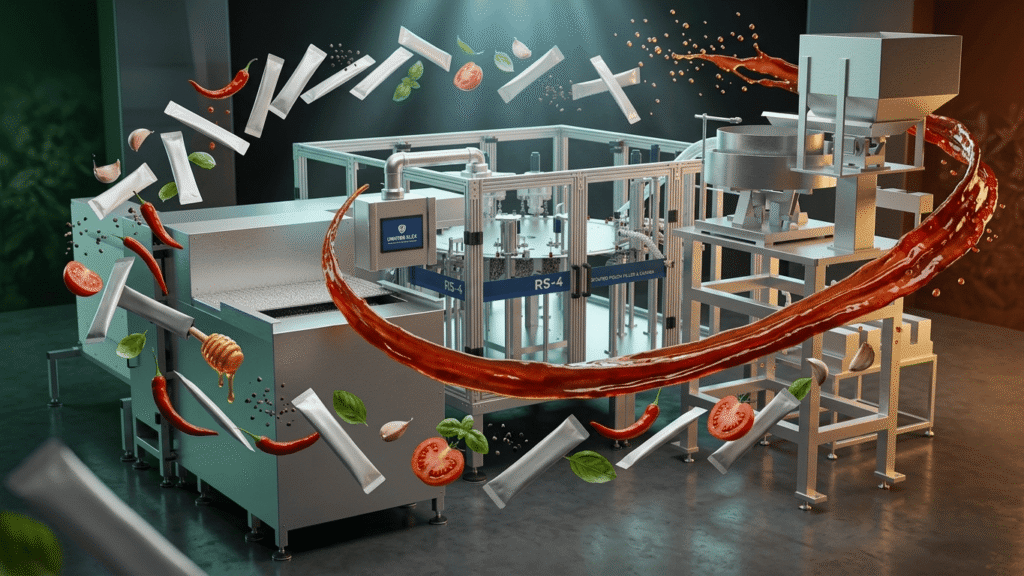
Sauce manufacturers today are under constant pressure to deliver consistent quality, faster output, and more convenient packaging formats, without increasing operational costs. This has driven packaging technology to evolve beyond traditional formats toward more efficient, precision-driven solutions like stick pack machines.
From controlled portioning to high-speed multilane production, modern stick pack systems, such as those engineered by Unified Flex, are designed to meet these demands. But can they truly transform how sauces are packaged and delivered to end consumers? The answer lies in their engineering and performance capabilities.
Core Problems with Traditional Sauce Packaging
Before evaluating transformation, it’s important to understand the limitations of conventional systems.
Operational Gaps in Bottles & Jars
Parameter | Traditional Packaging | Operational Impact |
Portion Control | Manual / user-dependent | Product waste, inconsistency |
Contamination Risk | High after opening | Reduced shelf life |
Logistics Efficiency | Bulky | Higher transport/storage cost |
Production Speed | Moderate | Limited scalability |
Material Usage | High | Increased packaging cost |
From an engineering standpoint, these inefficiencies accumulate across the value chain, affecting OEE (Overall Equipment Effectiveness) and total cost of ownership.
How Do Stick Pack Machines Improve Overall Sauce Packaging Performance?
Sauces stick pack packaging machines are redefining how sauces are packaged by addressing key operational challenges across production, quality, and efficiency.
Engineering Precision in Portioning and Filling
One of the most critical factors in sauce packaging is accuracy in portioning, especially for high-viscosity liquids such as dressings and condiments. Modern stick pack machines integrate advanced filling technologies to ensure consistent output.
Unified Flex machines utilize:
- Piston fillers for thick sauces, ensuring controlled volumetric dispensing
- Multi-head combination weighers for weight-based accuracy
- Check weighers to eliminate underfilled or overfilled packs
- Product transfer pumps for smooth flow without altering product consistency
For engineers and operations managers, this level of precision minimizes product giveaway, reduces waste, and ensures compliance with regulatory standards.
High-Speed Multilane Production Efficiency
Production throughput is a key performance indicator in any manufacturing environment. Sauces stick pack packaging machines are designed to maximize output through multilane configurations, allowing simultaneous packaging across multiple channels.
Unified Flex offers scalable solutions, including:
- MSP 300mm: Up to 300 stick packs per minute (up to 6 lanes)
- MSP 440mm: Up to 400 stick packs per minute (9 lanes)
- MSP 800mm: Up to 800 stick packs per minute (16 lanes)
Operating at approximately 50 cycles per minute, these machines enable high-volume production within a relatively small footprint. For business owners, this translates to higher ROI per square foot of production space.
Maintaining Product Freshness and Safety
Food safety and shelf life are non-negotiable in sauce packaging. Stick pack machines are engineered to deliver airtight, contamination-free packaging through advanced sealing and barrier technologies.
Key technical features include:
- Heat sealing and ultrasonic sealing for strong, leak-proof closures
- Barrier films that protect against moisture, oxygen, and light
- Leak-proof formats such as 3-side and 4-side seal designs
- Single-use packaging to eliminate cross-contamination
These features ensure that sauces retain their flavor, texture, and safety throughout the supply chain, an essential requirement for both regulatory compliance and brand trust.
Material Efficiency and Cost Optimization
From a business perspective, packaging costs impact profitability. Stick pack formats are inherently material-efficient, using less film compared to traditional packaging.
Benefits include:
- Reduced raw material consumption
- Lower shipping and storage costs due to compact size
- Minimized product waste through precise portioning
For engineers and operations managers, this results in streamlined logistics and improved cost control, especially in high-volume production environments.
Flexibility Across Product Types
Modern sauce manufacturers often deal with a diverse product portfolio, ranging from thin liquids to thick pastes and granular mixes. Stick pack machines offer versatility across multiple product types, including:
- Liquids (ketchup, mayonnaise, dressings)
- Semi-viscous sauces
- Powders and granulated condiments
This flexibility allows manufacturers to standardize their packaging infrastructure while accommodating different SKUs, reducing the need for multiple specialized machines.
Customization and Branding Capabilities
In retail environments, packaging plays a crucial role in influencing consumer decisions. Stick packs provide a highly customizable surface for branding, enabling:
- High-quality printed designs
- Clear product labeling and traceability (via integrated printers)
- Differentiation on crowded shelves
Unified Flex also supports in-house graphic design services, helping brands create visually appealing packaging that aligns with their identity.
Are Stick Pack Machines Compatible with Sustainable Packaging Materials?
Sustainability is increasingly becoming a priority for both consumers and regulators. Stick pack machines are evolving to support eco-friendly materials, including:
- Compostable films (PLA, PHA, paper-based materials)
- Recyclable mono-material films (PE, PP)
While these materials may require adjustments such as optimized tension control and low-temperature sealing, Unified Flex machines are engineered to accommodate these changes. This positions manufacturers to transition toward sustainable packaging without compromising performance.
How Do Stick Packs Improve Consumer Convenience?
From the end-user perspective, stick packs offer unmatched convenience:
- Easy-to-carry, single-serve portions
- Tear notches and perforations for effortless opening
- Controlled dispensing with minimal mess
For businesses, this translates into improved customer satisfaction and increased product adoption, particularly in sectors such as food service, travel, and e-commerce.
Why Unified Flex Stick Pack Machines Stand Out
With over 17 years of industry experience, Unified Flex has developed stick pack solutions customized to the complex needs of sauce, dressing, and condiment manufacturers.
Key strengths include:
- High-speed multilane systems (up to 800 packs per minute)
- Compatibility with powders, granules, and liquids
- Integration with advanced filling and weighing systems
- Customizable configurations for different production needs
- Support for sustainable packaging materials
Our flexible packaging machines are designed not just for performance, but for long-term reliability and adaptability in dynamic production environments.
So, Can Stick Pack Packaging Machines Truly Transform Sauce Delivery?
Sauces stick pack packaging machines are not just an incremental improvement; they represent a fundamental shift in how sauces are packaged, distributed, and consumed, offering engineers precision, reliability, and scalability, enabling operations managers to achieve greater efficiency, cost savings, and streamlined workflows, and empowering business owners to unlock new market opportunities through enhanced convenience, stronger branding, and sustainable packaging solutions.
Unified Flex stands at the forefront of this transformation, providing advanced stick pack solutions that align with modern manufacturing demands.
Don’t let outdated packaging limit your growth. Talk to our team and discover how Unified Flex stick pack machines can transform your production line into a high-efficiency, high-output operation.