
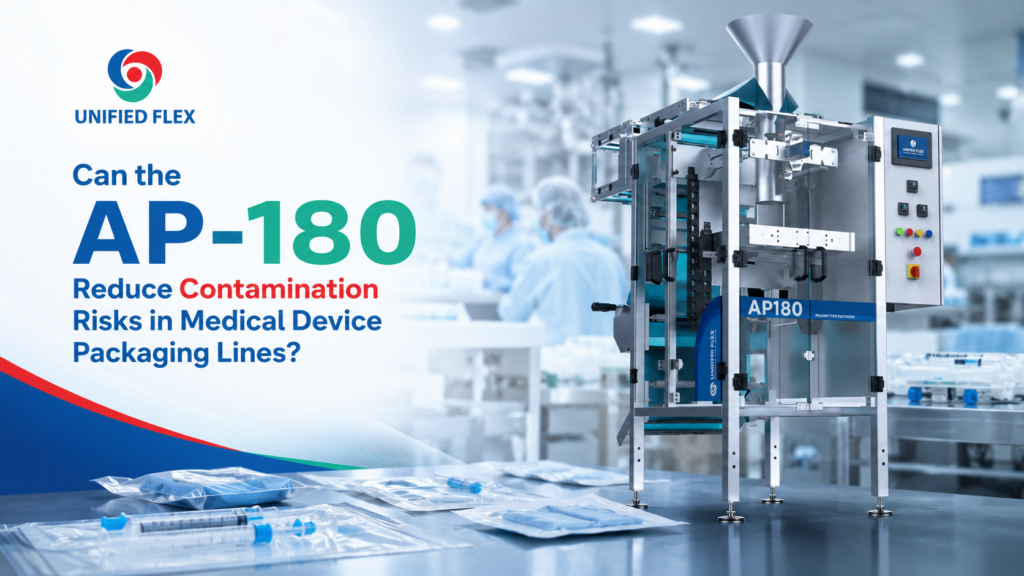
Can the AP-180 Reduce Contamination Risks in Medical Device Packaging Lines?
By Unified Flex Editorial Team | Reviewed by Packaging Engineering Specialists | July 2026
Contamination risk is more than a quality concern; it is a production variable that affects reject rates, batch holds, OEE, regulatory compliance, and, ultimately, patient safety. Even a minor packaging defect can compromise sterile integrity and lead to costly recalls.
Most contamination issues don’t originate from the packaging material itself but from process variability, including inconsistent sealing, unstable web handling, and excessive manual intervention.
The Unified Flex Auto Pouch Bagger AP-180 is one of the automated medical device packaging machines engineered to address these challenges by delivering precise, repeatable packaging processes that help reduce process variability and maintain sterile barrier integrity.
Table of Contents
Where Contamination Actually Enters the Packaging Line
Before evaluating how any automatic packaging machine contributes to sterile packaging, engineers must first understand where contamination risks originate.
While packaging materials play an important role, real-world production environments reveal that contamination can often result from mechanical inconsistencies and process variation rather than film performance alone.
Common contamination sources include:
- Inconsistent seal temperature control: Older sealing systems often experience temperature drift during long production runs. Although seals may appear acceptable during visual inspection, they can fail peel strength, burst, or dye penetration testing.
- Uneven jaw pressure: Variations in sealing pressure across the seal width can create weak zones or channel leaks, particularly in 3-side and 4-side seal pouches where corner integrity is critical.
- Film handling variability: Poor web tracking, wrinkles, or inconsistent web tension may prevent proper seal formation before the sealing jaws even engage.
- Manual product handling: Every unnecessary operator touchpoint introduces opportunities for particulate contamination, environmental exposure, or accidental product damage.
- Lengthy equipment changeovers: Manual tooling adjustments during product or pouch format changes may increase product exposure and require additional operator interaction with production equipment, depending on the manufacturing process.
Each of these issues represents a process control challenge rather than simply a materials issue. For this reason, contamination prevention begins with machine design and production consistency.
Production Stability Is Part of Contamination Control
Experienced manufacturing engineers recognize that contamination events are frequently the result of unstable production rather than isolated equipment failures.
Frequent packaging line stoppages, repeated line restarts, operator adjustments, and process interruptions may increase opportunities for contamination before the sterile barrier has been fully established.
The Auto Pouch Bagger AP-180 is designed around production stability. Its PLC-controlled automation, modular architecture, and intuitive 7-inch HMI enable operators to maintain consistent operating parameters throughout extended production runs while minimizing manual intervention.
Stable production means fewer unexpected adjustments, reduced operator interaction with in-process products, and greater confidence that validated process parameters remain consistent from the first pouch to the last.
How the AP-180 Reduces Contamination Risks
The AP-180 is an automated pouch packaging machine designed for manufacturers packaging medical devices, pharmaceutical products, and other products requiring hygienic, consistent, and automated pouch packaging.
Precision Sealing Through Rotatable Horizontal Seal Jaws
The integrity of a sterile medical package ultimately depends on the quality of its seal.
The AP-180 utilizes rotatable horizontal seal jaws engineered to produce uniform and repeatable seals across extended production runs. Rather than relying on mechanical timing alone, the sealing system maintains consistent geometry from one pouch to the next.
For process engineers, this consistency is particularly valuable because it minimizes gradual performance drift, a common issue where seal quality slowly deteriorates throughout a production shift without immediately triggering alarms.
When producing stick packs, pillow bags, 3-side seal pouches, or 4-side seal sachets, the AP-180 delivers repeatable sealing performance that can help support sterile barrier integrity when used with appropriate packaging materials and validated packaging processes.
PLC-Controlled Process Consistency
The AP-180 combines pneumatic jaw activation with PLC-based electronic control, allowing sealing parameters to remain within tightly controlled operating windows throughout production.
Compared with conventional mechanically timed systems, PLC-based control helps maintain consistent process parameters throughout production, reducing process variability and supporting more consistent seal formation.
For quality engineers performing routine validation, more consistent process control typically translates into fewer failed seal-strength tests, reduced process variation, and improved confidence during production qualification.
Hygienic Stainless Steel Product Contact Parts
Medical device manufacturers operate under rigorous sanitation protocols, making hygienic equipment design essential.
The AP-180 features stainless steel product contact parts that support routine cleaning and sanitation procedures while maintaining long-term durability.
Beyond corrosion resistance, stainless steel provides stable, non-porous contact surfaces that withstand repeated cleaning cycles without degradation. This simplifies routine sanitation while supporting GMP-driven manufacturing environments where hygienic design plays a critical role in contamination prevention.
The AP-180 incorporates hygienic design principles found in modern pharmaceutical packaging machines, making it suitable for packaging medical devices, pharmaceutical products, and other products manufactured in highly regulated environments where cleanliness and process consistency are critical.
In-Line Forming, Filling, and Sealing
One of the most effective ways to reduce contamination is to minimize unnecessary product handling.
As an automatic packaging machine, the AP-180 performs pouch forming, filling, and sealing in one continuous automated process.
By reducing unnecessary transfer points between individual operations, manufacturers can significantly reduce opportunities for airborne particulate contamination, operator contact, or environmental exposure before the sterile barrier is established.
Automation does not replace operator expertise; it enables operators to supervise controlled processes rather than directly influence critical packaging operations.
Tool-Less Changeovers Reduce Exposure
Medical manufacturers frequently package multiple product formats within a single facility.
Traditional equipment often requires lengthy tooling adjustments during changeovers, increasing machine downtime and operator interaction with production components.
The AP-180 supports rapid tool-less changeovers between different bag styles, including:
- Stick Packs
- Pillow Bags
- 3-Side Seal Pouches
- 4-Side Seal Pouches
Faster changeovers can shorten the period during which packaging systems remain open, helping reduce contamination opportunities while improving overall production efficiency.
Integration Reduces Additional Handling
Contamination risk extends beyond the automatic packaging machine itself.
Disconnected production equipment often requires manual product transfers between filling, weighing, coding, and sealing operations, introducing unnecessary handling throughout the packaging process.
The AP-180 is designed to integrate with a wide range of upstream equipment, including:
- Auger Fillers
- Piston Fillers
- Volumetric Cup Fillers
- Combination Weighers
- Continuous Pumps
Its ability to “handshake” with these systems creates a synchronized packaging line where products move efficiently from filling through final sealing with minimal manual intervention.
The AP-180 can also be equipped with optional lot code printers, date code printers, and barcode scanners, allowing traceability functions to be integrated directly into the packaging process while reducing additional handling. This supports more efficient product identification and helps manufacturers meet traceability requirements without introducing additional manual steps.
For operations managers, this integrated workflow can improve production efficiency while helping reduce opportunities for contamination.
Real-World Scenario: Eliminating Seal Integrity Failures
Consider a medical device manufacturer producing sterile diagnostic test strips that begins experiencing intermittent seal-integrity failures during routine dye penetration testing. After investigation, engineers identify seal-jaw temperature drift and uneven sealing pressure, common issues with aging mechanical packaging equipment.
By upgrading to the Unified Flex Auto Pouch Bagger AP-180, the manufacturer can replace manual variability with PLC-controlled automation, repeatable sealing performance, and an integrated forming, filling, and sealing process. This can result in more consistent seal quality, reduced manual handling, and fewer opportunities for contamination throughout production.
Beyond potentially improving sterile barrier integrity, the manufacturer may also benefit from fewer batch holds, reduced material waste, faster changeovers, and improved Overall Equipment Effectiveness (OEE), helping create a more reliable and scalable packaging operation.
The Business Case for Reducing Contamination Risk
For business owners and operations managers, contamination represents much more than a quality issue. Every rejected pouch, batch hold, production stoppage, or recall directly impacts profitability.
Investing in automated medical device packaging machines allows manufacturers to reduce process variability while improving throughput, product quality, and long-term operational efficiency.
Reducing process variability contributes to measurable improvements, including:
- Lower scrap and material waste
- Fewer rejected batches
- Reduced rework
- Improved OEE
- Higher production throughput
- Lower Cost of Poor Quality (COPQ)
- Reduced recall exposure
- Stronger customer confidence
Combined with production speeds of up to 40 pouches per minute, support for multiple pouch formats, and a compact production footprint, the AP-180 can help manufacturers increase production capacity while supporting contamination control through more consistent packaging processes.
Why It Matters
Reducing contamination risk begins with improving process control rather than relying solely on inspection. By combining PLC-controlled automation, precision sealing, hygienic design, and integrated packaging capabilities, the Unified Flex Auto Pouch Bagger AP-180 helps manufacturers build more consistent, reliable, and scalable medical device packaging operations.
For engineers, operations managers, and business owners, it offers a practical solution for improving sterile barrier integrity while supporting regulatory compliance and long-term production efficiency.
Ready to build a more reliable medical device packaging line? Get in touch with Unified Flex today to discuss your application, request a quote, or schedule a consultation with one of our packaging experts.