
Spirulina Packaging: Why Packaging Film Determines Stick Pack Performance
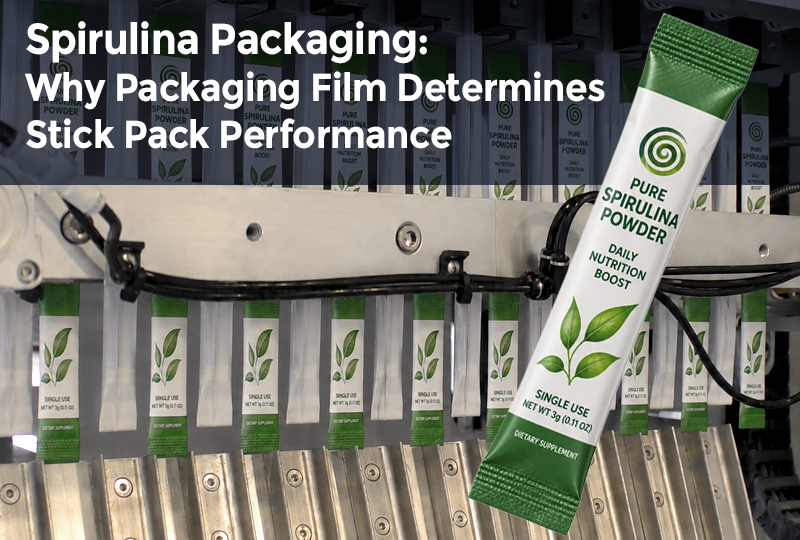
If you are packaging spirulina in stick packs, film performance is not assessed by its barrier properties alone. It is judged by how consistently it performs throughout production, from material handling and printing to sealing operations and extended production runs.
When film selection does not align with the requirements of the packaging process, the result is rarely immediate failure. Stick packs continue to be produced, but operators often compensate through sealing adjustments, web tracking corrections, registration changes, and additional quality inspections to maintain package quality.
Over time, these interventions increase production complexity, reduce operating efficiency, and make it more difficult to predict how the packaging process will perform from one production run to the next.
Spirulina packaging places particular demands on packaging film because the material must do more than protect a moisture-, oxygen-, and light-sensitive powder. It must also move consistently through the packaging machine, maintain seal integrity, support print quality, and deliver repeatable package performance under changing production conditions.
For this reason, film selection in spirulina packaging is less about theoretical material specifications and more about how reliably the material supports the packaging process under real operating conditions.
Table of Contents
Variability That Builds During Stick Pack Production
During production, packaging film does not operate independently. Web handling, sealing conditions, print registration, machine settings, and roll-to-roll consistency all influence package performance. Small changes in any of these variables can affect how reliably stick packs are formed, printed, and sealed.
These effects may appear insignificant in isolation. Over time, however, they begin to interact.
A slight variation in film thickness may influence sealing behaviour. Changes in the coefficient of friction can affect web tracking and material handling. Differences between material rolls may require adjustments that were unnecessary during the previous production run. Conditions that appeared stable during one shift may not behave identically during the next.
This variability is rarely constant, making it difficult to identify. Instead, it appears intermittently within a packaging process that otherwise seems to be operating normally.
As variability accumulates, maintaining consistent stick pack performance becomes increasingly dependent on operator intervention rather than the inherent stability of the packaging process.
Film Choices That Appear Correct but Create Packaging Limitations
A packaging film can satisfy technical specifications and still create challenges during commercial production.
Structures selected primarily for barrier performance may provide more protection than the product requires while increasing material costs. Films selected to reduce material usage may require tighter process control during sealing and web handling. Materials that perform well during qualification trials may not deliver the same results when exposed to normal production variation over extended manufacturing runs.
These issues are not always visible during initial evaluation.
Short production trials and controlled testing environments rarely represent everyday operating conditions, where machine speeds, material rolls, environmental conditions, and production schedules continually introduce variation into the packaging process.
As a result, a film that appears to be the correct choice during qualification may require continual adjustment once it becomes part of routine production.
For spirulina packaging, the question is not whether a film meets its technical specifications. It is whether the film continues to support stable package quality as normal manufacturing conditions begin to change.
Where Film Properties Influence Stick Pack Performance
Packaging film is more than a protective barrier. It influences how reliably the packaging process performs throughout production.
Barrier performance determines how well the packaged spirulina is protected from moisture, oxygen, and light during storage. However, product protection represents only one aspect of film performance.
Seal initiation characteristics determine how consistently the film seals as temperature, pressure, and dwell time naturally fluctuate throughout production. A narrow sealing window may perform well under ideal conditions while becoming increasingly sensitive during extended manufacturing runs.
Thickness consistency influences how predictably the material behaves as it moves through the packaging machine. Variations within a roll or between rolls can affect web tracking, registration accuracy, and seal consistency.
The coefficient of friction influences how smoothly the film feeds through the machine. Changes in friction can alter tension, tracking, and material handling, increasing the likelihood of adjustments during production.
Printability also plays an important role. Product information, lot codes, expiry dates, and branding must remain clear and consistently positioned throughout the production run.
These characteristics are often evaluated independently. In practice, they interact within the same packaging process.
When film properties reduce operating tolerance, maintaining package quality becomes increasingly dependent on continual adjustment rather than a stable manufacturing process.
Step 1: Match the Film Structure to Spirulina's Requirements
Selecting a packaging film for spirulina is often approached as a barrier decision. In practice, it is a risk decision.
Moisture, oxygen, and light all influence product stability, but providing the highest possible barrier does not automatically produce the best packaging outcome. Every film structure represents a balance between product protection, machinability, material cost, and process tolerance.
A structure that provides more protection than the application requires may increase material costs without improving shelf life. Conversely, reducing barrier to lower material costs can leave the product more sensitive to storage and distribution conditions.
The objective is not to maximize barrier performance. It is to select a film structure that manages product risk while remaining compatible with the realities of commercial stick pack production.
Step 2: Evaluate the Film Properties That Influence Stick Pack Production
Once the film structure has been selected, the next consideration is how consistently it supports the packaging process.
For spirulina, sealing performance is particularly important because stick packs contain relatively small product volumes. A film with a narrow sealing window may produce acceptable seals under controlled conditions but become increasingly sensitive as normal variations in temperature, pressure, or dwell time occur during production. A wider operating window provides greater tolerance without continual adjustment.
The film’s coefficient of friction also influences production stability. If friction changes from one roll to the next, the web may not track consistently through the machine. Registration accuracy, seal placement, and package appearance can all be affected, even when machine settings remain unchanged.
Thickness consistency is equally important. Variations across a roll or between production batches influence how the material responds during sealing and web handling. Maintaining a consistent gauge helps produce more uniform stick packs while reducing unnecessary machine corrections.
Finally, film stiffness and dimensional stability influence how reliably the web feeds through equipment. Materials that stretch, curl, or respond differently under production conditions can increase process variability, particularly during long production runs where even minor inconsistencies become more pronounced.
These characteristics are rarely evaluated together. In practice, they determine whether the film supports a stable packaging process or becomes another variable that operators must continually manage.
Step 3: Validate Under Commercial Production Conditions
Film evaluation should not end once the material successfully completes qualification testing.
A film that performs well during a controlled trial may respond differently when exposed to extended production runs, roll changes, normal machine adjustments, and the day-to-day variation found in commercial manufacturing. These conditions introduce variables that short validation runs rarely capture.
For spirulina stick pack packaging, validation should confirm more than package integrity. It should demonstrate that the film continues to feed consistently, maintain registration, and produce reliable seals without requiring continual process adjustments as production conditions evolve.
The objective is not simply to determine whether the film works. It is to determine whether it continues to support stable, repeatable production under the conditions it will encounter every day.
Aligning Film Selection with Commercial Stick Pack Production
In spirulina packaging, film selection is often treated as a material decision. In practice, it influences every stage of the packaging process.
The selected film determines more than the product’s barrier protection. It affects how consistently the material feeds through the packaging machine, how reliably seals are formed, how accurately graphics and coding remain registered, and how much operating tolerance exists before production begins requiring adjustment.
These interactions become more significant as production volumes increase. A film that performs predictably under changing operating conditions allows the packaging process to remain stable despite the normal variation encountered during commercial manufacturing. Conversely, a material that operates within a narrow processing window may require continual intervention to maintain the same level of package quality.
Film selection should therefore be considered alongside equipment capability and process requirements rather than as an independent purchasing decision. When these elements are evaluated together, manufacturers are better positioned to build a packaging process that is both reliable and repeatable over the long term.
Conclusion
In spirulina stick pack packaging, the packaging film influences far more than the finished package. It affects how predictably the material moves through the machine, how consistently seals are formed, and how reliably production performs over time.
A film that protects the product but continually requires machine adjustments, quality inspections, or process corrections has not solved the packaging challenge, it has simply shifted it to the production floor.
The most effective film is not necessarily the one with the highest barrier properties or the lowest material cost. It is the one that balances product protection with process stability, allowing the packaging line to operate consistently under everyday manufacturing conditions.
That is when film selection stops being a material decision and becomes a manufacturing advantage.