
How Does Matcha Tea Packaging Protect Color, Aroma, and Flavor from Air, Light, and Moisture?
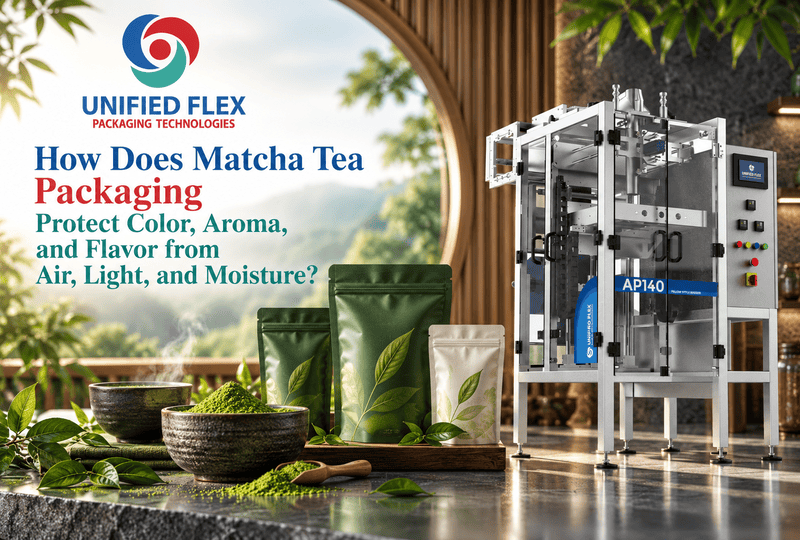
By Unified Flex Editorial Team | Reviewed by Packaging Engineering Specialists | August 2026
Matcha is a highly sensitive powder, and its quality can change quickly when exposed to air, light, or moisture. For engineers, operations managers, and business owners, protecting that quality requires more than choosing an attractive pouch.
The real challenge is controlling exposure throughout filling, sealing, storage, and distribution.
That is where matcha tea packaging becomes an engineering decision rather than just a packaging choice. For automated production, a matcha tea packaging machine becomes part of that control system by coordinating filling, pouch formation, and sealing around the product’s handling requirements.
Why Matcha Is Technically Difficult to Protect
Matcha presents a different packaging challenge from many granular or free-flowing dry products because the product itself is chemically sensitive and physically difficult to handle.
Oxygen Drives Oxidative Quality Loss
Exposure to oxygen can contribute to degradation of oxidation-sensitive compounds in matcha, including catechins, pigments, and aroma-related components.
From a packaging-engineering perspective, oxygen protection depends on several variables working together:
- Oxygen Transmission Rate (OTR) of the packaging structure
- Residual oxygen inside the package after filling
- Package headspace
- Seal integrity
- Product exposure during filling
- Storage temperature and time
This distinction matters because a sealed package is not automatically an oxygen-proof package. Flexible films have measurable gas-transmission characteristics, and a technically sound matcha package must be specified according to the required barrier performance and validated shelf life.
Light Can Accelerate Color and Compound Degradation
Matcha’s vibrant green appearance is closely associated with its chlorophyll-containing plant material. Light exposure can accelerate photochemical reactions that affect pigments and other sensitive compounds.
Recent research examining matcha powder under different water activity and light conditions found that light exposure, particularly when combined with higher water activity, accelerated losses in several bioactive compounds. Light-shielded storage improved stability under the conditions studied.
For packaging engineers, this means a light barrier is a functional specification, not simply a graphic-design decision.
Opaque, metallized, foil-containing, or other appropriately engineered barrier structures may be considered depending on shelf-life targets, distribution conditions, sustainability requirements, and machine compatibility.
Moisture Changes Both Product Quality and Process Behavior
Matcha is an ultra-fine powder with a high surface area. Changes in environmental humidity can therefore affect powder behavior during both storage and packaging.
Moisture exposure may contribute to:
- Agglomeration or clumping
- Changes in powder flow
- Bulk-density variation
- Dosing inconsistency
- Powder adhesion to equipment surfaces
- Increased difficulty maintaining a clean sealing zone
Packaging structures used for matcha should consequently be evaluated for Water Vapor Transmission Rate (WVTR) as well as OTR.
For operations teams, humidity control is not limited to the finished pouch. Ambient conditions around powder handling, hopper storage, filling, and sealing can also influence process repeatability.
These changes can also affect filler performance and machine settings, making powder behavior an important consideration when configuring a matcha packaging line.
How Packaging Creates a Controlled Environment Around Matcha
Protecting matcha requires coordinated control across the package material and the packaging process.
Barrier Film Controls Environmental Ingress
The film structure is the primary physical barrier between matcha and the external environment.
A suitable structure should be selected according to the required oxygen, moisture, and light protection while also providing the sealability and mechanical properties required by the packaging equipment.
No packaging machine can compensate for an incorrectly specified film.
The machine’s job is to form, fill, and seal the selected material consistently without compromising the barrier system. On systems such as the Unified Flex AP-140, film selection and sealing parameters must therefore be evaluated together.
Portioning Reduces Repeated Product Exposure
Traditional tins can provide excellent initial protection, but after opening, the remaining product is repeatedly exposed to the surrounding atmosphere each time the container is used.
Single-serve sachets approach the problem differently.
Each dose remains independently sealed until use. Opening one package does not expose the remaining production lot stored in other sachets.
That makes format selection a product-protection and portion-control decision, not simply a branding decision.
Performance Factor | Single-Serve Sachets | Tins | Bulk Packs |
Post-opening exposure | Limited to one dose | Repeated exposure | Repeated/high exposure |
Portion control | Pre-measured | Scoop dependent | Application dependent |
Portability | High | Moderate | Low |
Remaining product protection | Individual packs remain sealed | Product repeatedly exposed | Large quantity may be exposed |
Retail experience | Premium and convenient | Traditional | Primarily functional |
The best format still depends on intended use, distribution channel, volume, shelf-life target, and packaging economics.
For automated sachet production, the packaging system must also maintain consistent dose control and seal formation across repeated cycles.
Residual Oxygen Can Be Managed During Packaging
For applications requiring additional oxygen management, reducing oxygen inside the package may be considered alongside high-barrier film.
The Unified Flex Auto Pouch Bagger AP-140 offers nitrogen flushing as an optional feature.
Nitrogen flushing can be used to displace a portion of the oxygen-containing atmosphere in the package before final sealing. However, nitrogen flush should not be treated as an automatic shelf-life guarantee.
Gas flow, package geometry, fill volume, machine timing, headspace, film barrier, seal integrity, and measured residual oxygen all influence actual performance.
For critical shelf-life applications, packaging performance should be verified through package testing rather than assumed from machine configuration alone.
What Operations Teams Should Monitor During Matcha Packaging
Stable matcha packaging depends on controlling a few key process variables.
- Fill-Weight Drift: Changes in bulk density or powder feeding can affect dose consistency. Monitor fill weights and adjust filler settings within established control limits.
- Powder in the Seal Zone: Fine matcha dust can interfere with sealing. Fill timing and sealing parameters should be optimized to keep the seal area clear.
- Humidity Changes: Ambient humidity can affect powder flow and filling consistency, so environmental conditions should be monitored between runs.
- Cleaning and Maintenance: Fine powder can accumulate on equipment. The AP-140 uses stainless-steel contact parts and off-the-shelf components, helping simplify routine cleaning, servicing, and parts replacement.
Why the AP-140 Fits Growing Matcha Production
For companies moving from manual or semi-manual packaging into structured automatic production, the AP-140 provides a practical platform for controlled scale-up.
As a packaging machine manufacturer, Unified Flex configures flexible packaging systems around factors such as product behavior, filler requirements, package format, and production targets rather than treating every powder application the same.
Key AP-140 characteristics for matcha tea packaging include:
- Production speeds of up to 40 pouches per minute
- Maximum bag size up to 4.5 inches wide by 7.5 inches long
- Integration capability with auger, piston, and volumetric fillers
- Pneumatically activated horizontal sealing
- 7-inch HMI touchscreen
- Stainless-steel contact parts
- Optional nitrogen flush
- Flexible bag-style capability with appropriate tooling
The maximum rated speed should not be interpreted as the appropriate operating speed for every matcha application.
Actual throughput depends on dose size, filler performance, film characteristics, package dimensions, product flow, sealing requirements, and downstream equipment.
For a sensitive powder, the correct operating point is the speed at which the line can repeatedly maintain fill accuracy, package integrity, and acceptable process capability, not simply the highest mechanical speed.
A Practical Control Map for Matcha Packaging
What the Production Team Sees | Likely Process Influence | Engineering Response |
Fill weights begin drifting | Bulk-density or feeding variation | Review hopper conditions, filler setup, auger parameters, and weight-control data |
Seal consistency changes | Powder near the seal interface or parameter variation | Evaluate product clearance, sealing temperature, timing, pressure, and dwell |
Setup changes between batches | Product or environmental variation | Establish documented recipes and changeover procedures |
Excessive powder accumulation | Fine-particle dust generation | Implement defined sanitation and preventive-maintenance intervals |
Shelf-life performance misses target | Barrier, residual oxygen, seal, or storage issue | Review OTR/WVTR, light barrier, seal testing, headspace oxygen, and distribution conditions |
This troubleshooting approach prevents teams from treating every quality issue as a machine problem. Matcha packaging performance is the result of the product, filler, film, bagger, environment, and operating parameters working together as one system.
Scaling Beyond the AP-140
Production requirements change as brands grow.
The AP-140 can support growing or moderate-output operations, while higher-volume applications may require different machine architectures.
Unified Flex also offers:
- Auto Pouch Bagger AP-180: For applications requiring a different capacity or package configuration, the AP-180 provides another automatic pouch-packaging option.
- Multilane Sachet Baggers: Unified Flex’s MSB 406mm, MSB 508mm, and MSB 813mm platforms provide multilane sachet-packaging options for operations moving toward higher throughput.
- Multilane Stick Pack Systems: Unified Flex offers stick pack packaging machines such as the MSP 300mm, MSP 440mm, and MSP 800mm platforms, which provide scalable options for higher-output stick-pack production.
The correct matcha tea packaging machine should be selected based on actual throughput requirements, target package geometry, dose size, filler configuration, available floor space, changeover frequency, and expected future capacity.
How Should a Matcha Packaging Line Be Validated?
A reliable matcha packaging line should be validated as a complete product-filler-film-machine system.
Teams should test product flow, fill accuracy, film compatibility, seal quality, package size, and target speed before finalizing production settings. Working with an experienced packaging machine manufacturer also allows teams to evaluate the equipment configuration against actual powder behavior before the line enters routine production.
Unified Flex tests customer products before delivery to help configure the system around actual product characteristics.
For shelf-life validation, package integrity, storage performance, residual oxygen, and barrier properties may also need to be verified.
What It Means for Your Operation
Matcha’s color, aroma, and flavor are highly sensitive to oxygen, light, and moisture. Protecting these attributes requires treating each sachet as part of a controlled packaging system, not simply as a container.
The AP-140 supports this approach through controlled powder dosing, repeatable seal formation, flexible filler integration, and a scalable platform for growing matcha operations.
For teams evaluating a matcha packaging line, machine selection should begin with the product’s flow characteristics, target dose, package format, barrier requirements, and production volume.
Talk to a matcha packaging specialist or request a quick quote to discuss an AP-140 configuration for your matcha production line.