
Keto Protein Powder Stick Pack Packaging: Selecting the Right Film for Product Protection and Production
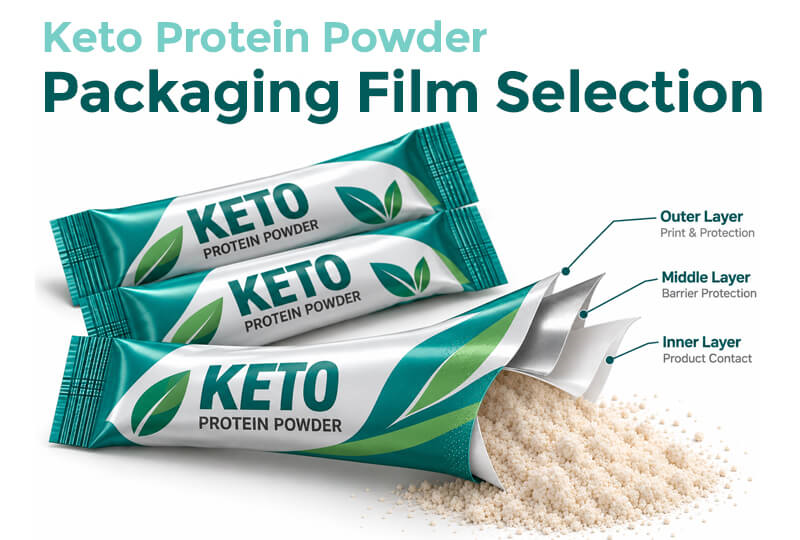
Developing a keto or protein powder stick pack involves more than choosing a convenient single-serving format. The packaging film must protect the formulation throughout its intended shelf life while performing consistently during forming, filling, and sealing.
This balance can be difficult to achieve. Protein powder formulations may contain ingredients with different sensitivities to moisture and oxygen, while the packaging material itself must withstand the mechanical and thermal demands of automated production.
A film that provides excellent barrier protection may not necessarily be the easiest material to run on a packaging machine. Conversely, a material that forms and seals efficiently may not provide sufficient protection for the product.
For manufacturers, the objective is to select a film that satisfies both requirements without introducing unnecessary material costs or production limitations.
Table of Contents
Why Film Selection Matters for Keto and Protein Powder Stick Packs
Keto and protein powder formulations often contain combinations of proteins, fats, sweeteners, flavoring ingredients, and other functional components. These ingredients do not necessarily respond to storage conditions in the same way.
Moisture exposure can contribute to caking or changes in powder flowability, while oxygen exposure may affect the stability of oxidation-sensitive ingredients, particularly certain fats and flavors.
The level of protection required depends on the complete formulation, intended shelf life, storage conditions, and distribution environment.
Film selection also influences what happens before the finished stick pack reaches the customer. Material stiffness, friction, thickness, and sealing behavior can affect how reliably the film moves through automated packaging equipment.
A suitable structure must therefore protect the product without creating avoidable difficulties during commercial production.
Step 1: Establish the Barrier Requirements of the Formulation
The first step is determining what the film needs to protect against.
For protein powders containing moisture-sensitive ingredients, water vapor transmission rate (WVTR) is an important consideration. WVTR indicates how much water vapor passes through a packaging material under specified test conditions.
A lower WVTR generally indicates stronger resistance to moisture transmission, although the required level depends on the formulation and intended storage conditions.
Oxygen transmission rate (OTR) becomes relevant when the formulation contains ingredients susceptible to oxidation. Keto protein powders containing certain fat sources, for example, may require particular attention to oxygen exposure because oxidation can affect flavor and product quality.
However, selecting the lowest possible WVTR or OTR is not automatically the most economical solution.
High-barrier structures may involve additional material layers or more complex laminations, increasing packaging costs without necessarily providing meaningful benefits for every formulation.
Manufacturers should establish barrier targets using product stability requirements and shelf-life testing rather than selecting materials based solely on their advertised barrier performance.
Step 2: Evaluate Film Properties That Affect Stick Pack Production
Once the necessary barrier protection has been established, the next question is whether the selected material can perform consistently on the packaging line.
Several film properties deserve attention.
Heat-Sealing Characteristics
Stick packs depend on properly formed seals to maintain package integrity.
Different films require different combinations of sealing temperature, pressure, and contact time. A material with a narrow sealing window may be less tolerant of variations in operating conditions.
For powder applications, this becomes particularly important because product particles entering the sealing area can interfere with seal formation.
The selected film should therefore be evaluated for its ability to form acceptable seals under the conditions expected during production.
Coefficient of Friction and Web Handling
Coefficient of friction influences how packaging film moves across machine surfaces and interacts with other materials.
Variation in friction can affect web movement and tracking, potentially contributing to registration problems or inconsistent package formation.
For narrow stick packs, maintaining film alignment is important because the available space for forming and sealing is limited.
Manufacturers should consider not only the friction characteristics of an initial film sample but also their consistency across production rolls.
Thickness and Dimensional Stability
Film thickness influences mechanical behavior and heat transfer during sealing.
Inconsistent thickness can cause variations in how the material responds to the packaging process, while insufficient dimensional stability may contribute to stretching, curling, or tracking difficulties.
These characteristics are particularly relevant when evaluating alternative film structures intended to reduce material consumption.
A thinner film may reduce material usage, but that advantage must be weighed against its ability to withstand handling and maintain acceptable package quality.
Step 3: Consider Sustainability Without Compromising Packaging Performance
Sustainability is becoming an increasingly important consideration in flexible packaging decisions. However, evaluating a more sustainable stick pack structure requires more than comparing material thickness or the number of layers.
For keto and protein powders, reducing packaging material is only beneficial if the revised structure continues to protect the formulation and performs reliably during production.
For example, downgauging may reduce the amount of film used per stick pack. Yet a thinner structure may introduce different sealing or handling characteristics that require additional evaluation.
Mono-material structures may also be considered where improved compatibility with certain recycling streams is a design objective. However, their suitability depends on the required barrier properties, seal performance, available material structures, and local recycling infrastructure.
A recyclable-material claim should not be confused with confirmation that a finished stick pack will actually be accepted or recovered through existing collection systems.
Manufacturers should also consider the consequences of inadequate protection. Packaging that uses less material but contributes to product deterioration or rejected packages may not deliver the intended environmental benefit.
The objective is to identify opportunities for material improvement while maintaining the functional requirements of the application.
Step 4: Validate Film Performance Under Production Conditions
A film may produce acceptable stick packs during a short trial but behave differently during sustained operation.
Longer production runs can reveal variations associated with roll changes, web tension, sealing conditions, and material consistency.
Validation should therefore extend beyond confirming that an individual stick pack can be formed and sealed successfully.
For keto and protein powder applications, manufacturers should evaluate seal integrity, package appearance, film tracking, and the consistency of finished packs over the intended operating period.
When comparing alternative materials, the evaluation should also consider whether the new film requires changes to operating conditions or affects the achievable production rate.
This is particularly important when introducing a more sustainable structure. Its environmental advantages should be assessed alongside its performance on the intended packaging equipment.
The findings can then be used to establish a film specification that defines acceptable material properties and supports consistent sourcing.
Aligning Film Selection with Packaging Equipment
Film development and equipment selection should not be treated as entirely separate decisions.
Unified Flex’s Auto Pouch Baggers AP-140 and AP-180 can be configured for stick pack applications with appropriate tooling. Both systems provide automated VFFS operation, but the suitability of a particular film must be established for the intended package dimensions and equipment configuration.
Evaluating the packaging material alongside the machine allows manufacturers to identify potential compatibility issues before committing to commercial production.
At Unified Flex, application requirements can be considered together when evaluating a proposed packaging solution, helping manufacturers connect their material choices with the practical demands of automated stick pack production.
From Film Selection to Commercial Production
The right packaging film must do more than meet a barrier specification. It must protect the keto or protein powder formulation, form reliable seals, run consistently on the selected equipment, and support the manufacturer’s material and sustainability objectives.
By evaluating these requirements together, manufacturers can make more informed film decisions and reduce the risk of discovering compatibility problems after production begins.
Planning a keto or protein powder stick pack application?