
Keto Protein Powder Packaging Machine: Overcoming the Challenges of Stick Pack Production
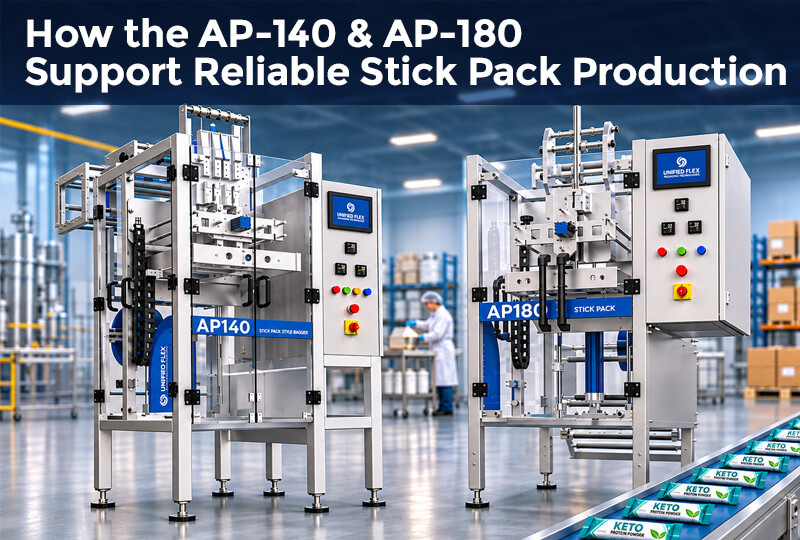
Developing a keto or protein powder formulation for stick packs is one step toward introducing a new product. Producing those stick packs consistently is another. A formulation that performs well during product development may present different challenges when it must be dispensed into narrow packaging, sealed, and processed repeatedly on an automated production line.
For manufacturers, selecting a protein powder packaging machine involves more than determining whether the equipment can produce the desired stick pack dimensions. Powder flow characteristics, filling requirements, sealing conditions, and production speed must work together to support the intended application.
Understanding these challenges is essential before moving from formulation development to automated stick pack production.
Table of Contents
The Challenges of Packaging Keto and Protein Powders in Stick Packs
Why Narrow Stick Packs Complicate Powder Filling
Stick packs have a relatively narrow profile, making the relationship between powder behavior and the available filling space particularly important.
Protein and keto powder formulations can contain combinations of protein concentrates or isolates, fats, fibers, sweeteners, flavoring agents, and other functional ingredients. Depending on their composition and physical characteristics, these powders may behave differently during dispensing. Free-flowing formulations may move through a filling system relatively easily, while more cohesive powders may resist movement, form bridges, or discharge irregularly. Fine particles can also become airborne during filling, particularly when powder is released into a narrow package.
These behaviors matter because the filling system must deliver the intended quantity of powder through the available opening without allowing product to accumulate where it could interfere with subsequent operations. The difficulty is not necessarily that a powder cannot be packaged in a stick pack. Rather, the dosing method, discharge characteristics, and package geometry must be compatible.
A formulation that fills successfully under one set of conditions may require different filling parameters or equipment when the serving weight, powder composition, or stick pack dimensions change.
Preventing Powder Contamination in the Seal Area
A stick pack must contain the intended serving and maintain an effective seal throughout handling, distribution, and storage. For powdered products, one potential complication is the presence of product particles in the sealing area.
During filling, fine powder may become suspended in the air or adhere to packaging surfaces. If particles remain between the film layers when the sealing jaws close, they can interfere with direct contact between the sealing surfaces.
The consequences depend on the packaging material, sealing conditions, and amount and location of powder contamination. In some cases, contaminated seals may exhibit reduced strength or incomplete bonding, potentially affecting package integrity.
This creates an important relationship between filling and sealing operations. The powder must be dispensed into the package while allowing the seal area to remain sufficiently clear for the intended sealing process. Manufacturers must therefore consider more than the heat-sealing capability of a packaging machine. The timing of product discharge, powder behavior, package geometry, and sealing conditions can all influence the outcome.
For keto and protein powders containing fine or cohesive ingredients, these interactions should be evaluated with the actual formulation and packaging film rather than assumed from machine specifications alone.
Maintaining Production Output When Filling Time Varies
Packaging machine specifications often highlight maximum production speed. However, the advertised number of packages per minute does not necessarily represent the achievable output for every powder formulation.
In stick pack production, the filling operation must be coordinated with the machine’s packaging cycle.
Some powders may discharge quickly and consistently, while others require more time to deliver the intended quantity. Serving weight, powder flowability, filling equipment, and the dimensions of the package can all influence the time required for dosing. If the filling operation cannot be completed within the intended cycle, the packaging process may need to operate at a lower speed.
For example, two protein powder formulations packaged at the same serving weight may require different filling times because of differences in their physical characteristics. Even if the packaging machine can mechanically operate at a particular rate, the filling system may become the limiting factor. Pouch length and packaging film properties can also influence operating speed.
This means manufacturers should distinguish between a machine’s maximum rated capacity and the output achievable with their specific formulation, filling system, and packaging material.
The objective is not simply to operate at the highest possible speed, but to establish a production rate at which filling and packaging operations can function consistently.
Accommodating Different Protein Powder Serving Sizes in Stick Packs
Not every keto or protein powder formulation is intended to deliver the same quantity of product. A concentrated nutritional blend may require a relatively small serving, while a protein-rich formulation intended to deliver a larger nutritional contribution may require substantially more powder.
For packaging equipment selection, the relevant consideration is not serving weight alone but the space the powder occupies within the intended package. A larger serving may require a longer or wider stick pack, depending on the powder’s bulk density and the dimensions available for filling. The package must also provide adequate space for product discharge and sealing.
This becomes especially important when manufacturers plan to package several formulations or serving configurations. A stick pack dimension suitable for one product may not accommodate another, even when both belong to the same nutritional powder category.
Before selecting equipment, manufacturers need to establish whether their intended stick pack dimensions fall within the capabilities of the packaging system and whether those dimensions are practical for the product being filled.
How the AP-140 and AP-180 Support Stick Pack Production
Unified Flex’s Auto Pouch Baggers AP-140 and AP-180 are modular vertical form-fill-seal (VFFS) systems that can be configured for keto and protein powder stick pack applications. Their suitability can be assessed through four technical considerations: filling-system compatibility, automated sealing, production capacity, and supported package dimensions.
Integrating Powder Filling Systems with the AP-140 and AP-180
The Auto Pouch Baggers AP-140 and AP-180 are designed to interface with conventional filling equipment, including auger fillers, volumetric fillers, and weighing systems. This allows manufacturers to select a dosing method suited to the characteristics of their keto or protein powder formulation.
For applications using an auger filler, the filling equipment measures and dispenses the required quantity of powder while the bagger handles pouch formation and sealing. The two systems must operate in coordination to ensure that each dose is delivered at the appropriate stage of the packaging cycle.
This separation of filling and pouch-forming functions allows the equipment configuration to be evaluated according to the product’s dosing requirements without assuming that the bagger itself determines filling accuracy.
Evaluating Stick Pack Production Speed with the AP-140 and AP-180
The Auto Pouch Baggers AP-140 and AP-180 offer production speeds of up to 40 pouches per minute. However, this maximum rating does not represent a fixed operating speed for every keto or protein powder stick pack application.
Actual output depends on product fill time, pouch length, and packaging film properties. These factors must be considered when assessing whether either machine can meet the manufacturer’s production targets.
For capacity planning, the achievable production rate should be established through trials using the intended formulation and packaging materials, rather than relying solely on the machine’s maximum rated speed.
Beyond Machine Specifications: What Makes an Equipment Investment Reliable
A packaging machine may meet the required specifications on paper, but manufacturers need to know how it will perform in their own production environment. That is why Unified Flex begins by examining the product, packaging format, filling requirements, and production targets before recommending an equipment configuration. Drawing on our packaging automation experience, we connect machine capabilities to specific operational needs, from selecting suitable filling technology to accommodating pouch formats and integrating equipment into existing production lines. But selecting the right equipment is only one part of a successful investment. A defined project process gives manufacturers visibility into how their requirements are assessed, how the solution is developed, and how the project moves toward delivery. And once the machine is running, its long-term value depends less on where it was built than on how quickly replacement parts and technical assistance can be accessed when needed. For manufacturers committing significant capital to automation, these are the factors that turn an equipment purchase into a more predictable, manageable investment.
From Stick Pack Feasibility to Reliable Production
Moving from product development to automated stick pack production requires manufacturers to make informed decisions about their packaging equipment. The objective is not simply to find a machine capable of producing stick packs, but to select a system that can accommodate the intended formulation and support the required production process.
With the Auto Pouch Baggers AP-140 and AP-180, Unified Flex offers configurable solutions for different stick pack applications. Selecting the appropriate system involves evaluating the product’s filling requirements, package dimensions, and production objectives to determine a suitable equipment configuration.
Looking for a protein powder packaging machine for your keto or protein powder application?