
Disposable EEG Electrode Packaging: Choosing Film That Supports Consistent Package Performance
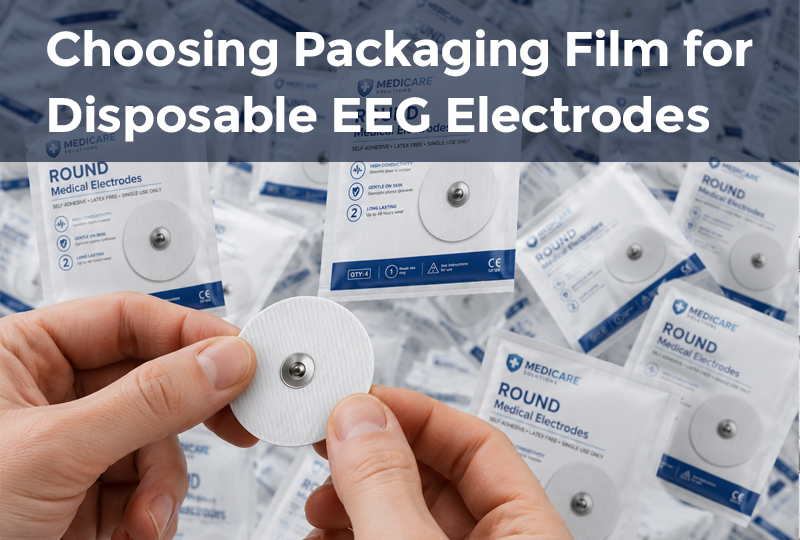
If you are working with disposable EEG electrode packaging, film performance is not assessed by its behavior during qualification trials. It is judged by how consistently it performs across production runs, printing requirements, sealing operations, and changing packaging conditions.
When film selection does not align with packaging requirements, the result is rarely immediate failure. Packages continue to be produced, but operators often compensate through print adjustments, sealing changes, material inspections, and additional quality checks.
Over time, these interventions increase complexity, reduce efficiency, and make it more difficult to predict how the packaging process will perform from one production run to the next.
Disposable EEG electrode packaging places particular demands on packaging materials because the package must do more than contain the product. It must support product identification, traceability requirements, and package integrity while maintaining consistent performance throughout production.
For this reason, film selection in disposable EEG electrode packaging is less about theoretical material specifications and more about how reliably the material supports the packaging process under real operating conditions.
Table of Contents
Variability That Builds During Normal Production
During production, film does not operate independently. Printing systems, sealing conditions, material handling, and roll-to-roll consistency all influence package performance. Small changes in any of these variables can affect how the package is formed, printed, or sealed.
These effects may be minor in isolation. Over time, however, they begin to interact.
A small shift in print registration may coincide with changes in material handling. A variation in film properties may influence sealing behavior. Conditions that appeared stable during one run may not behave identically during the next.
This variability is not constant, which makes it difficult to identify. Instead, it appears intermittently within a process that otherwise seems to be operating normally.
As variability accumulates, maintaining consistent package performance becomes increasingly dependent on process control rather than material specifications alone.
Film Choices That Appear Correct but Create Packaging Limitations
A film can meet specifications and still create challenges within the packaging program.
Structures selected primarily for barrier performance may provide protection levels that exceed application requirements while increasing material costs. Films chosen to reduce material consumption may require tighter control during production. Materials that perform well during qualification trials may not deliver the same results when exposed to normal production variation over time.
These issues are not always visible during initial evaluation.
Short production runs and controlled testing environments do not fully represent everyday operating conditions, where variation occurs across production shifts, material rolls, and packaging requirements.
As a result, a film that appears to be the correct choice on paper may require additional attention once it becomes part of the packaging process.
In disposable EEG electrode packaging, the question is not whether a film satisfies specifications. It is whether the film continues to support package performance when normal production conditions begin to change.
Where Film Decisions Introduce Packaging Risk
Film is not simply a packaging material. It influences how reliably the package performs throughout production and distribution.
Several characteristics determine whether a film supports consistent package performance.
Print surface quality influences how clearly product information, lot codes, and traceability data can be applied and maintained. In medical device packaging, inconsistent print quality can create identification challenges long before the product reaches the end user.
Seal performance determines how tolerant the package is to variation in temperature, pressure, and dwell time. A film that requires tight process control may perform well under ideal conditions while becoming more sensitive during normal production.
Thickness consistency affects how predictably the material behaves during forming and sealing. Variations within a roll or between rolls can influence package appearance and process repeatability.
Material handling characteristics influence how the film moves through the packaging process. Differences in friction, stiffness, or roll quality can affect tracking, tension control, and overall production stability.
These characteristics are often evaluated independently. In practice, they interact within the same packaging process.
When film properties reduce operating tolerance, maintaining package performance becomes increasingly dependent on adjustment and intervention rather than process control.
Step 1: Choose the Structure Based on Packaging Risk
The first decision is not which structure performs best on paper. It is the one that introduces the least risk into the packaging program.
In disposable EEG electrode packaging, printability, package integrity, material consistency, and production performance are not independent. A structure that improves one characteristic can make another more difficult to manage, depending on how the laminate is built and how the package is produced.
High-barrier laminations are often evaluated when product protection is a primary concern. In some applications, these structures can provide performance beyond what the package requires while increasing material costs and reducing flexibility.
Metalized structures are frequently considered when manufacturers are looking for a balance between barrier performance and material efficiency. Their effectiveness depends on the specific structure and how consistently it performs during production.
Clear laminations are often selected when product visibility, print quality, or package presentation are priorities. However, they must still provide the sealing and performance characteristics required for the application. In practice, the structure is not selected because it appears superior on a specification sheet.
It is selected because it performs reliably under the conditions the packaging program will actually encounter.
Step 2: Control the Properties That Affect Package Performance
Once the structure is selected, the next question is whether it will behave consistently in production.
That begins with film handling characteristics. Changes in friction can affect how the material moves through the packaging process. If friction varies from roll to roll, tracking, tension, and overall material handling become less predictable.
Thickness consistency matters for the same reason. If thickness varies, the film will not print, form, or seal the same way throughout production. Consistent thickness helps support more predictable package performance and reduces the need for adjustment.
Seal performance must also remain repeatable under defined operating conditions. Package integrity depends on the film’s ability to produce reliable seals as temperature, pressure, and dwell conditions interact during production.
Mechanical properties such as tensile strength, puncture resistance, tear resistance, and elongation also influence how the material performs. These characteristics help determine how well the film tolerates handling, production stresses, and normal variation throughout the packaging process.
Taken together, these properties determine whether the film behaves as a controlled material or a recurring source of variation within the packaging program.
Step 3: Treat Incoming Roll Quality as a Process Input
Variation does not start at the packaging machine.
Differences in roll quality, thickness consistency, coefficient of friction, or sealing characteristics translate directly into process variation. When these properties change from roll to roll, packaging conditions that previously produced acceptable results may no longer behave the same way.
If material variation is not controlled upstream, it is typically managed during production through adjustment, inspection, and intervention.
The outcome is predictable: more operator involvement, greater process sensitivity, and less consistent package performance.
For this reason, incoming roll quality should be treated as a process input rather than simply a material specification. The more consistent the material, the more predictable the packaging process becomes.
Step 4: Validate Under Real Production Conditions
Film should be evaluated under conditions that reflect actual operation.
This includes:
- Startups and restarts
- Extended production runs
- Normal process variation
- Roll changes
Performance during controlled trials is not sufficient.
A film may perform well during qualification testing and still behave differently when exposed to the conditions encountered during everyday production. Changes in material rolls, operating conditions, and normal process variation can all influence how consistently the packaging process performs.
The objective is not simply to confirm that the film works.
It is to confirm that the film continues to perform predictably under the conditions where variability naturally occurs.
Aligning Film Selection with Real Production Conditions
In disposable EEG electrode packaging, package performance depends on how well film behavior aligns with production conditions.
Film selection, packaging equipment, and operating conditions are not independent decisions. They function as part of the same process.
When film properties align with how the packaging process actually operates, production becomes more predictable. Material handling remains consistent, sealing performance becomes more repeatable, and operators spend less time responding to minor variations.
When film properties introduce sensitivity, the opposite occurs. Production continues, but maintaining package quality requires more adjustment, inspection, and intervention.
The objective is not to eliminate variation. Every packaging process experiences some degree of variation.
The objective is to prevent normal variation from becoming a recurring source of instability.
Conclusion: Disposable EEG Electrode Packaging Should Support a Predictable Process
In disposable EEG electrode packaging, film performance is defined by how consistently it behaves during production.
A film that performs well during qualification testing but requires continual adjustment during production does not reduce variability. It simply shifts the burden of managing that variability to operators and quality teams.
Stable packaging programs are built on materials that move predictably through the packaging process, maintain repeatable sealing performance, and behave consistently from roll to roll. When those conditions are met, variation remains manageable and package quality becomes easier to maintain under normal operating conditions.
The objective is not to eliminate variation. Every packaging process experiences some degree of variability. The objective is to prevent that variability from becoming a recurring source of instability.
That is when film selection stops being a material decision and becomes a process advantage.