
From Product Protection to Production: Selecting Packaging Film for Magnesium Stick Packs
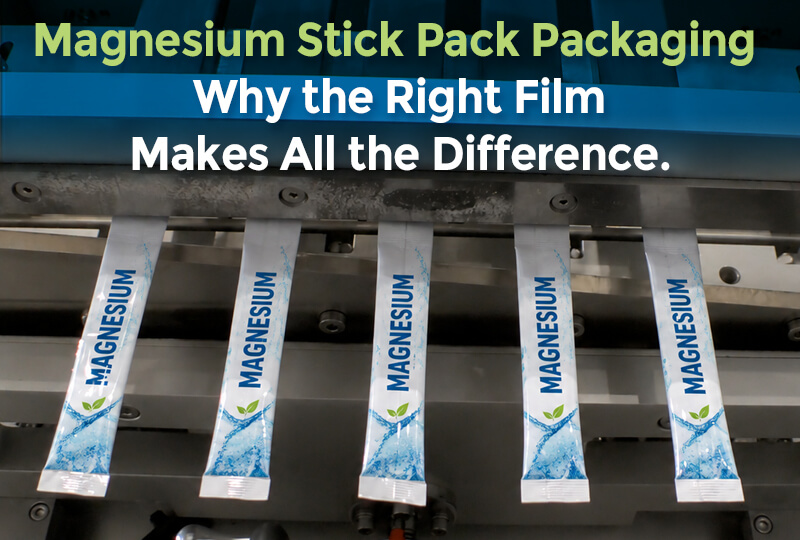
Packaging film for a magnesium stick pack has two jobs. It has to provide the protection the formulation requires throughout its intended shelf life, while also performing consistently as it moves through forming, filling, and sealing during production.
A film structure can meet the required barrier specifications and still create challenges on the packaging line. Sealing characteristics, coefficient of friction, thickness consistency, and dimensional stability can all influence how the material handles during production.
These considerations become increasingly important in multilane stick pack production, where one web of film is formed, filled, sealed, and cut across multiple lanes. Variations in film behavior can affect registration, sealing, and overall process consistency.
For magnesium drink mixes, film selection therefore requires more than identifying a suitable barrier structure. The material also needs to be evaluated for how reliably it can support the actual packaging process.
Table of Contents
Packaging Decisions That Can Limit Production
Decisions made when developing the stick pack can affect how the product runs once it reaches the packaging line. Serving size, stick dimensions, and film structure are not only package specifications; each places different requirements on the filling and packaging process.
Dose size influences the amount of product the filling system has to deliver during each cycle. Stick dimensions establish the package the machine has to form and fill. Film selection affects how the web moves through the machine, maintains registration, and responds during sealing. With fine or dusty formulations, controlling product around the seal area becomes another consideration.
Individually, these decisions may appear straightforward. Their effect becomes more important when production is distributed across multiple lanes, where filling, film movement, sealing, cutting, and discharge have to remain synchronized cycle after cycle.
For magnesium stick pack packaging, the package therefore has to perform both throughout its intended shelf life and on the production line.
When a Suitable Film Still Creates Production Challenges
A packaging film can meet the required specifications for a magnesium stick pack and still create challenges during commercial production.
Structures selected primarily for moisture protection may provide the required barrier but behave differently during sealing and web handling. Changes in film structure or gauge made to reduce material usage can also affect how the material behaves during web handling and sealing. A material that performs well during an initial trial may also require more adjustment when it is run for longer periods or across different rolls.
These issues are not always apparent during the initial film evaluation.
Short production trials do not reproduce every condition encountered during routine manufacturing. Changes in machine speed, material rolls, sealing conditions, and the production environment can all influence how consistently the film performs over time.
As a result, a film that performs well during qualification may become more difficult to manage during regular production.
The question is therefore not simply whether the film meets its technical specifications, but whether it can maintain the required performance throughout commercial production.
Where Film Properties Influence Magnesium Stick Pack Performance
Packaging film has to perform at several points in a magnesium stick pack’s lifecycle. It protects the powder during storage and distribution, but before it can do that, the material has to move through the packaging equipment, maintain its position, and form reliable seals.
These requirements are connected. A film structure selected for product protection also has mechanical and sealing characteristics that influence how it behaves during production. Material that is difficult to track, sensitive to changes in sealing conditions, or inconsistent from roll to roll can require more intervention even when its barrier properties are suitable for the product.
Film selection therefore requires barrier performance and production behavior to be evaluated together. A structure that provides the required product protection must also have the physical and sealing characteristics needed for repeatable stick pack production.
Step 1: Match the Film Structure to Magnesium's Requirements
The film structure for a magnesium drink mix should be selected around the level of protection the formulation needs throughout its intended shelf life.
Moisture is an important consideration because many magnesium salts and powdered drink mix ingredients can interact with moisture during storage. The required barrier, however, depends on the complete formulation, expected shelf life, and distribution conditions rather than magnesium alone.
Selecting the highest possible barrier is therefore not automatically the best approach. A higher-barrier structure may add material and cost beyond what the application requires, while insufficient protection can leave the product more vulnerable to moisture exposure during storage and distribution.
The objective is to select a film structure that provides the necessary product protection while remaining suitable for commercial stick pack production.
Step 2: Evaluate the Film Properties That Influence Stick Pack Production
Once the required film structure has been established, the next consideration is how the material will perform on the packaging line.
Sealing characteristics determine the range of conditions under which reliable seals can be formed. A narrow sealing window provides less operating latitude for variations in temperature, pressure, and dwell time, while a wider operating window gives the process greater flexibility during sustained production.
Coefficient of friction influences how the web moves through the packaging machine. If friction varies between rolls, web tension and tracking can change, which can affect registration and seal placement even when the machine settings remain unchanged.
Thickness consistency also affects web handling and sealing. Variations across the film or between rolls can change how the material responds as it moves through the machine and enters the sealing area.
Film stiffness and dimensional stability influence how consistently the web maintains its shape and position. Film that stretches, curls, or behaves differently as production continues can introduce additional variation into tracking and registration.
For magnesium stick packs, these properties should not be evaluated independently. Together, they determine whether the selected film can provide the required product protection while supporting consistent forming, sealing, and web handling throughout production.
Step 3: Validate Under Commercial Production Conditions
Film performance should be validated beyond the initial production trial.
A material that runs successfully for a short period may behave differently during longer runs, particularly as rolls are changed and normal variations in production conditions occur. These differences can reveal issues that are difficult to identify during initial qualification.
For magnesium stick packs, validation should confirm that the film continues to track consistently, maintain registration, and form reliable seals throughout the run. It should also show whether comparable performance can be maintained from one roll to the next without repeated changes to machine settings.
The goal is to establish that the film can support repeatable production under normal manufacturing conditions, not simply that it can produce an acceptable stick pack during a controlled trial.
Aligning Film Selection with Commercial Stick Pack Production
The final film specification should bring together the requirements established during development and validation rather than treating any single property as the deciding factor.
For a magnesium drink mix, that means defining the barrier needed for the intended shelf life, confirming that the structure can be converted into the required stick pack format, and establishing acceptable ranges for properties such as thickness, coefficient of friction, and sealing performance. These requirements can then become part of the film specification used when sourcing future rolls.
This is important because commercial production depends on receiving material that performs consistently from one order or production lot to the next. A successful trial has limited value if subsequent film varies enough to change how the packaging process behaves.
The result should be a film specification that can be reproduced by the supplier and reliably used in production, not simply a material that passed the original trial.
From Film Selection to Commercial Production
Moving from film selection to commercial production requires the material and packaging equipment to be evaluated as parts of the same system. Film trials can confirm how the selected structure behaves with the product, filling process, stick dimensions, sealing conditions, and required production rate before the final configuration is established.
Unified Flex evaluates these application requirements during system development to help manufacturers establish a practical path from initial testing to commercial stick pack production.
Conclusion
Film selection for magnesium stick packs ultimately comes down to balancing product protection with production performance. Barrier properties, sealing characteristics, thickness consistency, coefficient of friction, and dimensional stability all influence that balance, but their importance will vary with the formulation, package, equipment, and production requirements.
The objective is not simply to identify a film that can produce an acceptable package during a trial. It is to establish a film specification that can protect the product and perform consistently under commercial production conditions.
For manufacturers scaling magnesium stick pack production, that consistency is what turns a suitable film structure into a reliable part of the packaging process.