
How Do Salt Packaging Machines Handle Fine, Coarse, and Specialty Salt Without Product Loss?
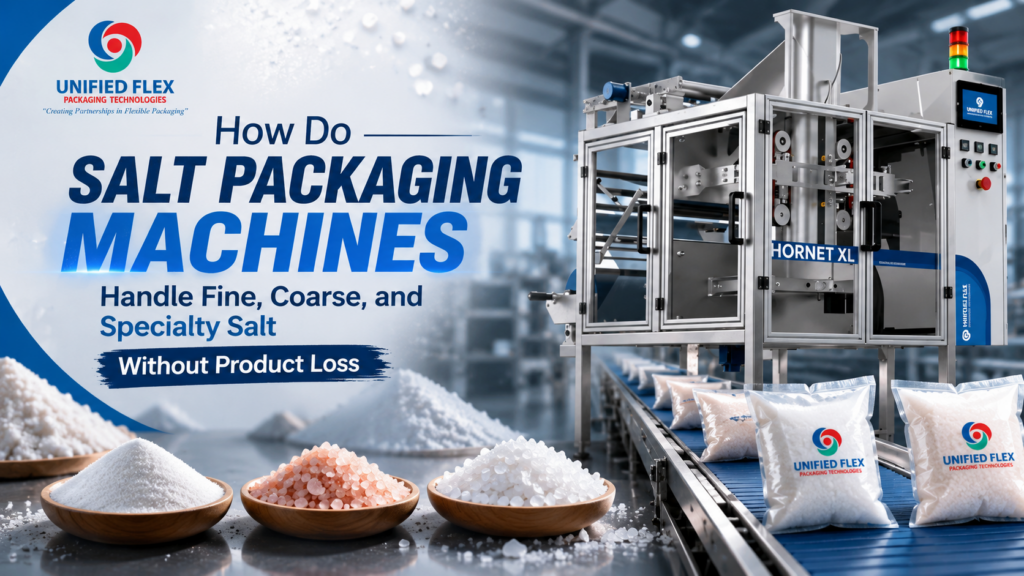
By Unified Flex Editorial Team | Reviewed by Packaging Engineering Specialists | July 2026
Salt presents several unique packaging challenges depending on its particle size, bulk density, flowability, moisture sensitivity, and abrasiveness.
Although it may appear to be a simple free-flowing material, different salt grades behave differently during packaging. These variations influence filling accuracy, product flow, and overall machine performance, while the abrasive nature of certain salt grades primarily contributes to long-term equipment wear.
For manufacturers, the challenge isn’t just filling bags; it’s doing so accurately and efficiently while minimizing product loss, downtime, and waste.
Flexible packaging machines like the VFFS Vertobagger Hornet XL from Unified Flex are engineered to address these challenges across fine, coarse, and specialty salt applications.
Table of Contents
Why Salt Requires Specialized Packaging Considerations
Unlike many dry products, salt presents multiple engineering considerations during packaging.
It is naturally hygroscopic, meaning it readily absorbs moisture from the environment. Certain grades exhibit very high flowability, while others are more prone to bridging, compaction, or inconsistent discharge. Coarser varieties are also highly abrasive, contributing to gradual wear of machine components over time and affecting long-term equipment reliability.
Product loss rarely stems from a single equipment failure. Instead, it develops from several interconnected process variables that gradually reduce Overall Equipment Effectiveness (OEE).
These include:
- Inconsistent product flow through the filling system
- Product bridging inside hoppers
- Overfilling caused by inaccurate dosing
- Dust contamination affecting seal integrity
- Moisture ingress leading to clumping
- Mechanical wear from abrasive salt particles
- Film misregistration and reject bags
- Extended changeover times between SKUs
An effective food powder packaging machine should be designed to address these process variables collectively rather than individually.
How Different Salt Grades Affect Packaging Performance
Not every salt behaves the same, which is why a single filling configuration rarely delivers optimal performance across multiple SKUs.
Salt Type | Engineering Challenge | Packaging Requirement | Unified Flex Solution |
Fine Table Salt | High flowability, dust generation, seal contamination | Precise auger filling, accurate sealing temperature | Servo-controlled filling for accurate dosing, supported by a precision sealing system for reliable seal integrity. |
Coarse Rock Salt | Large particle size, inconsistent feeding, abrasive wear | Controlled product discharge and durable construction | Stainless-steel machine design with stable product flow |
Himalayan Pink Salt | Heavy crystals and variable particle geometry | Accurate weight-based filling | Combination weighing with repeatable dosing accuracy |
Kosher Salt | Flake variation and inconsistent bulk density | Flexible filling configuration | Encoder-controlled bag formation combined with a configurable filling system to accommodate variations in bulk density |
Specialty Salt Blends | Mixed particle sizes, seasoning segregation, higher product value | Gentle product handling and configurable fillers | Modular filling systems with fast SKU changeovers |
Rather than applying a one-size-fits-all approach, Unified Flex automatic salt packaging machines are configured around the material characteristics of each product. Factors such as bulk density, particle morphology, flowability, and angle of repose are considered when selecting the appropriate filling technology, helping improve filling accuracy while minimizing product giveaway.
How Modern Salt Packaging Machines Minimize Product Loss
Successfully packaging salt requires more than simply forming, filling, and sealing a bag.
Product loss can occur at multiple stages of the packaging cycle, including product feeding, dosing, bag formation, sealing, and equipment changeovers. Modern VFFS packaging systems are engineered to control each stage of this process, ensuring consistent product quality while minimizing waste.
At Unified Flex, these engineering principles are integrated into the Vertobagger Hornet XL, combining application-specific filling systems, servo-driven automation, precision sealing, and intelligent controls to package fine, coarse, and specialty salts with greater efficiency.
The following engineering features work together to reduce product loss at every stage of the packaging process.
Precision Filling with Application-Specific Feeding Systems
One common cause of product loss is selecting a filling technology that is not well suited to the product being packaged.
Fine table salt is a free-flowing powder that moves readily through the filling system and may generate airborne dust, which can affect dosing accuracy if not properly controlled. Coarse salts and specialty blends behave differently because of their larger particle size and varying bulk density.
Rather than relying on a one-size-fits-all approach, Unified Flex integrates the Vertobagger Hornet XL with application-specific filling technologies such as auger fillers, combination weighers, volumetric cup fillers, and piston fillers. Matching the filling technology to the product’s flow characteristics can improve dosing accuracy, reduce spillage, and help minimize product giveaway.
Servo-Controlled Motion for Consistent Product Flow
Maintaining accurate product flow requires precise synchronization throughout the packaging cycle.
Some traditional mechanical packaging systems can develop inconsistencies as components wear or production conditions change, resulting in inaccurate fills, poor bag presentation, and unnecessary material waste.
The Vertobagger Hornet XL utilizes servo-controlled pulling belts, encoder-based bag length measurement, and photo-eye print registration to synchronize film advancement, product discharge, and bag positioning. This helps improve bag accuracy, reduce reject rates, and can contribute to improved Overall Equipment Effectiveness (OEE).
Precision Sealing for Moisture Protection
Salt is naturally hygroscopic, making seal integrity critical for preserving product quality.
Even minor variations in sealing pressure or temperature can allow moisture to enter the package, leading to clumping, shorter shelf life, and customer complaints.
The Vertobagger Hornet XL combines servo-controlled horizontal sealing jaws with digital temperature control to produce consistent, airtight seals. Optional ultrasonic sealing, poly sealing jaws, and nitrogen flushing further enhance package protection for moisture-sensitive salt products.
Durable Machine Construction for Abrasive Applications
Salt’s abrasive nature places continuous stress on packaging equipment, making durability an important consideration for long-term production efficiency.
To maintain consistent performance, the Vertobagger Hornet XL incorporates stainless-steel construction, self-aligning pulling belts, encoder-controlled positioning, one-piece forming collar assemblies, and tool-less changeovers. These engineering features minimize wear-related downtime while maintaining filling accuracy over extended production runs.
Intelligent Automation for Repeatable Performance
Operator setup variability is another common source of production inconsistency.
The Vertobagger Hornet XL minimizes manual intervention through a 10-inch Human Machine Interface (HMI) powered by an Omron PLC (Allen Bradley optional). Digital production recipes help operators quickly recall validated machine settings, reducing setup errors and supporting repeatable packaging quality across multiple shifts.
Fast Changeovers for Multi-SKU Production
Salt manufacturers frequently package multiple product types, bag sizes, and private-label SKUs on the same production line.
The Vertobagger Hornet XL is designed to support rapid product transitions through tool-less forming collar replacements, modular filling configurations, self-aligning components, and full 360-degree maintenance access. These features help reduce Mean Time to Changeover (MTCO), improve equipment utilization, and support greater production flexibility.
The Business Impact of Reducing Product Loss
Product loss in salt packaging is rarely caused by a single failure. More often, it results from small inefficiencies such as overfill, inconsistent product flow, seal defects, film waste, and lengthy changeovers. While these losses may seem minor individually, they can impact operating costs and profitability over high-volume production runs.
By reducing these inefficiencies, Unified Flex automatic salt packaging machines can help manufacturers improve Overall Equipment Effectiveness (OEE), minimize product giveaway, lower Total Cost of Ownership (TCO), and maintain consistent production quality.
As a versatile food powder packaging machine, the Vertobagger Hornet XL is engineered to handle both fine powders and granular food products with high accuracy and reliability.
Why the Vertobagger Hornet XL Is Ideal for Modern Salt Packaging
Modern salt manufacturers require flexible packaging machines that deliver accuracy, flexibility, and long-term reliability across a wide range of salt products and packaging formats.
The Vertobagger Hornet XL is engineered to help meet these demands with a modular design, application-specific filling options, and precision automation that minimizes product loss while maintaining consistent performance. From fine table salt and coarse rock salt to specialty blends, it provides the flexibility and efficiency needed to support today’s evolving production requirements.
If you’re looking to reduce product giveaway, improve packaging accuracy, and optimize production efficiency, Unified Flex can help. Contact our team to discuss your application and discover how the VFFS Vertobagger Hornet XL can be configured to meet your specific salt packaging requirements.