
How Does a Spice Filling Machine Accurately Handle Fine Powders, Coarse Blends, and Mixed Spices?
By Unified Flex Editorial Team | Reviewed by Packaging Engineering Specialists | Aug 2026
Ask any operations manager running a bulk spice line, and they’ll tell you the same thing: the hardest part of spice packaging isn’t the bag; it’s the product inside it. A facility might run turmeric one shift, a coarse peppercorn blend the next, and a seasoning mix with visible flakes later in the week. Each behaves differently inside the filler, and those differences are where packaging lines can lose accuracy, uptime, and product yield.
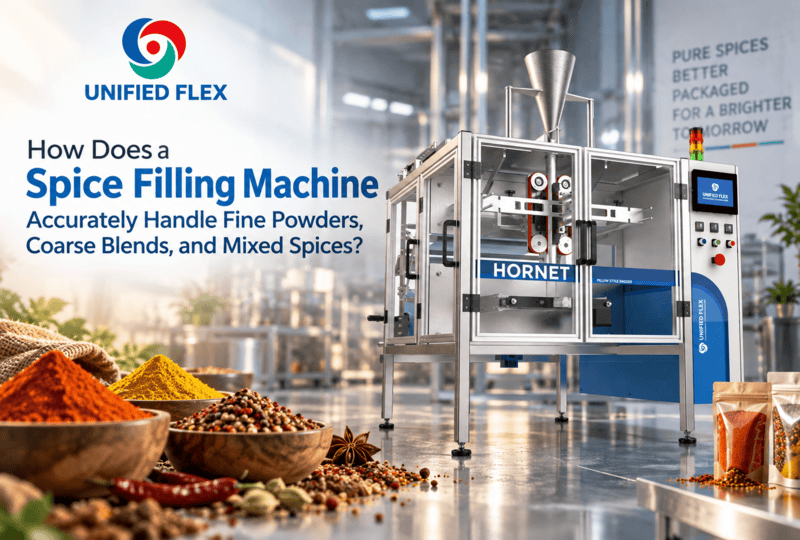
For business owners and engineers evaluating a spice filling machine, the real question isn’t “How fast can it run?” It’s “How consistently can it handle different product characteristics without turning every SKU change into a major adjustment?” That’s where filler selection, dust control, and machine design intersect, and where a well-configured vertical form fill seal machine such as the Unified Flex Vertobagger Hornet becomes valuable.
The Challenge: Three Products, Three Different Physics
Fine powders, coarse blends, and mixed spices don’t behave the same way once they start moving through a packaging line.
- Fine powders such as turmeric, cumin, and chili powder can aerate, compact, bridge inside hoppers, and generate airborne dust. Changes in bulk density can affect dosing consistency, while dust migrating into the sealing zone can interfere with seal formation.
- Coarse blends such as peppercorns, cracked spices, and dry rubs with larger particulates flow differently. Irregular particle shapes don’t always settle uniformly, meaning equal volumes may not consistently represent equal weights.
- Mixed spices introduce another challenge: segregation. Powders, herbs, flakes, and larger particles have different densities and can separate during conveying or hopper movement. Oil-bearing ingredients may also stick or clump, further affecting product flow.
For multi-SKU operations, this variability can turn routine changeovers into repeated adjustment cycles unless the filling system is configured around actual product behavior.
The Engineering Response: Match the Filling Method to the Spice
This is where filler integration matters more than headline speed. Effective flexible packaging machines need more than reliable bag formation; they must integrate with the appropriate dosing technology for the product being packaged.
The Unified Flex automatic spice packaging machine, the Vertobagger Hornet, can integrate with auger fillers, volumetric cup fillers, piston fillers, combination scales, and continuous pumps. That flexibility allows the filling method to be selected according to the product rather than forcing every spice through the same dosing principle.
An auger filler, for example, can provide controlled metering for many fine powders, while coarse or irregular blends may require a weighing or alternative dosing approach.
Importantly, fill accuracy depends on the complete filling system, including filler configuration, product density and flowability, target weight, calibration, and operating conditions. Application testing is therefore essential for establishing repeatable performance for each SKU.
Once the dose is delivered, the Hornet uses servo-controlled pulling belts, a servo-controlled horizontal seal, and digital temperature controllers to support stable film movement and consistent sealing conditions.
For engineers, that coordination is critical: accurate dosing means little if product dust, unstable film movement, or inconsistent sealing compromise the finished bag.
The Result: Fewer Failure Points, Not Just Faster Output
When the filling method matches product behavior and the VFFS process remains stable, the operational benefits extend beyond fill weight:
- More consistent package weights help reduce unnecessary product giveaway and underweight risk.
- Better control at the sealing stage helps reduce seal-related rework and downstream leakage.
- Reliable package integrity supports moisture protection, helping preserve flowability and aroma.
- 360-degree maintenance access and straightforward belt changeovers make routine cleaning and servicing more manageable in dusty spice environments.
For a facility running multiple spice SKUs, a properly configured automatic spice packaging machine creates a more repeatable process with less operator intervention after changeovers.
The Benefit: A Line That Adapts Instead of Fighting the Product
The advantage for business owners and operations managers isn’t that every spice behaves the same way. It’s that flexible packaging machines can be configured around those differences and specific production requirements.
Fine powders can be paired with controlled powder dosing. Coarse blends can use a filling method suited to irregular particle flow. Mixed formulations can be handled with greater attention to product presentation and segregation.
Combined with the Hornet’s controlled film movement, sealing, filler integration, and serviceability, this creates a packaging process built around repeatability rather than constant correction.
Where sanitation requirements are more demanding, Hornet Washdown configurations can also support easier cleaning between production runs.
Other Unified Flex Spice Packaging Machines
Beyond the Vertobagger Hornet, Unified Flex offers other vertical form fill seal machines that can be configured for spice packaging applications based on product characteristics, bag format, sanitation requirements, and production goals:
- VFFS Vertobagger 2.0
- VFFS Vertobagger 2.0 Ultrasonic
- VFFS Vertobagger Falcon
- VFFS Vertobagger Hornet Washdown
- VFFS Vertobagger Hornet XL
Selecting the right automatic spice packaging machine depends on spice flow characteristics, required fill weight, filling method, film structure, bag size, and production environment. Unified Flex can help determine which vertical form fill seal machine and configuration best fit the application.
What Accurate Spice Filling Means for Your Operation
Spice filling accuracy isn’t about one impressive number on a specification sheet. It’s about whether your line can package fine powders, coarse blends, and mixed spices while maintaining controlled dosing and reliable package performance.
That’s the standard an automatic spice packaging machine should be measured against.
With the appropriate filler and application-specific configuration, the Unified Flex Vertobagger Hornet provides the filling integration, film control, sealing consistency, and serviceability needed to support repeatable bulk spice packaging.
For operations teams managing multiple SKUs, that consistency means less product giveaway, fewer avoidable packaging failures, more predictable production, and better protection of the aroma, authenticity, and reputation behind every bag.
Your spice behaves differently. Your packaging system should be engineered accordingly.
Connect with Unified Flex to identify the right filling and VFFS configuration for consistent bulk spice packaging.