
How Smart Sensors and PLC Automation Improve Pharmaceutical Packaging Accuracy?
In pharmaceutical and nutraceutical manufacturing, a single milligram of deviation in dosing isn’t a quality issue; it’s a regulatory failure. Engineers, production managers, and business owners who run high-throughput packaging lines already know this. The question isn’t whether precision matters; it’s how to achieve and sustain it at scale.
The answer increasingly lies in two integrated technologies: smart sensors and programmable logic controller (PLC) automation. Together, they transform packaging lines from mechanically reactive systems into intelligent, self-correcting production environments.
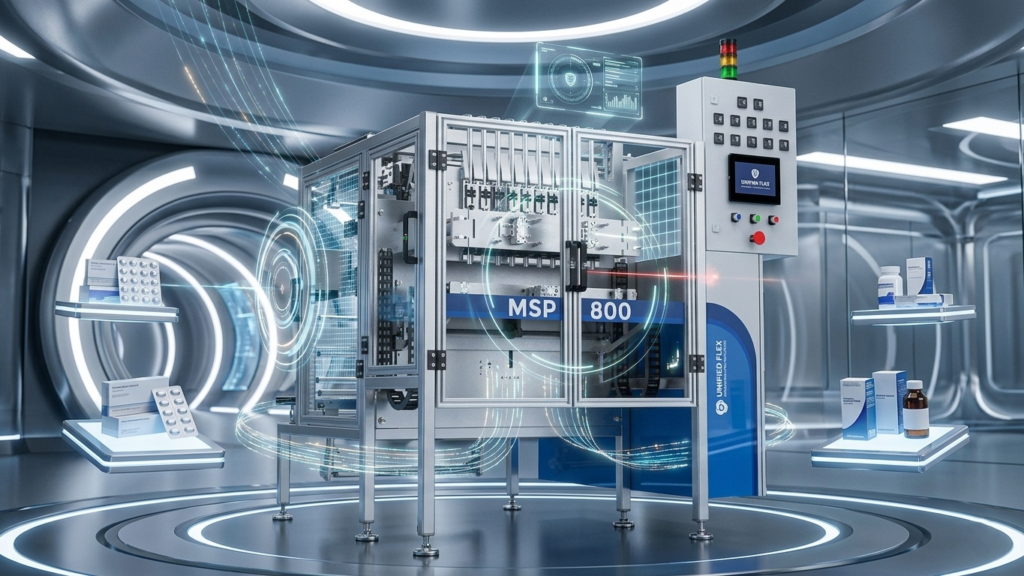
At Unified Flex, advanced pharma packaging machines integrate sensor-driven controls and PLC automation to support precision filling, reliable sealing, and scalable production performance.
This article explores how these technologies improve packaging accuracy and strengthen manufacturing efficiency.
Table of Contents
Why Packaging Accuracy Matters More Than Ever
Packaging errors in pharmaceutical and nutraceutical production have consequences far beyond material waste.
Common packaging issues include:
- Inconsistent fill weights across batches
- Incorrect dosing levels
- Seal integrity failures
- Misaligned pouches or labels
- Product contamination risks
- Excessive product giveaway
- Production downtime due to manual adjustments
For manufacturers handling powders, capsules, herbal formulations, functional supplements, and protein products, maintaining consistency across thousands of units per hour becomes a critical engineering challenge.
Packaging systems today must operate with measurable precision while maintaining throughput and regulatory compliance requirements.
To meet increasing accuracy and compliance demands, Unified Flex pharma packaging machines use intelligent automation to continuously monitor production variables and maintain consistent packaging performance.
The Role of PLC Automation in Pharmaceutical Packaging Systems
Programmable Logic Controllers (PLCs) function as the central processing system within automated packaging machinery. A PLC continuously monitors machine inputs, analyzes data, and executes control commands across the packaging line.
Unlike traditional systems dependent on operator judgment, PLC-based systems process operational data in milliseconds and automatically adjust machine behavior.
In pharmaceutical packaging applications, PLC systems control:
- Filling mechanisms
- Film movement systems
- Sealing temperatures
- Servo motor synchronization
- Conveyor operations
- Product indexing
- Sensor inputs
- Batch coding systems
Flexible packaging machines such as multilane sachet systems, VFFS equipment, stick pack systems, and stand-up pouch baggers increasingly depend on PLC architectures for production consistency.
The objective is simple:
Reduce process variability while increasing repeatability.
For operations managers, repeatability translates directly into predictable production performance and lower operational risk.
How Smart Sensors Improve Packaging Precision
Smart sensors serve as the eyes and feedback systems of high-performance flexible packaging machines.
Unlike conventional detection systems, modern industrial sensors continuously collect process data and communicate directly with PLC systems for immediate corrective actions.
Rather than identifying failures after they occur, sensor-driven packaging systems proactively prevent errors.
Bag Detection Sensors
Improper bag positioning frequently creates sealing defects and filling errors.
Bag detection sensors verify:
- Correct pouch placement
- Proper opening status
- Alignment accuracy before filling cycles
If misalignment occurs, the PLC can halt production or reject the cycle automatically.
Unified Flex systems incorporate bag detection technology to reduce product loss and eliminate improper fill-and-seal operations.
For high-speed packaging environments, this capability reduces rework and scrap rates.
Precision Fill Monitoring
Accurate dosing is particularly important in nutraceutical and pharmaceutical products where formulation consistency affects both efficacy and compliance.
Smart filling sensors integrated with:
- Auger fillers
- Piston fillers
- Volumetric cup systems
- Multi-head weighers
allow real-time measurement and adjustment of fill conditions.
For example, nutraceutical powders such as Ashwagandha often exhibit inconsistent flow behavior under humidity variation.
Without automated monitoring, manufacturers commonly encounter:
- Powder bridging
- Uneven lane performance
- Fill inconsistencies
- Material waste
Multilane systems such as the MSP series use synchronized monitoring technology to maintain dosing accuracy across multiple lanes simultaneously.
This ensures controlled and repeatable output even during high-speed production.
Case Example: Improving Fill Consistency for Ashwagandha Powder Packaging
Ashwagandha powder can behave unpredictably during production due to factors such as humidity changes and varying flow characteristics. In high-speed multilane packaging environments, these conditions may create uneven powder movement and lane-to-lane dosing variation.
To support more stable production, Unified Flex configured its MSP 440 Multilane Stick Pack system with synchronized lane monitoring and PLC-driven process controls. By combining sensor feedback with automated adjustments, the system helps maintain more consistent powder flow and repeatable fill performance across production runs.
This type of real-world application highlights how smart sensors and PLC automation can improve packaging accuracy while reducing process variability in nutraceutical manufacturing.
Sensor + PLC Integration Creates Closed-Loop Control Systems
The greatest advantage emerges when smart sensors and PLC automation operate together within a closed-loop control system.
- In traditional systems: Detect issue → operator notices → manual adjustment → production resumes.
- In smart systems: Detect issue → PLC analyzes → automatic correction → uninterrupted production.
This reduces dependence on manual intervention while improving consistency.
For engineers managing production efficiency, closed-loop automation improves:
- Overall Equipment Effectiveness (OEE)
- First-pass yield rates
- Machine uptime
- Changeover efficiency
- Process capability
Packaging becomes a controlled engineering process rather than an operator-dependent activity.
Intelligent Sealing Systems Reduce Product Integrity Risks
Seal quality remains one of the most critical performance indicators in pharmaceutical packaging.
Poor sealing creates risks, including:
- Moisture ingress
- Oxygen exposure
- Product degradation
- Reduced shelf life
- Consumer complaints
Advanced packaging systems now integrate:
- Temperature sensors
- Pressure monitoring systems
- Servo-controlled film tracking
- Digital sealing controls
These technologies maintain highly repeatable sealing conditions.
Unified Flex pharma packaging machines use controlled film movement and precision sealing technologies to support packaging consistency across stick packs, sachets, and pouch formats.
For products sensitive to oxygen exposure, optional vacuum systems and nitrogen flushing further protect formulation stability.
Automation Supports Regulatory Compliance
For pharmaceutical and nutraceutical manufacturers, packaging accuracy is closely linked to regulatory requirements.
FDA and GMP frameworks increasingly demand:
- Traceability
- Batch verification
- Label accuracy
- Date coding consistency
- Tamper-evident systems
Smart automation systems simplify compliance through integrated monitoring and data collection.
Packaging systems equipped with PLC controls can support:
- Batch tracking
- Production reporting
- Alarm history recording
- Error logging
- Process validation support
For business owners, this minimizes compliance risks while strengthening audit readiness.
Accurate packaging data also creates measurable operational visibility.
The Business Case: Accuracy at Scale
Packaging accuracy directly affects material costs, operational efficiency, and long-term profitability. For engineers, operations managers, and business owners, even small variations at the production scale can create measurable losses.
In high-volume flexible packaging machines, a 2–3% overfill can lead to significant product giveaway over time. Smart sensors and PLC automation help maintain precise dosing through real-time monitoring and process adjustments, reducing waste and improving consistency.
Seal failures create additional costs beyond scrap, including customer complaints, product returns, and potential brand impact. Sensor-PLC integration helps maintain stable sealing conditions and reduce process variation.
Smart automation also delivers broader operational benefits:
- Reduced product waste through improved fill consistency
- Lower labor dependency through automated process adjustments
- Faster changeovers across multiple SKUs
- Increased throughput with fewer process interruptions
- Improved scalability without proportional labor increases
At Unified Flex, pharma packaging machines integrate intelligent controls designed to reduce downtime, improve efficiency, and support reliable high-speed production performance. At scale, packaging accuracy becomes more than a quality metric; it becomes a business advantage.
Conclusion
Smart sensors and PLC automation aren’t upgrades to a packaging line; they’re the engineering foundation that makes precision packaging possible at production scale. For engineers, they mean tighter process control and faster diagnostics. For operations managers, they mean reduced downtime and measurable yield improvement. For business owners, they mean lower material waste, stronger compliance posture, and a packaging operation that scales with demand without sacrificing quality.
The nutraceutical market rewards brands that deliver consistency. The packaging line is where that consistency is either built or broken.
Ready to evaluate smart automation for your nutraceutical packaging operation? Contact Unified Flex to discuss your production requirements and find the right pharma packaging machines for your line.
This article was reviewed by Unified Flex packaging specialists with experience designing pharmaceutical and nutraceutical packaging systems.