
In Bulk Food Packaging, Reliability Lives in the Bag
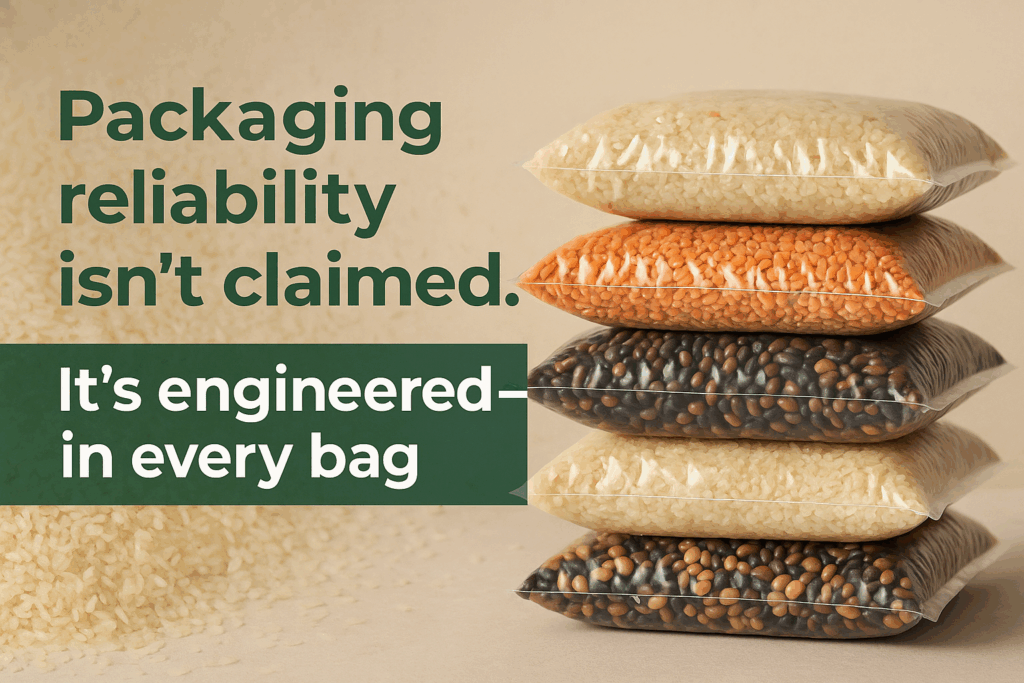
On a bulk food packaging floor, reliability isn’t measured by speed or output; it’s measured by what survives the journey. Every sealed bag on a pallet carries weight, literally and figuratively. Ten kilograms of flour, beans, or rice in each package might not sound demanding, but together, they test every layer of material, every seam, and every design assumption.
When a bag splits, leaks, or collapses, the problem isn’t cosmetic; it’s structural. That’s why in bulk food packaging, the real test starts and ends with the bag itself, its structure, its material, and its ability to endure pressure, moisture, and time.
And among all formats, the pillow bag remains the most reliable, not because it’s the simplest, but because it’s the one built to perform under stress.
The Physics of Bulk Packaging
Packaging for dry bulk products operates under a different kind of stress. Weight is constant, product flow is unpredictable, and storage time is long. Beans and lentils shift and settle; flour and starch release fine dust; rice absorbs and releases moisture depending on its environment.
Every one of those variables affects how a bag behaves, how the film stretches, how the seal holds, and how the structure responds to stacking. Bulk packaging is not decorative; it’s structural engineering in flexible form. When done right, it doesn’t just contain product; it preserves value.
Challenges in Bulk Food Packaging
Seal Contamination and Strength Drift
Fine powders and grains release dust that can migrate into the seal area. Even a trace of residue between layers of film weakens fusion and allows oxygen or moisture to sneak through over time. In high-speed packaging lines, fluctuating temperature or pressure can amplify this effect, causing tiny leaks that only reveal themselves weeks later.
The packaging solution must therefore deliver seal reliability even under imperfect conditions, films that fuse cleanly, resist contamination, and retain strength through the full storage cycle.
Material Stress and Film Deformation
In bulk food packaging, every bag is a load-bearing structure. Under stacked conditions, the bottom layer supports the combined weight of everything above it. Films that are too stiff crack at the seams; those that are too flexible lose their shape and collapse under compression.
Reliability depends on a balance of tensile strength from the structural layers and elasticity from the inner sealant layer. When both work in harmony, the film flexes underweight without losing form, maintaining stability across long shipping and storage cycles.
Barrier and Moisture Resistance
Moisture and oxygen are silent enemies of dry goods. They cause clumping, spoilage, and a dulling of flavor and color over time. Traditional mono films often allow slow vapor transfer that shortens shelf life.
Modern multi-layer laminations solve this with barrier materials like EVOH, PVDC, or metalized films that block both oxygen and moisture at the molecular level. These films maintain freshness and prevent product degradation even in humid or fluctuating environments, a requirement for long-term bulk food packaging storage.
Dimensional Stability and Palletization
After sealing, the challenge shifts from containment to stability. Bags must hold their shape during palletizing, wrapping, and transport. Small variations in film thickness or surface friction can cause sliding or collapse in stacked loads.
Controlled film stiffness and consistent surface COF (coefficient of friction) create predictable stacking behavior. The result is reliable pallet geometry, no shifting, no deformation, no wasted product during distribution.
Sustainability Pressure
Sustainability adds a new layer of complexity to bulk food packaging. Processors are expected to use less material and more recyclable structures, but reducing film gauge narrows the margin for error. Thinner films can stretch underweight or lose their seal integrity if not carefully balanced. The solution isn’t to overbuild the package; it’s to design smarter, more efficient structures that maintain protection with less material.
The Pillow Bag: Reliability Engineered in Three Seals
Geometry That Works Under Pressure
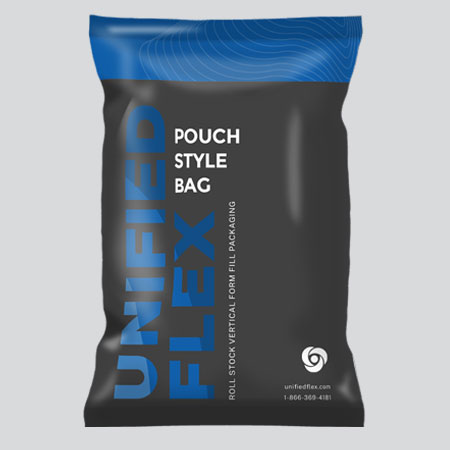
The pillow bag remains a mainstay in bulk food packaging because its design distributes stress evenly. The central back seal carries vertical load, while the two cross seals flex slightly to absorb compression. This creates a balanced structure that resists splitting and deformation during stacking and transit.
Its simplicity is deceptive; every fold, every weld line contributes to how the bag handles mechanical pressure. Fewer seams mean fewer failure points. In bulk packaging, that simplicity is precision by design.
Film Architecture: The Backbone of Reliability
Modern pillow bags are built from films that act as multi-layer systems, each layer engineered to handle a specific performance demand.
- Outer Layer: Provides stiffness, print clarity, and abrasion resistance.
- Barrier Layer: Uses EVOH, PVDC, or metalized material to block oxygen, vapor, and light.
- Sealant Layer: Typically LDPE or CPP, ensuring flexibility and a clean seal even under dust exposure.
Together, these layers behave as one cohesive structure. They bend under pressure but don’t crack, flex underweight but don’t stretch permanently. This balance between rigidity and resilience defines the bag’s strength, not by chance, but by composition.
Controlled Sealing for Consistency
In bulk packaging, sealing reliability is a process discipline as much as a material property. Controlled heat, dwell time, and film tension determine whether a seal fuses cleanly or weakens under load. Pillow bags perform well here because their structure supports uniform pressure across the sealing zone.
By maintaining consistent film alignment and balanced thermal response, pillow bags achieve durable seals that withstand the combined stress of filling, stacking, and long-term storage, without adding complexity to the process.
Packaging Stability Across Product Types
A single packaging format must often handle multiple products, fine powders, coarse grains, or round legumes. Each behaves differently during filling and settling. The pillow bag’s form accommodates that variability naturally. Its flexible structure adjusts to product density, maintaining shape and closure integrity regardless of how the contents shift or compact over time.
That adaptability makes it not just a reliable format, but a versatile one, suited to nearly every bulk food packaging environment.
Sustainability That Works on the Floor
Sustainability succeeds when it supports production reality. Pillow bags use less film per unit than complex pouch styles, minimizing waste without compromising protection. When manufactured from downgauged or recyclable PE-based laminations, they further reduce material consumption while maintaining sealing performance.
Fewer seams, fewer joins, and a continuous film web mean less energy per seal and fewer opportunities for product loss. For processors, that’s sustainability that delivers measurable efficiency, not marketing rhetoric.
Conclusion: The Bag Tells the Truth
Reliability in bulk food packaging isn’t determined by marketing claims, it’s proven by the packaging itself. Every bag that holds shape, keeps its seal, and protects its contents is evidence of design integrity.
The pillow bag remains the standard not because it’s old, but because it’s engineered for the realities of bulk production: constant pressure, variable conditions, and high expectations for quality. Its strength lies in its geometry, its endurance in its material structure, and its dependability in how it performs shift after shift.
In the end, reliability doesn’t just live in the bag; it’s built into every layer, every seal, and every shipment that arrives exactly as it should.