
Keto Protein Powder Packaging: Are Manufacturers Overlooking the Potential of Stick Packs?
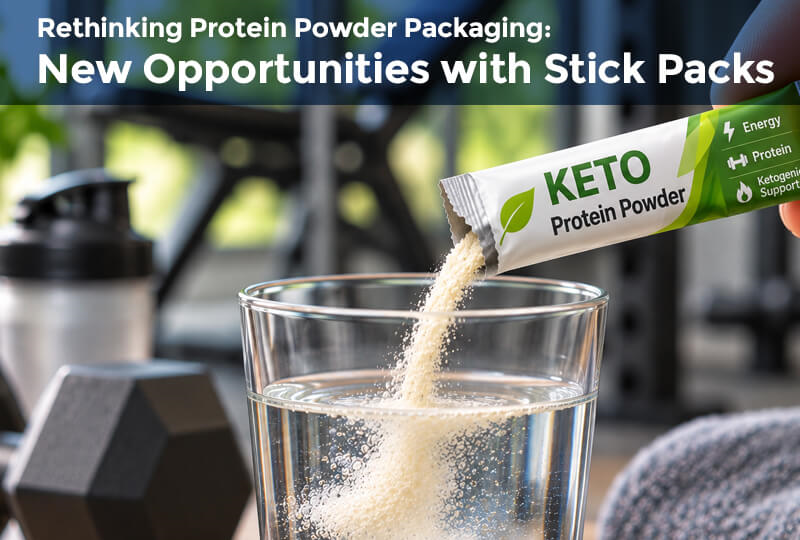
In the competitive keto protein powder market, developing a differentiated formulation is no longer the only way for manufacturers to compete. How a product is portioned, packaged, and positioned can influence which consumer needs it serves and which market opportunities a brand can pursue.
Consider the growing range of nutritional powder applications, from protein-enriched coffee and hydration blends to targeted keto supplements and single-serving nutritional products. Each represents an opportunity to develop products around specific consumption occasions rather than relying solely on traditional product categories. For manufacturers, the question is not simply whether they can formulate these products, but whether their packaging strategy allows them to pursue these opportunities effectively.
Stick packs can support this approach by enabling premeasured formulations designed around specific serving requirements and preparation methods. But their suitability depends on decisions involving powder characteristics, serving volume, package dimensions, and consumer usability.
While manufacturers continue competing through new ingredients and formulations, they may be overlooking another avenue for differentiation: developing products around the capabilities of the packaging format itself. The risk is that commercially promising product concepts remain unexplored while competing brands find ways to serve those applications.
Table of Contents
How Serving Size Influences Product Positioning
In nutritional powder development, serving size is generally established around the intended nutritional contribution of the product. However, serving size also influences packaging feasibility and how the product can be positioned.
Consider two different nutritional powder applications: a protein-enriched hydration powder designed to contribute a modest amount of protein to a beverage, and a meal-replacement formulation intended to deliver a more substantial quantity of nutrients. Both may be suitable for individual servings, but their packaging requirements can be considerably different.
The hydration formulation may occupy a relatively small volume, making a narrow stick pack a practical option. The meal-replacement formulation may require a substantially larger powder quantity, creating limitations around package dimensions and consumer handling.
This distinction becomes especially important in the keto market, where formulations may include combinations of fats, proteins, electrolytes, fiber, and other functional ingredients. Different ingredient compositions can influence both the required serving weight and the physical volume occupied by the powder.
Serving Architecture as a Product Development Decision
Manufacturers evaluating stick packs should consider how the intended nutritional function relates to the amount of powder required per serving.
For example, a formulation intended to deliver a smaller, targeted nutritional contribution may offer greater flexibility in stick pack dimensions than one intended to replace an entire meal.
This does not mean reducing serving sizes simply to fit a preferred package. Nutritional objectives, labelling requirements, and intended use must remain central to formulation development.
Instead, the opportunity lies in identifying product concepts where the intended serving and the physical packaging format are compatible from the beginning.
When serving architecture and packaging feasibility are evaluated together, manufacturers can make more informed decisions about which product concepts are practical to develop.
How Stick Packs Can Create Opportunities for Product Portfolio Expansion
Stick packs can also influence how manufacturers structure and differentiate their nutritional powder portfolios. Rather than treating every formulation as a variation of the same product, manufacturers can consider whether individually portioned packaging supports distinct applications, product configurations, or customer requirements.
For example, a brand could develop a range of targeted nutritional powders, each designed around a specific serving requirement.
One formulation might focus on protein supplementation, another on electrolyte replenishment, and another on a keto-oriented nutritional application.
Where the serving volume and powder properties permit, stick packs could provide a common packaging format across these offerings.
This approach can support product differentiation while giving the brand a recognizable packaging identity.
Exploring Trial Packs and Product Assortments
Individual packaging also allows manufacturers to explore different commercial configurations. A product line could include single-flavor cartons, multi-flavor assortments, or smaller trial quantities.
These configurations can be useful when introducing unfamiliar formulations or developing products for customers who want to evaluate flavor and preparation characteristics before committing to a larger purchase.
For example, a manufacturer could develop a 10-gram unflavored protein powder stick pack designed to be mixed into morning coffee, yogurt, or smoothies. Rather than positioning the formulation as a conventional protein shake, the manufacturer could offer it as a way for consumers to add protein to foods and beverages they already consume. This creates an opportunity to develop a product around a specific usage occasion, with the serving size and packaging format designed to support that application.
Such examples illustrate that stick packs are not limited to one type of nutritional powder or preparation occasion.
However, portfolio expansion introduces additional considerations. More formulations and package configurations may increase inventory requirements, packaging material variations, production changeovers, and SKU management complexity.
The commercial opportunity therefore needs to be evaluated alongside the operational implications.
The objective is not to create more product variations simply because the format permits them. It is to identify differentiated offerings that serve a defined customer requirement and justify their production costs.
Why Powder Properties Matter in Stick Pack Design
In protein powder packaging, serving weight alone does not determine the space required inside a stick pack. Differences in bulk density, particle characteristics, and flow behavior can significantly influence package dimensions and filling requirements.
A 2019 study published in the Journal of Food Engineering examined whey protein concentrate ingredients and found that differences in composition and microstructure influenced their bulk density, cohesiveness, and rehydration properties.
These findings highlight why manufacturers cannot determine stick pack suitability from serving weight alone. The physical characteristics of the formulation also influence the space required to accommodate a serving and how the powder behaves during handling.
The Relationship Between Bulk Density and Package Dimensions
Consider two hypothetical protein powders, each requiring a 25-gram serving. If Powder A has a loose bulk density of 0.40 g/mL, its approximate volume would be:
25 ÷ 0.40 = 62.5 mL
If Powder B has a loose bulk density of 0.60 g/mL, its approximate volume would be:
25 ÷ 0.60 = 41.7 mL
Although both formulations have the same serving weight, Powder A occupies approximately 50% more volume than Powder B. That difference can significantly influence the required stick pack dimensions.
The calculated powder volume is also not the same as the total internal package volume required. Manufacturers must account for the space needed during filling and for forming reliable seals. Powder settling, compressibility, and the conditions under which bulk density is measured can further influence package sizing.
A narrow stick pack may therefore accommodate one formulation comfortably while requiring different dimensions, or proving unsuitable, for another formulation of equal weight.
Flowability Adds Another Layer of Complexity
Powder behavior also affects packaging feasibility. Some protein powders flow relatively freely, while others may exhibit cohesiveness, bridging, or inconsistent movement under certain conditions. Ingredient composition, moisture content, particle size, and powder processing can all influence these characteristics.
For manufacturers, this means that the physical behavior of the formulation should be evaluated before finalizing the packaging concept.
Designing Stick Packs Around the Consumer's Preparation Experience
Packaging feasibility does not end when the required quantity of powder fits inside the package. The stick pack must also support how the consumer is expected to prepare and use the product. This is particularly relevant for nutritional powders intended to be mixed with water, milk, or other liquids.
An elongated package may offer advantages when dispensing powder into certain bottle or shaker openings. However, the effectiveness of that design depends on several interacting factors.
Opening Design and Powder Discharge
The opening created by a tear notch must be large enough to allow the powder to discharge effectively. For relatively free-flowing powders, a narrow opening may provide sufficient control during pouring. More cohesive formulations may behave differently. Powder can adhere to the internal packaging surfaces or require additional shaking and squeezing to empty. This creates a potential mismatch between the package’s visual design and its practical performance.
A stick pack may contain the correct serving weight but still be difficult to empty completely. For manufacturers, that raises an important question: Is the package designed only to accommodate the intended serving, or also to help the consumer transfer that serving effectively?
Evaluating opening dimensions, tear behavior, residual powder, and compatibility with the intended preparation container can help identify usability issues before commercialization. These considerations are especially relevant when developing formulations intended for repeated daily use, where small preparation difficulties may become recurring frustrations.
What Manufacturers Risk Overlooking When Evaluating Stick Packs
The commercial value of stick packs also depends on whether the packaging format supports a viable product concept. When packaging feasibility is assessed only after formulation development, manufacturers may encounter constraints that require changes to serving quantities, package dimensions, or the intended product configuration.
For example, a manufacturer could develop a protein formulation around a particular nutritional target and later discover that its required serving volume is impractical for the desired narrow stick pack.
At that stage, the available options may involve revisiting the formulation, selecting a different package size, or reconsidering the packaging format. These changes can affect development schedules, packaging specifications, and the commercial positioning of the product. Earlier feasibility assessment does not eliminate these challenges, but it can help manufacturers identify them while more design options remain available.
Looking Beyond Packaging Cost Per Unit
Another consideration is how manufacturers evaluate the economics of individually portioned packaging. Stick packs introduce material and production costs that must be assessed carefully. However, evaluating the format only on packaging cost per serving may overlook its potential contribution to product differentiation.
For example, an individually portioned formulation might support a specialized product offering, a trial assortment, or a distribution opportunity that requires premeasured servings. Whether these applications justify the additional costs depends on demand, pricing, production volume, and the manufacturer’s commercial objectives. There is no guarantee that a stick pack offering will generate incremental sales or improve profitability.
The more useful question is whether the format enables a commercially attractive product proposition that would be difficult to deliver in the same way otherwise.
Manufacturers who evaluate packaging only after finalizing the product concept may miss opportunities to align formulation, serving requirements, and market positioning from the outset.
Making Packaging Part of the Product Development Strategy
For keto and protein powder manufacturers, stick pack packaging should be evaluated as more than a final production decision. The format can influence serving architecture, product configurations, preparation experience, and the feasibility of bringing certain formulations to market.
However, these opportunities must be balanced against the physical characteristics of the powder, package dimensions, production requirements, and commercial economics.
Not every nutritional powder is suitable for a narrow stick pack, and not every product benefits from being individually portioned.
The opportunity lies in identifying applications where the formulation, serving size, packaging format, and intended consumer experience support one another.
As manufacturers develop new nutritional powder products, considering stick pack feasibility earlier can help reveal practical constraints and potential product opportunities before major development decisions are finalized.
The question is not simply whether an existing formulation can fit into a stick pack. It is whether designing the formulation and packaging together could lead to a more commercially relevant product.
Unified Flex Packaging Technologies provides automated stick pack packaging solutions for powdered products. Our team can help manufacturers evaluate their packaging requirements and identify equipment options suited to their applications.