
What Makes the MSP 800 Suitable for High-Speed Magnesium Hydroxide Stick Pack Packaging?
By Unified Flex Editorial Team | Reviewed by Packaging Engineering Specialists | September 2026
Magnesium hydroxide is challenging to package at high speed because moisture, formulation changes, and fine particles can affect powder flow, dosing, and seal quality.
For engineers and operations managers, the key requirement is consistent dosing, stable film movement, and reliable sealing across multiple lanes.
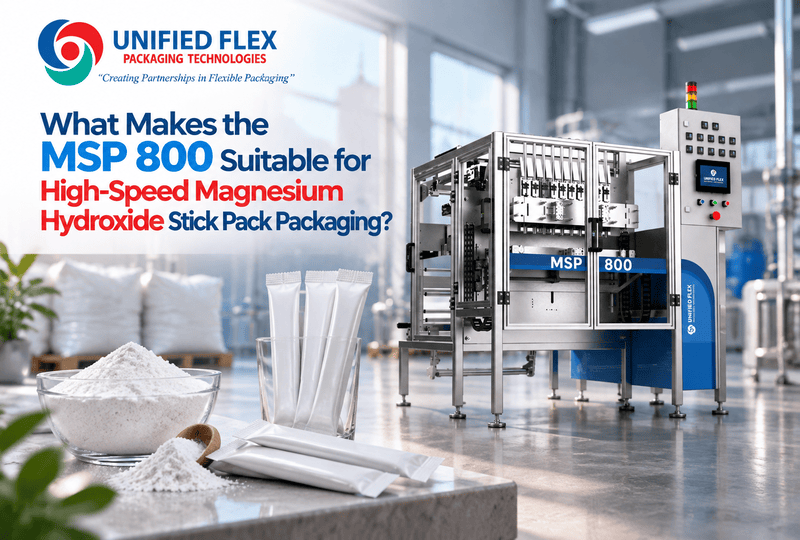
The Multilane Stick Pack – MSP 800mm from Unified Flex is designed for these demands, supporting up to 16 lanes and production speeds of up to 800 stick packs per minute.
Note: Actual production speed depends on product characteristics, fill weight, stick pack dimensions, film structure, filler configuration, sealing requirements, and validated operating parameters.
Table of Contents
Why Magnesium Hydroxide Is a Demanding Powder to Package
Before evaluating a magnesium hydroxide powder filling machine, it is important to understand how the powder behaves on the production line.
- Moisture sensitivity: Magnesium hydroxide can absorb moisture from the surrounding environment, contributing to clumping and changes in powder flow.
- Formulation variability: Flavor systems, additives, particle size, and formulation changes can alter how the powder behaves during filling.
- Fine-particle dusting: Fine powders may generate dust during dispensing. If powder reaches the sealing area, maintaining clean seals can become more difficult.
- Bulk-density variation: Changes in density and powder presentation can influence the amount of product delivered during each auger cycle.
These challenges are not solved by one machine feature. High-speed magnesium hydroxide packaging requires coordinated control over filling, film handling, sealing, and machine motion.
Why Stick Packs Make Sense for Magnesium Hydroxide
For manufacturers evaluating packaging formats, stick packs offer several practical advantages when single-dose presentation is required. A stick pack packaging machine can support efficient multilane production while producing a compact, retail-ready package format.
Feature | Magnesium Hydroxide Stick Packs | Bottles | Jars |
Portability | Single-dose and easy to carry | Bulkier multi-dose format | Less practical for on-the-go use |
Storage & Shipping | More space-efficient format | Requires more storage space | Higher storage footprint |
Dose Control | Pre-portioned single-dose format | Requires measuring the dose | Requires measuring the dose |
Dispensing Method | Tear and pour | Pour from bottle | Scoop from container |
Packaging Efficiency | Typically uses less packaging material | More packaging material per serving | Uses more packaging material |
For business owners, flexible stick packs can provide material and logistics efficiencies compared with many rigid packaging formats. The actual cost advantage depends on film structure, secondary packaging, production volume, sourcing, and distribution requirements.
For operations teams, stick packs can be produced across multiple lanes, making the format well suited to higher-volume retail, pharmacy, multipack, and direct-to-consumer programs.
Engineering Features That Address Magnesium Hydroxide’s Challenges
The following MSP 800 features help address the key filling, sealing, film-handling, and process-control challenges associated with high-speed magnesium hydroxide packaging.
Independent Auger Control Supports Lane-to-Lane Dosing Stability
For magnesium hydroxide powder, an auger-based filling system is typically appropriate because it provides controlled volumetric dosing for powders that may not behave like highly free-flowing granules.
On a multilane machine, one of the engineering concerns is lane-to-lane variation.
Minor differences in powder presentation, density, or feed behavior can influence how much material reaches individual dosing screws. The Multilane Stick Pack – MSP 800mm addresses this through independent servo-controlled auger screws, allowing dosing adjustments to be made at the lane level rather than forcing operators to compensate across the complete filling system.
Mixing blades within the auger filler can also help maintain more consistent powder presentation to the dosing screws.
Why That Matters to Your Production Team
- For the engineer, lane-level adjustment provides another control point during setup and validation.
- For the operations manager, it can make troubleshooting more targeted when a particular lane begins moving away from the required fill parameters.
- For the business owner, better process control supports the larger objective: producing saleable product at high output without allowing speed to create unnecessary waste or rework.
Per-Lane Temperature Control Helps Protect Seal Performance
Filling the correct quantity is only part of a successful magnesium hydroxide stick pack.
The package still needs a dependable seal.
Fine powder can migrate toward the sealing area, while film characteristics, web conditions, operating speed, and temperature distribution can all affect seal response. On wide-web multilane equipment, one section of the machine may occasionally require a slightly different adjustment than another.
The MSP 800 provides independent temperature control per lane, enabling sealing parameters to be adjusted with greater precision.
Instead of changing one global setting and potentially disturbing lanes that are already performing correctly, operators have greater ability to address localized sealing behavior.
That becomes increasingly valuable as production rates rise and the available sealing window becomes tighter.
Synchronized Servo Motion Supports High-Speed Operation
High throughput only creates value when the packaging process remains synchronized.
At higher cycle speeds, there is less time for every mechanical event. Film feeding, filling, indexing, sealing, and cutting must occur according to precisely coordinated timing sequences.
The Multilane Stick Pack – MSP 800mm uses electronically geared motion control with synchronized servo motors to coordinate these machine functions.
This is particularly relevant for operations teams because high-speed packaging instability is often not caused by one isolated component. It may develop from the interaction between multiple events.
A controlled motion platform helps maintain repeatable machine timing as the line moves toward production-scale output.
Servo-Controlled Film Handling Improves Wide-Web Stability
A machine operating across as many as 16 lanes must manage a comparatively wide film web.
That introduces additional considerations around:
- Film tension
- Registration
- Alignment
- Repeatable movement
- Positioning across forming collars
The MSP 800 incorporates a servo-controlled film pulling mechanism to maintain consistent web movement, while digital film alignment to the forming collars supports more stable film positioning across the forming section.
For an operations manager, stable film handling can mean fewer interventions related to tracking.
For engineering teams, it provides more control when establishing production parameters for a specific film structure and stick pack dimension.
MSP 800 Control Map for Magnesium Hydroxide Production
Production Challenge | Why It Can Occur | MSP 800 Control Feature |
Lane-to-lane fill variation | Bulk-density and powder-feed changes can affect individual dosing screws | Independent servo-controlled augers and filler mixing blades |
Seal performance drifts on one lane | Localized powder, film variation, or thermal conditions can change seal response | Independent temperature control per lane |
Seal consistency becomes harder at higher speeds | Higher output reduces available dwell time and tightens machine timing | Electronically geared motion and synchronized servo motors |
Film tracking affects multiple lanes | Wide webs are sensitive to tension and alignment changes | Servo-controlled film pulling and digital film alignment |
Horizontal seal maintenance must be planned | Seal-actuation design affects maintenance procedures | Pneumatic horizontal sealing mechanism |
Replacement-part delays extend downtime | Proprietary components can increase sourcing lead times | Off-the-shelf, non-proprietary North American components |
Powder accumulation develops over long runs | Fine powders can accumulate around packaging equipment | Stainless steel and anodized aluminum construction supports cleaning and durability |
The Stick Pack Format Supports the Business Case, Not Just the Machine
Selecting the right equipment should also support the product’s commercial format.
Compared with many bottles and jars, magnesium hydroxide stick packs provide several practical advantages.
A single stick can contain a pre-portioned dose, eliminating the need for the consumer to measure powder from a larger container. The slim format is portable, easier to integrate into multipacks, and suitable for pharmacy, retail, and direct-to-consumer distribution.
Flexible stick packs can also use less packaging material than many rigid multi-dose packages and can improve storage and shipping efficiency because rollstock and finished stick packs can occupy less space than many rigid containers.
For business owners, this means the packaging investment can support more than production speed. It can support unit-dose positioning, distribution efficiency, and a compact retail presentation.
Maintenance Accessibility Matters When You Are Producing at Scale
A high-speed stick pack packaging machine only creates value when it can maintain reliable production and return to operation efficiently after routine maintenance or unexpected stoppages.
The MSP 800 is constructed using stainless steel and anodized aluminum and is designed around commercially available, non-proprietary components where applicable.
Routine maintenance still requires proper cleaning, inspection, and lubrication according to the machine’s maintenance schedule. For magnesium hydroxide and other fine powder applications, cleaning practices are especially important because powder can gradually accumulate in the filling and packaging areas during extended operation.
Using more readily sourceable components can also help maintenance teams reduce dependence on difficult-to-obtain proprietary replacement parts.
For operations managers, this directly affects one of the most important production metrics: recoverability after maintenance or an unexpected stoppage.
Why Work With Unified Flex for Magnesium Hydroxide Stick Pack Packaging?
Unified Flex develops flexible packaging automation for powder, granular product, and liquid applications, including multilane stick pack systems such as the MSP 800. For magnesium hydroxide projects, the objective is to configure the magnesium hydroxide powder filling machine around the product’s actual behavior rather than forcing the formulation into a generic packaging setup.
Important application variables should be evaluated before finalizing the line, including:
- Required dose and target fill-weight tolerance
- Powder particle size and bulk density
- Flow and dust characteristics
- Desired stick pack dimensions
- Film structure and seal requirements
- Target production speed
- Number of lanes
- Auger filler configuration
- Downstream secondary packaging requirements
That application-level evaluation is particularly important for magnesium hydroxide because two formulations carrying the same product name may behave differently once they enter a high-speed filling environment.
Building a More Stable Magnesium Hydroxide Stick Pack Line
The MSP 800 is suited for high-speed magnesium hydroxide packaging because it combines lane-level dosing and temperature control, synchronized servo motion, stable film handling, and output of up to 800 stick packs per minute.
For engineers, this supports process optimization; for operations managers, more consistent lane performance; and for business owners, scalable unit-dose production. The final configuration should be validated through application review and product testing.
Planning a magnesium hydroxide stick pack line? Unified Flex can help evaluate your powder characteristics, target dose, film structure, stick pack dimensions, required throughput, and filling configuration to determine whether the MSP 800 is the right platform for your production requirements.