
Nuts Packaging Machine: Designing Stable Packaging Lines for Almonds, Cashews, and Trail Mix Production
If you run almonds, pistachios, cashews, or trail mix on a packaging line, the first day is rarely the problem.
The real test comes later, after extended shifts, film roll changes, and multiple changeovers, when different nut blends move through the line and production targets increase while the packaging system is expected to maintain consistent pouch geometry and seal integrity. That is where a nuts packaging machine proves its value.
Nuts are mechanically simple products to fill, but they are unforgiving of inconsistency. Almonds and peanuts are dense and transfer load through the pouch. Pistachios can distribute unevenly inside the bag. Trail mixes contain ingredients of different sizes that settle during filling and vibration. Over thousands of cycles per hour, small variations in forming alignment, film indexing, or seal engagement begin to matter. At that point, the question is not peak speed. It is repeatability.
A stable nuts packaging machine must reproduce the same pouch geometry, filling cycle, and sealing event consistently across long production runs.
Table of Contents
Application Reality: What Nut Products Actually Require
Whole Nuts
Whole nuts such as almonds, peanuts, and pistachios behave as dense particulate products. During filling, the product settles naturally inside the pouch and transfers load through multiple contact points between kernels.
This means the pouch structure itself becomes part of the load-bearing system during distribution.
In pillow bag packaging formats, forming consistency is critical. If bag length varies or seal placement drifts, pouch presentation gradually changes across production runs.
Whole nuts do not require complex handling systems.
They require stable forming, consistent indexing, and repeatable sealing across thousands of mechanical cycles.
Trail Mix and Blended Products
Trail mixes introduce a different mechanical profile.
Because the product contains ingredients with different densities, internal distribution can vary from cycle to cycle. Heavier components settle toward the bottom of the pouch while lighter ingredients shift during vibration and transport.
When pouch geometry changes slightly, those variations become more visible in the finished package.
For these applications, repeatable pouch positioning and consistent sealing become more important than absolute machine speed. Trail mixes do not fundamentally change the packaging process. They increase sensitivity to repeatability.
How Performance Changes During Real Production
When a nuts packaging machine begins to lose stability, the change is usually gradual.
Forming Alignment
In film-based packaging systems, the forming collar establishes the pouch structure before sealing. If alignment shifts due to vibration or incremental mechanical movement, pouch geometry begins to change.
Seal parameters may remain unchanged, but the physical interface between film layers varies slightly from cycle to cycle.
Film Indexing
Film pulling systems maintain bag length and seal placement. Over-extended production runs, small indexing variation can influence headspace consistency and seal location.
Dimensional consistency becomes increasingly important as production hours accumulate.
Seal Engagement
Horizontal sealing depends on consistent timing and pressure. As cycle frequency increases, repeatability becomes more important than peak closing speed.
Minor variation in seal engagement can reduce tolerance to the product near the seal area.
Operator Adjustment
One of the clearest indicators of reduced stability is increased operator correction.
Film tracking adjustments become more frequent. Seal dwell times are modified. Operators monitor the line more closely after roll changes.
These adjustments keep production running, but they also signal that the operating window has narrowed.
In high-cycle nut packaging applications, stability depends on mechanical consistency under repetition.
What Those Drift Signals Actually Mean
When these signals appear, the issue is rarely product handling. It is the control margin.
A packaging system must repeat three events consistently:
- forming geometry
- bag indexing length
- seal engagement
If any of these begin to drift across long production runs, the process window narrows.
At that point, the packaging line may still meet output targets, but no longer feels stable to the operators running it.
Speed ratings describe theoretical capability. They do not describe how a machine behaves across full production shifts with real film variation, product changes, and routine restarts.
A Solution for Nut Processors: Architecture That Maintains Repeatability
Once operators begin compensating, adjusting film tracking, seal timing, or pouch positioning, the limiting factor is no longer setup. It is repeatable under sustained cycling.
In nut packaging applications, the equipment must maintain three critical conditions throughout production:
- consistent pouch forming geometry
- repeatable film indexing length
- stable seal engagement
A nuts packaging machine designed with motion control stability and repeatable mechanical architecture helps maintain these conditions across extended production runs.
That is where equipment design becomes the solution.
Nuts Packaging Machine Platforms Designed for Production Stability
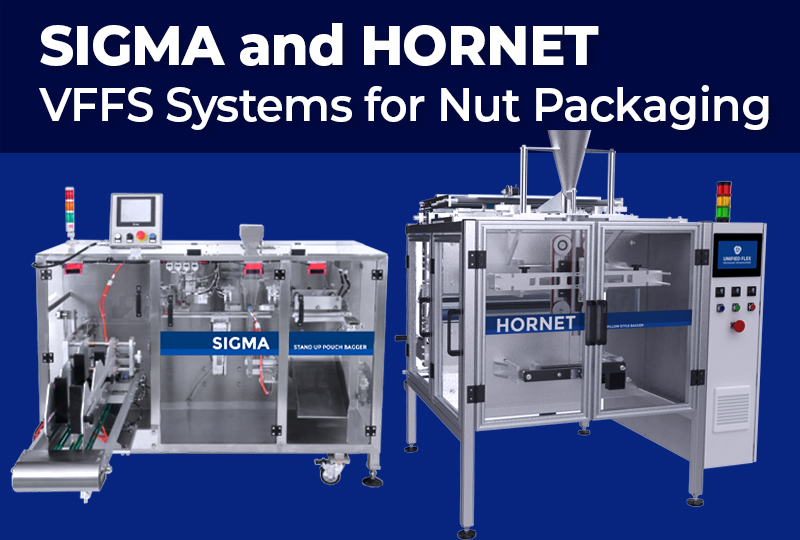
Vertobagger Hornet: VFFS System for Pillow Bag Nut Packaging
The Vertobagger Hornet is a vertical form fill seal system designed for pillow bag nut packaging applications. The system is capable of producing up to 80 bags per minute, depending on pouch size, film structure, and product fill characteristics.
The machine uses servo-controlled pulling belts and servo-driven horizontal sealing to maintain consistent bag length and seal timing across extended production cycles.
This electronically controlled motion architecture supports repeatable forming and sealing events, helping pillow bags and gusseted bags maintain stable geometry throughout long production runs.
For nut processors operating high-cycle pillow bag packaging lines, the Hornet platform focuses on maintaining forming alignment and sealing repeatability under sustained production conditions.
Doy Sigma: Preformed Pouch Packaging Machine for Nuts
The Doy Sigma is a preformed pouch packaging machine designed for small to medium production volumes. It can pack Doy Stand-Up Pouches, spout pouches,pillow bags, box pouches, and more with speeds of up to 20 cycles per minute depending on product fill time, pouch length and film properties.
This machine runs a servo motor mechanism for smooth flow of pouches in a linear path, while a convenient belt driven pouch loading area allows for a rotary arm pickup of pouches. There are two primary stations: on the first station pouches are flexed and opened to receive product from a dosing machine, and on the second station pouches are then sealed and transitioned out of the machine. A Motorized bag feeding system, Mechanical arm for bag pickup, Servo motor for linear bag movement, Vacuum generator and suction cups, Bag detection before filling, Vacuum sensors to ensure bag opening, and Strong gripper fingers to hold bag firmly all support the pouch handling process through the machine.
Evaluating a Nuts Packaging Machine Without Guesswork
The correct way to evaluate a nuts packaging machine is to treat it as a repeatability problem rather than a brochure comparison.
Nut products expose machine drift over long production runs, so evaluation should focus on stability under sustained operation.
Key questions include:
- Does pouch geometry remain consistent after roll changes and extended shifts?
- Does bag length remain repeatable across production runs?
- Does seal engagement remain stable without constant operator adjustment?
- How quickly does the system recover after changeovers and restarts?
These factors define the real operating window of a packaging system.
Validating equipment under actual product and film conditions ensures the packaging line can maintain stability during long production cycles.
Why Many Nut Processors Work with Unified Flex
Nut packaging lines rarely run exactly the same from plant to plant. That’s why Unified Flex systems are configured around the product, pouch format, and production requirements of each customer, rather than forcing operations into a fixed machine layout.
That approach is supported by experience. Having worked across many packaging applications, Unified Flex understands how products like almonds, cashews, pistachios, and trail mixes behave during filling and sealing, and designs systems accordingly.
The machine features themselves are built around practical outcomes on the production floor. Stable motion control, consistent film indexing, and repeatable sealing help operators maintain pouch consistency and reduce adjustments during long production runs.
Just as important, Unified Flex follows a structured, process-driven approach to engineering and project delivery. When companies invest in packaging equipment, they expect the project to be managed with the same discipline they apply to their own operations.
And over the long term, uptime depends on support. Processors care less about where a machine is built and more about how quickly parts and service are available. Using widely available, non-proprietary components helps ensure the line can be serviced quickly when it matters most.
Conclusion: Stability Is What Keeps Nut Packaging Lines Running
Nut products rarely create packaging problems because they are difficult to fill.
They create packaging problems because they expose whether a packaging system can maintain repeatability during sustained production.
Once operators begin compensating, adjusting tracking, seal timing, or pouch positioning, the process window has already narrowed.
At that stage, improving performance is less about chasing peak speed and more about restoring control margin: stable forming geometry, repeatable indexing, and consistent seal engagement across long production runs.
That is the purpose of selecting the right nuts packaging machine.
Within Unified Flex’s packaging platforms, Vertobagger Hornet and Doy Sigma represent two machine architectures designed to maintain consistent pouch geometry and sealing performance under real production conditions.
Throughput is what the line is asked to deliver. Repeatability is what keeps it delivering.