
How Pharmaceutical Packaging Machines Maintain Dosage Accuracy and Consistency
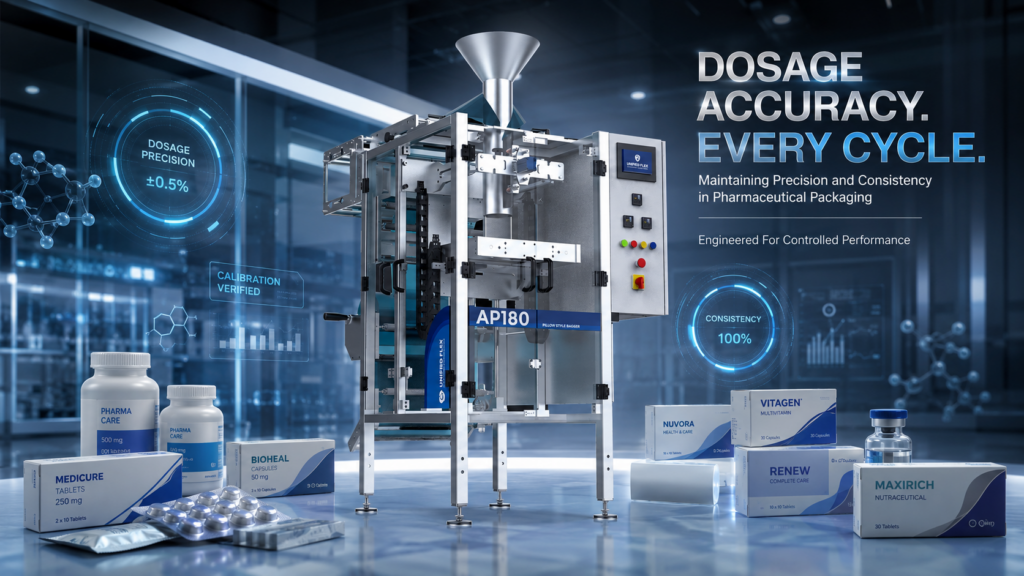
Across the nutraceutical and pharmaceutical manufacturing floor, dosage accuracy is no longer just a quality metric; it is a liability threshold. A stick pack short-filled by 8% doesn’t simply disappoint the consumer; it potentially misrepresents a regulated health claim. A sachet overfilled by the same margin quietly erodes profitability, unit after unit, at production scale.
This blog examines how modern pharmaceutical packaging machines maintain dosage accuracy, seal integrity, and production consistency under real manufacturing conditions. We anchor the discussion in a real-world production scenario involving a growing Ashwagandha nutraceutical brand that deployed the Unified Flex Multilane Stick Pack MSP 440 system.
The insights apply broadly to engineers, operations managers, and nutraceutical business owners responsible for maintaining scalable, compliant, and efficient packaging operations.
Table of Contents
The Ashwagandha Packaging Challenge: Why Dosage Accuracy Fails at Scale
Ashwagandha powder appears straightforward until production begins scaling.
From an engineering perspective, Ashwagandha presents several difficult filling behaviors simultaneously:
- Bulk density variations between blends
- Humidity sensitivity
- Powder aeration during transport
- Bridging inside hopper throats
- Particle segregation across multilane systems
- Inconsistent flow characteristics between SKUs
A mid-scale nutraceutical manufacturer packaging five separate Ashwagandha and adaptogen formulations experienced fill-weight variation ranging from ±6% to ±9% across production lanes.
At 400 stick packs per minute, this inconsistency was creating:
- Regulatory exposure
- Excessive product giveaway
- Consumer inconsistency
- Increased reject rates
- Frequent operator recalibration
- Seal failures during humid production conditions
A process audit identified three primary failure points:
- Mechanical Drift in Film Indexing: The existing pneumatic film-pull system produced inconsistent cavity positioning between lanes.
- Improper Auger Calibration: A single auger setting was being used across multiple powder densities and formulations.
- Thermal Instability in Seal Jaws: Seal temperature fluctuated during long production runs, compromising seal consistency.
These are not isolated failures. They are among the most common causes of dosage inconsistency in conventional pharmaceutical packaging machines.
The MSP 440 system was selected specifically to eliminate these mechanical instability points rather than compensate for inconsistency after it occurs.
The Engineering Architecture Behind Dosage Accuracy
The following systems demonstrate how pharmaceutical packaging machines maintain fill accuracy, sealing consistency, and stable production performance under high-speed nutraceutical manufacturing conditions.
Servo-Controlled Film Drive Systems
In conventional pneumatic systems, film indexing accuracy gradually deteriorates due to:
- air pressure fluctuations
- seal wear
- temperature changes
- tension instability
In multilane automatic packaging machines, these variables compound independently across each lane, increasing fill divergence over time.
The MSP 440 utilizes a servo-controlled film pulling system with closed-loop positional feedback on every cycle.
This architecture maintains sub-millimeter positioning accuracy regardless of:
- film tension variation
- production speed fluctuation
- environmental conditions
- continuous runtime stress
For engineers, this eliminates one of the largest hidden causes of volumetric fill inconsistency before the filling sequence even begins.
On a 5–9 lane configuration operating at up to 400 stick packs per minute, the system processes thousands of synchronized indexing events every minute while maintaining positional stability throughout production.
This level of repeatability is not achievable through conventional pneumatic actuation systems.
Precision Auger Filler Integration
In powder packaging applications, dosage accuracy is governed primarily by filler performance and machine synchronization.
Many mid-market pharmaceutical packaging machines fail because the machine and filler operate independently instead of as an integrated system.
For the Ashwagandha production line, the MSP 440 was configured with recipe-managed auger filler calibration for each SKU.
Each formulation received dedicated parameters for:
- auger pitch
- rotational count
- fill timing
- settling delay
- product density compensation
When operators switched from pure Ashwagandha powder to denser KSM-66 blends, the machine automatically adjusted filling parameters through stored recipe logic.
No manual recalibration was required on the production floor.
This is one of the most important distinctions between commodity bagging equipment and engineered automatic packaging machines.
The objective is not simply filling pouches.
The objective is maintaining repeatable target weights across varying powder behaviors without operator-dependent correction.
PID-Controlled Seal Jaw Temperature Systems
Seal integrity directly impacts both product protection and dosage reliability.
A compromised seal introduces:
- oxygen ingress
- moisture exposure
- contamination risk
- reduced shelf life
- formulation degradation
In continuous multilane production environments, maintaining stable seal temperature becomes increasingly difficult because the heat distribution changes constantly during runtime.
The MSP 440 integrates digital PID (Proportional-Integral-Derivative) temperature controllers across vertical and horizontal seal stations.
PID control continuously adjusts thermal output based on real-time deviation from the target temperature.
This creates highly stable sealing conditions across extended production cycles.
During the Ashwagandha packaging operation:
- target seal temperature: 140°C
- temperature variance maintained within: ±2°C
- previous system variance: ±12°C
The result was a dramatic reduction in seal blowout events and improved overall packaging consistency.
For operations managers, this means fewer rejected units, reduced downtime, and greater production reliability.
Solving the Multilane Synchronization Problem
Single-lane packaging systems do not experience the same synchronization challenges as multilane production environments.
In a 5–9 lane pharmaceutical packaging machine, every lane must:
- index simultaneously
- fill simultaneously
- seal simultaneously
Even slight timing drift between lanes eventually creates:
- variable cavity dimensions
- inconsistent fill volumes
- seal irregularities
- product loss
The MSP 440 resolves this through a master-slave servo synchronization architecture.
One axis operates as the master timing reference while all remaining lanes synchronize directly to its positional feedback.
If any lane deviates beyond allowable tolerance thresholds, the system automatically detects the variance before the defective product exits the sealing station.
For the Ashwagandha production team, this architecture reduced fill-weight variance from ±6–9% down to ±1.8% within the first week of deployment.
Importantly, this improvement occurred without modifying the upstream blending process.
That is the difference engineered synchronization control makes at production scale.
Performance Comparison: Before and After MSP 440 Deployment
Parameter | Prior System | MSP 440 System |
Fill weight variance (across lanes) | ±6–9% | ±1.8% |
Seal jaw temperature variance (per shift) | ±12°C | ±2°C |
Seal defect rate | 0.3–0.5% per run | <0.05% per run |
SKU changeover time | 45–60 min (manual recal.) | 12–18 min (recipe recall) |
Film waste per shift | ~3.2% of total film run | ~0.8% of total film run |
Traceability, Compliance, and Labeling
In nutraceutical packaging, dosage accuracy alone is not enough. Every automatic packaging machine must also support traceability through:
- lot code printing
- batch tracking
- expiration date marking
- reject verification systems
The MSP 440 integrates directly with thermal inkjet coders through PLC-controlled communication. For the Ashwagandha production line, every stick pack received a real-time 14-digit lot code and production date during operation. If a print was missed due to signal loss or ink failure, the reject system automatically removed the defective pack before secondary packaging.
This closed-loop traceability architecture helps manufacturers maintain FDA GMP compliance while reducing manual inspection dependency and labeling risk.
Operational Efficiency for Growing Nutraceutical Brands
The following operational factors directly influence production efficiency, scalability, and long-term packaging reliability.
Faster SKU Changeovers
For operations teams managing multiple SKUs, changeover time directly affects throughput and profitability.
The MSP 440 stores key operational parameters including:
- auger settings
- seal temperatures
- servo indexing
- fill timing
as digital product recipes. Operators can switch between formulations through the HMI interface without manual recalibration.
On the Ashwagandha line:
- previous changeover time: 45–60 minutes
- MSP 440 changeover time: 12–18 minutes
This reduced downtime and improved production efficiency.
Scalable Production Without Replacing Equipment
The MSP 440’s modular 5–9 lane configuration allows brands to increase production capacity without replacing the entire machine platform.
Manufacturers can scale output by adding additional lane tooling while maintaining:
- process consistency
- operator familiarity
- validation continuity
For growing nutraceutical brands, this prevents unnecessary capital replacement and production disruption.
Non-Proprietary Maintenance Architecture
A pharmaceutical packaging machine should not depend on proprietary replacement parts for routine maintenance.
The MSP 440 uses:
- standard servo drives
- commercially available heating elements
- accessible automation components
This reduces:
- lead times
- repair delays
- maintenance costs
- mean time to repair (MTTR)
For manufacturers, lower downtime directly improves operational reliability and long-term ROI.
Why Pharmaceutical Packaging Is a Systems Engineering Decision
The Ashwagandha case study demonstrates an important reality:
Dosage accuracy and sealing consistency are not standalone machine features. They are outputs of an integrated production system.
Critical engineering considerations include:
- servo vs pneumatic film control
- filler integration accuracy
- PID seal temperature control
- lane synchronization architecture
- traceability integration
- non-proprietary parts availability
These factors directly determine whether an automatic packaging machine can maintain stable performance at production scale.
For engineers, operations managers, and business owners, machine selection should be evaluated as a long-term process engineering decision rather than simply a throughput specification.
The Bottom Line
In nutraceutical manufacturing, every underfilled stick pack, failed seal, or unreadable lot code weakens product credibility.
Modern pharmaceutical packaging machines must deliver:
- repeatable dosage accuracy
- stable sealing performance
- automated traceability
- scalable production efficiency
under real manufacturing conditions.
Servo-controlled film systems, PID-regulated sealing, recipe-managed filling, and closed-loop traceability are no longer premium features. They are the operational standard for brands serious about compliance, consistency, and long-term growth.
At Unified Flex, we engineer pharmaceutical packaging systems designed to maintain that standard at scale.