
Spirulina Packaging: Overcoming the Challenges of Fine Powder Stick Pack Production
Introduction
At first glance, spirulina packaging doesn’t appear especially challenging. Like many powdered nutraceuticals, it is portioned into small stick packs, sealed, and prepared for distribution. On paper, the process seems relatively straightforward.
Manufacturers often discover otherwise once production moves beyond the first few packages. A line may start the day producing consistent stick packs, only for small variations to emerge as the run continues. Fill weights begin to drift, dust accumulates where it shouldn’t, package appearance becomes less uniform, or additional cleaning interrupts production. Individually, these issues may seem minor, but over thousands of packages they can affect product quality, production efficiency, and operating costs.
The challenge isn’t simply getting spirulina into a stick pack. It’s maintaining the same level of accuracy, consistency, and reliability throughout an entire production run. That raises an important question: what makes a seemingly straightforward powder so demanding to package at commercial scale?
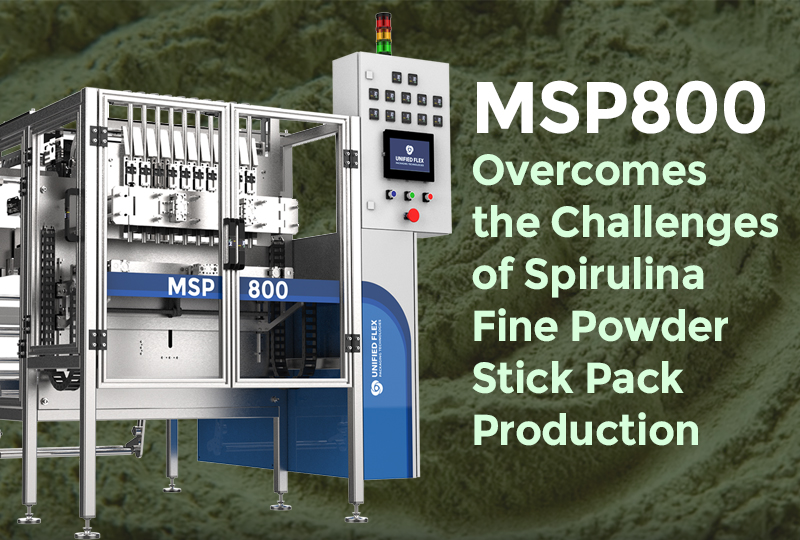
Table of Contents
The Packaging Challenges of Spirulina Powder
Although spirulina is packaged in relatively small quantities, the material itself presents several challenges that become more noticeable as production volumes increase. Its physical characteristics influence how it moves through the packaging process, how consistently it can be dispensed, and how reliably manufacturers can maintain production over extended runs.
Fine Particles Require Greater Process Control
Spirulina is typically supplied as a fine, lightweight powder. Unlike larger particles that settle more readily, fine powders are more easily disturbed during conveying and dispensing. This makes product movement less predictable and increases the likelihood of airborne dust around the filling area. Over extended production runs, dust accumulation can increase housekeeping requirements and make it more difficult to maintain a clean production environment.
Low Bulk Density Increases Filling Sensitivity
Another characteristic that influences spirulina packaging is its relatively low bulk density. A comparatively small weight of product occupies a larger volume, requiring careful control when dispensing into compact stick packs. Because each package contains only a small serving, even minor variations in the amount of product delivered can represent a significant percentage of the target fill weight. As production continues, maintaining the same level of accuracy from the first package to the last becomes increasingly demanding.
Maintaining Uniform Production at Scale
The challenge extends beyond individual packages. Commercial stick pack production requires every lane, every cycle, and every package to perform consistently over thousands of repetitions. Variations in powder flow can lead to inconsistent fill weights, while dust around the filling area may affect seal quality if not properly managed. Over extended production runs, manufacturers may also contend with product giveaway, rejected packages, additional cleaning, and unplanned downtime, all of which reduce overall line efficiency and increase operating costs.
These challenges are not unique to a single machine or production run. They are common characteristics of packaging fine powdered nutraceuticals at commercial scale, making controlled product handling and consistent dosing essential considerations when selecting a packaging system.
Why Filling Technology Matters
Many of the challenges associated with spirulina packaging don’t originate at the sealing station or with the packaging film. They begin during filling. If the powder cannot be delivered consistently into every stick pack, downstream adjustments can only compensate for the problem; they cannot eliminate it.
For this reason, auger filling has become the preferred method for many powdered nutraceuticals. Instead of relying on gravity alone, an auger filler meters a controlled volume of powder into each package using a rotating screw. This provides greater control over product delivery, making it well suited to lightweight powders packaged in small serving sizes.
Consistent metering is critical because every package depends on receiving the correct amount of product. Stable powder delivery helps maintain fill accuracy, reduce product giveaway, improve package uniformity, and minimize process variation across long production runs.
For manufacturers packaging spirulina, the filling system is therefore more than a dosing device; it is the foundation of a stable and repeatable packaging process. Choosing the right filling technology determines how consistently the entire packaging line performs.
Solving Spirulina Packaging Challenges with the MSP-800
Consistent Dosing Across Every Lane
For fine powdered products such as spirulina, consistent dosing is one of the biggest determinants of package quality. The MSP-800 addresses this through independent servo-controlled auger screws, allowing each lane to meter powder independently rather than relying on a single shared dosing system. This helps maintain more consistent fill weights across the machine while reducing lane-to-lane variation during extended production runs.
Maintaining Package Quality Throughout Production
Producing a high number of identical stick packs requires more than accurate dosing. Film movement, registration, and sealing must remain consistent throughout the production run. The MSP-800 combines servo-controlled film pulling, digital film alignment, and independent temperature control for each lane to help maintain seal integrity and a uniform package appearance across every lane.
Supporting Stable Powder Flow
Maintaining a consistent flow of fine powder is essential for repeatable production. The MSP-800 incorporates mixing blades for auger filler to promote more uniform product feed while electronically geared motion control and synchronous servo motors coordinate machine movements throughout the packaging cycle. Together, these systems help create a more stable filling process during long production runs.
Designed for Reliable Production
Commercial stick pack production demands both throughput and consistency. The MSP-800 is available in 9 to 16 lane configurations and can produce up to 800 stick packs per minute, depending on product characteristics, stick dimensions, and film properties. Rather than increasing speed alone, the multi-lane design allows manufacturers to scale production while maintaining repeatable performance across every lane.
Simplifying Maintenance and Long-Term Operation
Packaging performance depends on keeping equipment running reliably over time. The MSP-800 features a simple, clean, and robust design and uses off-the-shelf, non-proprietary components, helping simplify maintenance and parts replacement. For manufacturers, this can reduce service complexity and support long-term operational reliability.
Beyond Speed: Why Consistency Delivers Greater Business Value
Most manufacturers evaluate packaging equipment by asking how many stick packs it can produce per minute. While throughput is important, production performance is ultimately measured by how consistently those packages are produced over the course of an entire shift.
A packaging line that maintains stable fill weights, uniform package quality, and reliable sealing requires fewer operator adjustments, generates less product waste, and reduces the likelihood of rejected packages. The cumulative effect extends beyond the packaging department. More predictable production supports scheduling, inventory planning, quality assurance, and customer fulfilment by reducing unexpected interruptions and variability.
Consistency also improves cost control. Product giveaway, frequent cleaning, unplanned downtime, and material waste all contribute to a higher cost per package. When these variables are reduced, manufacturers can improve overall equipment effectiveness (OEE), make better use of raw materials, and produce a more predictable output without increasing labour requirements.
For manufacturers packaging spirulina and other powdered nutraceuticals, long-term productivity is therefore determined by repeatability rather than speed alone. A line that consistently performs to specification often delivers greater operational value than one designed simply to achieve the highest theoretical output.
Conclusion
Packaging spirulina successfully requires more than selecting a stick pack format. Fine powdered nutraceuticals present challenges that influence every stage of the packaging process, from product handling and dosing to package quality and production stability.
Addressing those challenges begins with understanding how the product behaves and selecting filling technology capable of delivering consistent, repeatable performance. Combined with a packaging system designed for commercial production, manufacturers can improve package quality, reduce waste, and maintain reliable operation across extended production runs.
As demand for convenient, single-serve nutraceutical products continues to grow, the ability to package fine powders consistently becomes more than a production objective, it becomes a competitive advantage. Choosing equipment engineered for the realities of powdered products helps manufacturers build a packaging process that supports both operational efficiency and long-term business growth.