
Spirulina Packaging: Why Stick Packs Have Become a Preferred Format
Introduction
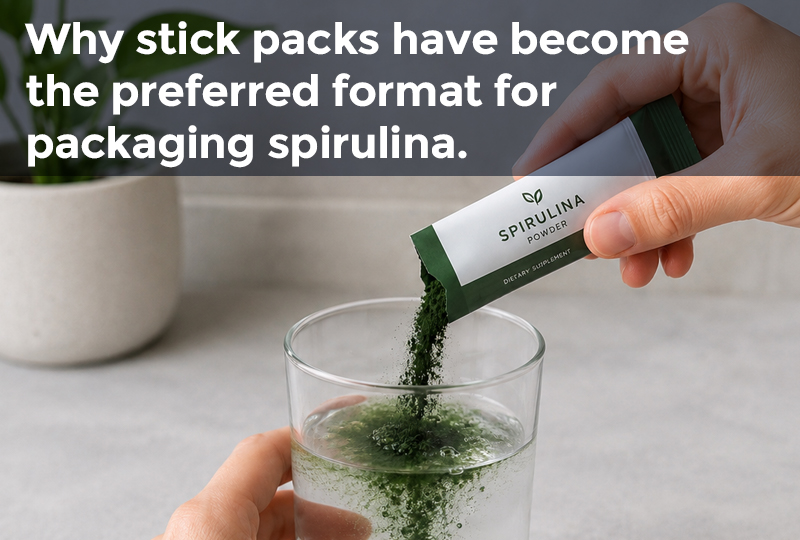
Spirulina packaging has evolved alongside the nutraceutical market. While the product is still commonly available in jars, stand-up pouches, and stick packs have become an increasingly familiar format for powdered spirulina sold in single-serving applications. Their growing presence is difficult to overlook, particularly as wellness brands continue introducing products designed for convenience, portability, and on-the-go consumption.
That raises an important question. Manufacturers have several packaging formats available, so why are more spirulina products being introduced in stick packs? The answer extends beyond the package itself. It reflects how consumer expectations, product positioning, and commercial strategy have changed, and how packaging has evolved to support those changes.
Table of Contents
Spirulina Is No Longer Packaged for One Type of Consumer
The spirulina market has expanded well beyond its traditional audience. Once associated primarily with dedicated health enthusiasts purchasing large tubs of powder, spirulina is now incorporated into a broader range of wellness products intended for everyday lifestyles. Consumers increasingly expect supplements that fit into busy routines, travel easily, and require little preparation before use.
This shift has changed how brands approach product development. Spirulina is no longer positioned solely as a bulk nutritional supplement. It is increasingly marketed through functional beverage mixes, wellness programs, subscription services, trial packs, and products designed for consumption at work, in the gym, or while travelling. Each application places different expectations on the package, influencing not only how the product is presented but also how it is purchased and used.
As consumer behaviour evolves, packaging becomes part of the product strategy rather than simply a means of containment. Manufacturers evaluating new spirulina products are increasingly considering how package format can improve accessibility, strengthen brand perception, and create opportunities to reach customers in ways that larger, traditional formats cannot.
Single-Serve Formats Support Consistency at Scale
Moving from multi-serving containers to individual portions changes more than the appearance of the finished product. It changes the manufacturing strategy behind it.
Instead of producing a smaller number of larger packages, manufacturers are producing thousands of identical units that must deliver the same presentation, fill weight, and quality throughout the production run. This places greater emphasis on repeatability, standardized production, and process consistency. Every package becomes a finished product rather than one serving within a larger container.
Single-serving production also creates opportunities to standardize operations. Uniform package dimensions simplify downstream processes such as cartoning, case packing, palletization, and inventory management, while consistent package presentation helps maintain product quality across high-volume production runs. As brands expand their product portfolios, standardized packaging formats can also simplify production planning by supporting multiple SKUs with a consistent packaging strategy.
For manufacturers, the transition to single-serving packaging is therefore more than a change in package size. It represents a different approach to production, one designed around consistency, scalability, and the ability to efficiently produce high volumes of finished consumer units.
Standardized Packaging Simplifies Storage and Distribution
The benefits of single-serving packaging extend well beyond the production floor. Once products leave the packaging line, logistics becomes a significant factor in overall operating efficiency, influencing storage, inventory management, distribution, and retail replenishment.
Individually packaged spirulina products are easier to organize into standardized cartons and shipping cases, creating greater consistency throughout warehousing and fulfillment. Uniform package dimensions improve pallet utilization and simplify inventory management by allowing manufacturers and distributors to work with predictable pack counts and standardized case configurations. As product volumes increase, this consistency helps streamline order fulfillment while improving warehouse organization and inventory accuracy.
Single-serving products also provide greater flexibility throughout the supply chain. Retailers can stock products in multiple pack counts without changing the individual package, while distributors can configure promotional packs, display-ready cartons, or e-commerce orders using the same standardized unit. Rather than simply reducing package size, single-serving packaging creates a logistics system that is easier to store, ship, replenish, and scale as demand grows.
When Packaging Becomes a Business Strategy
Perhaps the greatest impact of single-serving packaging is not operational, it is commercial. Package format increasingly influences how a product is positioned, marketed, and introduced to new customers.
Large tubs and multi-serving containers remain an effective choice for established users who purchase spirulina as part of their routine. However, they can create a higher barrier for first-time buyers who may be reluctant to commit to a larger purchase before trying the product. Single-serving packaging provides brands with greater flexibility to reach those customers through formats that support trial, convenience, and portability.
The same package can also support multiple commercial strategies. Brands can introduce travel packs for consumers on the move, sample packs for retail promotions, subscription programs that deliver pre-portioned daily servings, or multipacks designed for warehouse clubs and online marketplaces. Seasonal flavours, limited-edition formulations, and new product launches can often be introduced using an established packaging format without requiring an entirely new packaging strategy.
As consumer expectations continue to evolve, packaging is becoming a competitive decision rather than simply a production decision. Manufacturers that continue relying exclusively on traditional multi-serving formats may find it more difficult to respond to changing retail channels, growing e-commerce demand, and the increasing preference for products that fit into modern, on-the-go lifestyles. For many brands, evaluating single-serving packaging is no longer about following a trend; it is about ensuring the product remains relevant in a market where convenience, flexibility, and accessibility increasingly influence purchasing decisions.
Why Stick Packs Fit Single-Serve Spirulina
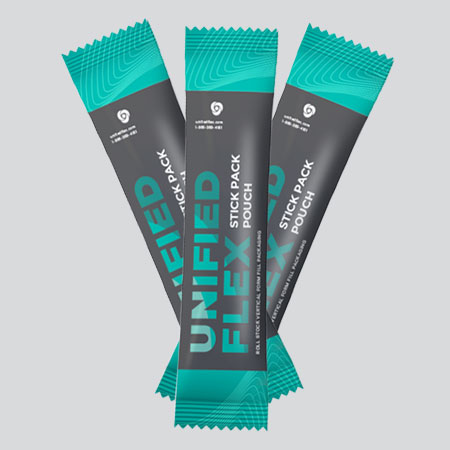
By the time manufacturers evaluate the requirements of single-serving packaging, the range of suitable package formats has narrowed considerably. The objective is no longer simply to package spirulina, it is to package it in a way that supports efficient production, distribution, merchandising, and consumer use. This is where stick packs have become a preferred solution for many powdered nutraceutical applications.
Their slim profile is well suited to small serving sizes while maintaining a compact package footprint. Standardized dimensions create a consistent appearance across production runs, simplify secondary packaging, and allow brands to build product lines around a single package format. Whether products are sold individually, bundled into multipacks, or incorporated into subscription programs, stick packs provide the flexibility to support multiple commercial strategies without fundamentally changing the packaging approach.
The format also aligns well with today’s retail and e-commerce environments. Stick packs are easy to merchandise, require less shelf space than larger containers, and fit naturally into display-ready cartons, travel kits, wellness programs, and promotional assortments. Their compact size also improves shipping efficiency by allowing more finished units to be transported within a given shipping volume, an advantage that becomes increasingly important as direct-to-consumer sales continue to grow.
For manufacturers, the decision is rarely based on convenience alone. Stick packs combine efficient use of packaging material, standardized production, practical logistics, and commercial flexibility into a single format. As spirulina products continue evolving beyond traditional tubs and bottles, stick packs have become a practical way to support both operational efficiency and changing market expectations.
Packaging Success Depends on More Than the Format
Selecting the right package format is only one part of successful spirulina packaging. Consistent results ultimately depend on how accurately the product is filled, how reliably the package is formed, and how repeatably the entire packaging process performs over extended production runs.
For powdered nutraceuticals such as spirulina, this begins with the filling system. Fine powders require controlled, repeatable dosing to maintain consistent package weights while minimizing variation across thousands of individual servings. When combined with a packaging system designed specifically for high-volume stick pack production, manufacturers can achieve the consistency required for commercial-scale operations.
Unified Flex approaches spirulina packaging as a complete production system rather than a standalone machine. The Multi-Lane Stick Pack MSP 800 Machine, paired with an auger filling system, is configured to produce high volumes of accurately filled stick packs while maintaining consistent package formation and seal quality. Rather than focusing solely on machine speed, the system is designed around repeatability, production stability, and the long-term reliability manufacturers expect from nutraceutical packaging operations.
Every application begins with understanding the product, production objectives, and commercial requirements before configuring the packaging solution. This process-driven approach helps ensure that the selected package format performs as intended, not only on the packaging line, but throughout distribution and into the hands of the consumer.
Conclusion
The evolution of spirulina packaging reflects a broader shift in the nutraceutical industry. As brands continue expanding into subscription services, e-commerce, travel-ready products, and convenient daily nutrition, packaging is becoming an increasingly important part of product strategy rather than simply a means of containing the product.
Single-serving packaging supports that strategy by creating opportunities for greater production consistency, improved logistics, more flexible merchandising, and stronger retail positioning. Within that broader shift, stick packs have emerged as one of the most practical formats for delivering those benefits while aligning with the expectations of today’s consumers.
For manufacturers evaluating the future of their spirulina products, the question is no longer whether stick packs are simply a convenient option. The more important question is whether the current packaging strategy is positioned to support where the market is heading next.