
Struggling with Turmeric Packaging? Here’s Why Stick Packs Are Taking Over
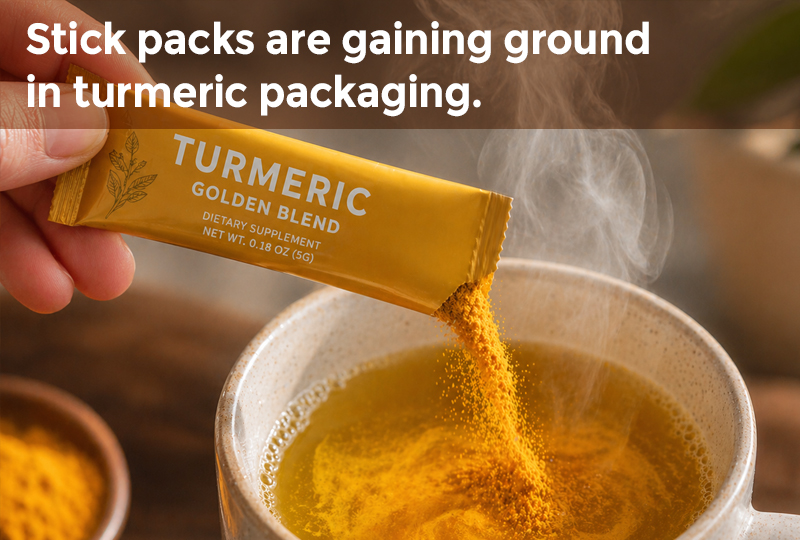
Turmeric is gaining real momentum across North America, showing up in supplement powders, wellness blends, and functional drinks as demand for plant-based health products continues to grow. The region already accounts for roughly 34% of the global turmeric supplement market, and demand is expected to expand at more than 5% CAGR over the next decade.
As the category grows, so does the pressure to stand out.
In that environment, formulation alone is not enough. Consumers are also paying attention to how easily a product fits into everyday use, how simple it is to carry, measure, and actually incorporate into a routine. That shift is making turmeric packaging a deciding factor.
But turmeric is not just part of a growing category. It is also a product that creates friction.
Table of Contents
The Problem: Turmeric Is Difficult to Handle and Use
Turmeric powder does not always behave consistently during production. Its flow characteristics can vary, leading to uneven fills, product giveaway, and inconsistent dosing. For operations teams, that directly affects accuracy, efficiency, and cost control.
Dust adds another layer of complexity. Fine turmeric particles can spread during filling, leading to product loss, increased cleaning, and production interruptions. What works at low volumes often becomes inefficient at scale.
Its strong pigmentation makes cleaning more demanding. Turmeric stains easily, requiring more thorough processes to avoid buildup or cross-contamination, especially in facilities handling multiple products.
There is also a user-side challenge. Many turmeric products are added to drinks or blends where consistency matters. When the format relies on scooping or measuring, variability becomes part of the experience.
Individually, these issues are manageable. At scale, they become harder to control.
Where Traditional Packaging Falls Short
Bulk containers and bottles can hold turmeric effectively, but they do little to reduce these challenges.
From a production standpoint, they do not address issues like inconsistent flow or dust. From a user standpoint, they introduce extra steps, measuring, handling, and storing, which can make the product less consistent and less practical to use regularly.
As turmeric becomes more integrated into daily routines, the gap between product quality and product usability becomes more noticeable. Packaging is no longer neutral. It directly shapes the experience.
The Shift: Packaging Is Moving Closer to Real Usage
This is where the category is starting to shift.
Across North America, turmeric products are increasingly being introduced in formats designed around real usage, portable, pre-measured, and ready to use. Instead of remaining pantry items, they are being positioned for daily routines and on-the-go consumption.
This is not a minor change in packaging. It reflects a broader shift in how turmeric products are used.
Products that remove steps are more likely to become part of everyday habits. And once a product fits naturally into a routine, repeat purchase follows.
In a market that is becoming more crowded, that shift creates a clear divide. Some formats align with how consumers want to use turmeric today. Others do not.
The Solution: Why Stick Packs Work
Stick packs stand out because they address both sides of the problem.
They provide precise, pre-measured portions, which removes guesswork and improves consistency for the end user. Each serving is controlled, which also supports formulation accuracy.
They are easy to carry and use, allowing turmeric to be consumed in the moment rather than prepared in advance. This makes them better suited to daily routines and on-the-go use.
From a production perspective, stick packs can support more controlled filling conditions. With the right setup, they help reduce dust dispersion, improve fill consistency, and limit product loss.
They also offer individually sealed units, which help protect the product from exposure to air and moisture over time.
More importantly, they remove the extra steps that come with bulk formats. Instead of requiring effort, the product becomes ready to use.
Where Stick Packs Fit Best
Stick packs are most effective in applications where consistency and ease of use directly influence how often the product is consumed.
In nutraceutical powders, they support accurate dosing without adding complexity. In functional drink mixes, they match how the product is actually used, quickly and often on the go. In wellness blends, they make portability and repeat use more practical. They also work well for trial and sample formats.
In each case, the format affects more than presentation. It shapes how the product is used and how often it is used.
What Brands Need to Get Right
Adopting stick packs requires the right approach.
Turmeric’s flow properties still need to be managed carefully, especially in blended formulations. Fill accuracy depends on selecting the appropriate filling system and maintaining consistent conditions.
Seal integrity is equally important. Fine powders can interfere with sealing if the process is not controlled properly, which can lead to leakage or compromised packaging.
Scale also matters. Stick packs deliver the most value when production is stable and repeatable. Without the right setup, the benefits can be offset by inefficiencies.
The format solves real problems, but only when it is implemented correctly.
A Practical Takeaway
Stick packs are gaining ground in turmeric packaging because they solve two problems at once.
They improve how turmeric is handled in production and how it is used in real life.
As the category continues to grow, packaging will play a larger role in determining which products stand out and which ones fall behind.
The question is no longer whether stick packs are becoming more relevant. It is whether your turmeric packaging is keeping pace with how the market is changing.