
The Future of Gel Pack Packaging Isn't About Capacity. It's About Risk.
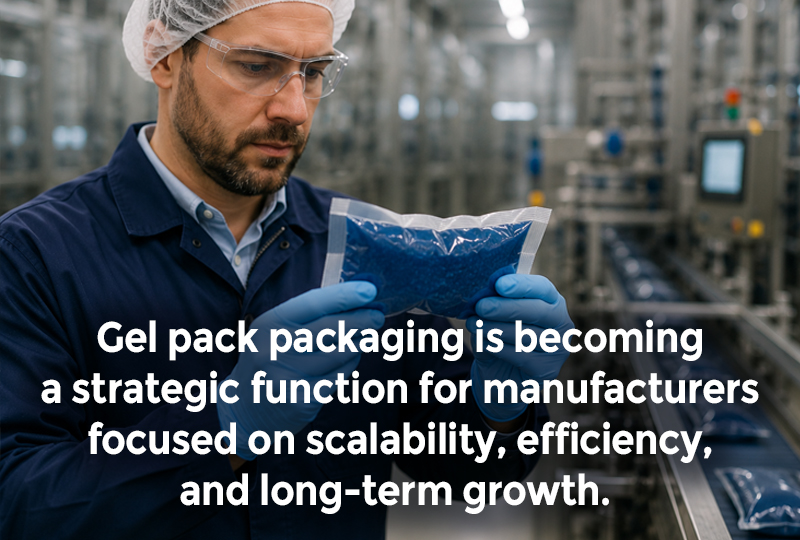
For gel pack manufacturers, capacity has traditionally been an important measure of production capability.
More customers mean more production. More production can require additional equipment, floor space, labor, and output. Increasing capacity allows manufacturers to meet growing demand and pursue larger contracts.
But capacity alone does not determine the value a supplier provides to its customers.
Customers also depend on their suppliers to deliver consistently. A leaking gel pack can compromise a shipment. A production delay can affect delivery schedules. Inconsistent package quality can create waste, complaints, and additional handling. And when demand changes unexpectedly, a supplier’s ability to respond can become just as important as its total installed capacity.
Seen from the customer’s perspective, these are not simply packaging problems. They are business risks.
That changes the question manufacturers need to ask. Instead of focusing only on how much can we produce?, it becomes how reliably can we deliver what our customers need?
For gel pack manufacturers looking to strengthen their competitive position, adding capacity may still matter. But the greater opportunity may be using that capacity to reduce uncertainty for the customer.
The future winners in gel pack packaging may not necessarily be the companies with the most capacity. They may be the companies that create the least risk for their customers.
The Cold Chain Is Becoming Less Forgiving
The basic role of the gel pack hasn’t changed. The consequences of failure can be much greater.
Temperature-controlled supply chains support biologics, vaccines, specialty pharmaceuticals, personalized medicines, premium foods, and direct-to-consumer meal kits. In many of these applications, the value and sensitivity of the product being shipped make temperature control a critical part of distribution.
The scale of the cold chain reflects that importance. Research and Markets projects the pharmaceutical cold chain packaging market will grow from approximately $31.4 billion in 2026 to $55.75 billion by 2030, while Grand View Research estimates the broader cold chain market could exceed $1.6 trillion by 2033.
But the more important issue for gel pack manufacturers isn’t simply market growth. It is what is at stake when temperature-controlled shipments fail.
A temperature excursion can result in product loss, rejected shipments, replacement costs, delivery delays, and, in regulated applications, additional quality and compliance concerns. The higher the value or sensitivity of the shipment, the less tolerance there is for inconsistency in the components used to maintain the required temperature range.
The gel pack may be a relatively small component of a temperature-controlled packaging system, but its performance contributes to protecting products for which failure can carry significant consequences.
Competition Goes Beyond the Gel Pack
On paper, the comparison may look straightforward: one gel pack supplier versus another. But the product is only part of what the customer is buying.
They also depend on the supplier behind it. Can production keep pace when demand increases? Can supply remain consistent? Can the supplier respond when requirements change? Can customers plan around lead times with confidence?
These factors matter because a lower unit price provides little advantage if supply disruptions, inconsistent quality, or limited responsiveness create problems elsewhere in the customer’s operation.
The competitive question therefore extends beyond who can supply the gel pack. It includes the reliability of the operation supporting it.
A supplier that can deliver consistently, respond to changing requirements, and reduce uncertainty gives customers something beyond the product itself: a supply relationship they can plan around.
The question becomes not only, “Who can supply our gel packs?”
It becomes, “Which supplier creates the least risk for our operation?”
The Capacity Trap
When demand rises, most manufacturers assume they need more capacity. Sometimes they do. But growth often exposes a different problem: process variation.
As production increases, small inconsistencies become harder to hide. Seal performance can drift. Fill weights can vary. Changeovers become more frequent. Workarounds that functioned at lower volumes start creating friction.
This is where many manufacturers misdiagnose the challenge. They think they have a capacity problem when they actually have a variation problem.
Scaling output and scaling consistency are not the same thing. One allows you to produce more. The other allows you to produce the same result repeatedly as volume grows.
The manufacturers that scale most successfully understand the difference. They don’t view growth as a test of how much they can produce. They view it as a test of how consistently they can produce it.
For gel pack manufacturers looking to increase output while maintaining consistency, packaging automation can become part of that equation. Unified Flex’s VertoBagger Falcon can be integrated with the appropriate filling system to automate gel pack packaging, helping manufacturers increase throughput while maintaining a repeatable packaging process.
The manufacturers that scale most successfully understand the difference. They don’t view growth as a test of how much they can produce. They view it as a test of how consistently they can produce it.
Process Maturity Can Reduce Customer Risk
As a gel pack operation grows, process maturity becomes important for more than internal efficiency. It also affects what customers experience.
Clear documentation, predictable lead times, defined quality procedures, and structured communication make it easier for customers to understand what to expect from their supplier. Consistent production processes provide greater confidence that the product and service they receive today can be repeated on the next order.
That predictability becomes particularly important when customers depend on gel packs as part of a larger temperature-controlled packaging system. An inconsistent component, unexpected delay, or breakdown in communication can create consequences beyond the cost of the gel pack itself.
For the manufacturer, mature processes help create repeatability. For the customer, that repeatability reduces uncertainty.
This is where process maturity can become a competitive advantage. It gives manufacturers another way to create value beyond price and capacity by demonstrating that their operation can support customer requirements consistently as business grows.
How Unified Flex Helps Manufacturers Prepare for What's Next
If process maturity is becoming a competitive advantage for gel pack manufacturers, it also matters when selecting a packaging partner.
Investing in packaging automation is a significant commitment. Success depends on more than the equipment itself. It depends on how well the project is planned, executed, and supported.
That’s why experienced manufacturers look beyond specifications. They evaluate how suppliers manage requirements, handle customization, communicate throughout the project, and support implementation.
At Unified Flex, we take a process-driven approach to every project. By combining packaging expertise with structured project execution, we help manufacturers reduce uncertainty and build packaging operations that can support long-term growth.
Because when companies make a major investment, they are not simply buying equipment. They are buying confidence that the project will deliver the results they expect.
Conclusion
For years, success in gel pack packaging was largely measured by output. The assumption was simple: the manufacturers that could produce the most would have the strongest competitive position.
The next decade may challenge that assumption. As customer expectations evolve, the industry’s competitive advantage is shifting toward the manufacturers that can deliver confidence at scale. Not because they have the most capacity, but because they have built operations capable of supporting increasingly demanding customers and increasingly complex requirements.
The companies that succeed won’t simply be trusted to produce gel packs. They’ll be trusted to support critical products, protect customer commitments, and perform when expectations are highest.
In the future of gel pack packaging, that may be the most valuable product a manufacturer can offer.