
What Packaging Performance Really Looks Like Beyond Bags/Minute
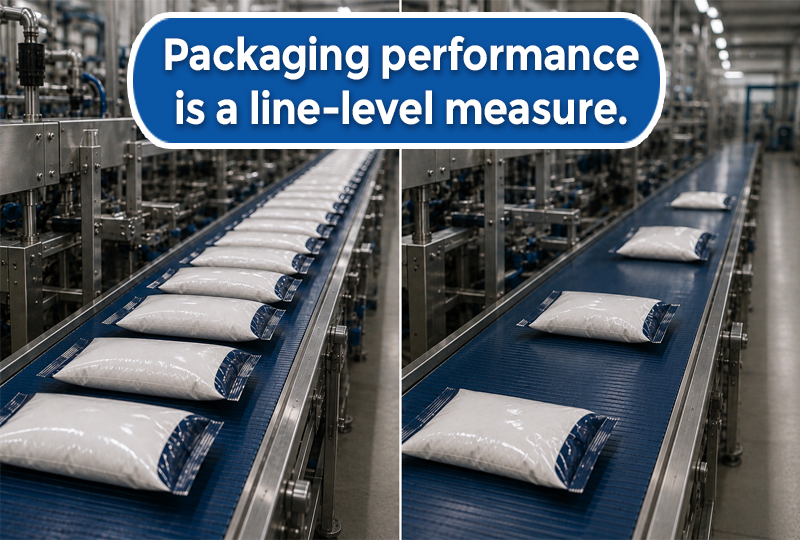
Packaging lines are getting faster. The more interesting question is whether they are getting better.
Rated speed remains an essential part of machine specification, but packaging performance is increasingly about what happens around that number: how consistently the line holds its target rate, how much saleable output it produces, how performance changes across SKUs, and how quickly production returns to steady state after a changeover or interruption.
That shifts the conversation from maximum speed to productive capacity.
And the distinction can be significant.
Table of Contents
Good Output Reveals Where Capacity Is Lost
An 80-bag/min line scheduled to run for an eight-hour shift has a theoretical capacity of 38,400 packages. But theoretical capacity assumes every scheduled minute is productive, the line continuously holds 80 bags/min, and every package meets specification.
Production progressively changes that number:
- Theoretical capacity: 80 bags/min × 8 hours × 60 minutes = 38,400 packages
- After 60 minutes of downtime: 80 bags/min × 7 hours × 60 minutes = 33,600 packages of available capacity
- If normal production variations cause the line to average 75 bags/min while running instead of continuously holding the rated 80 bags/min: 75 bags/min × 7 hours × 60 minutes = 31,500 packages produced
- After rejecting 1% of production: 31,500 × 99% = 31,185 good packages
The line hasn’t lost capacity in one place. It has lost time, rate, and quality. three very different performance problems.
That’s where OEE is useful. Availability identifies lost production time, performance captures the gap between target and actual running rate, and quality captures output that cannot be counted as good product.
The important number isn’t simply the final percentage. It’s knowing where the 7,215-package gap came from, because that determines where additional usable capacity can actually be recovered.
Peak Speed Is Easy. Holding It Is the Engineering Challenge
A machine’s maximum speed establishes what it can reach under specific conditions. Sustained performance shows what it can consistently maintain in production.
On a flexible packaging line, several operations have to remain synchronized at higher speeds. The filler has to complete the dose. Product has to discharge and clear the sealing area. Film has to index, register, and form. The seal process has to remain inside its acceptable window. Finished packages have to clear the machine.
At some point, one of those operations can become rate-limiting. Which one depends on the application.
A larger powder fill can extend the auger cycle. A lower-bulk-density product can change filling and discharge characteristics. A longer package increases the film travel required per cycle. A material change can affect forming or sealing conditions.
This is why a useful speed discussion needs conditions attached to it: 80 bags/min with which product, at what fill, in which package, using which material?
Without those variables, the number says relatively little about how consistently that speed can be maintained across a production schedule.
Packaging Performance Changes With the SKU
A packaging line does not necessarily deliver the same throughput across every SKU. Changes in product, fill weight, bag dimensions, and packaging material can shift which part of the process sets the production rate.
A heavier powder fill, for example, may require more time for the auger to meter and discharge the dose. A product with different flow characteristics can change filling and product-clearance behavior. A longer bag increases the film travel required per cycle, while a material change can affect forming and sealing conditions.
As a result, a line capable of 80 bags/min on one SKU may have a different sustainable rate on another, and for a different technical reason.
For engineering teams, the relevant measure is therefore performance across the intended SKU range. Equipment should be evaluated against the products and package formats that place the greatest demand on filling, bag forming, and sealing, not only the combination that produces the highest bags/minute.
This makes the section’s purpose much clearer: don’t use the best-performing SKU to define the performance of the entire packaging line.
Changeover Performance Is Part of Available Capacity
For high-mix operations, packaging performance includes how quickly a line moves from one SKU to stable production of the next.
Four 20-minute changeovers consume 80 minutes of an eight-hour shift. Reducing each by five minutes returns 20 minutes of available production time without increasing machine speed.
Looking beyond the mechanical changeover itself, a useful measure is the time from the last good package of one run to the first good package of the next at stable production conditions. Setup may be complete while fill parameters, film tracking, registration, or sealing conditions are still being stabilized.
Repeatable recipes, defined adjustment points, and consistent setup procedures can therefore have a measurable impact on available production time, particularly as run lengths shorten and changeover frequency increases.
The Entire Line Has to Support the Target Rate
A bagger’s rated speed can only translate into line throughput when the processes around it can support that rate. A 100-bag/min machine paired with a filling system that can consistently deliver 80 fills/min is, for that application, constrained by the filler’s output.
The same applies downstream. If inspection, conveying, or secondary packaging cannot accept packages at the required rate, accumulation can build until upstream equipment must slow or stop.
This is why packaging performance is a line-level measure. Filling, bagging, inspection, and downstream handling need to be sized and coordinated around the required throughput. Where appropriate, accumulation or buffering can also help the line absorb normal variations and short interruptions.
The goal is not maximum speed at every machine. It is continuous, balanced flow through the complete packaging line.
So, What Does Packaging Performance Really Look Like?
Packaging performance is not a single speed number. It is the ability of the line to consistently turn available production time into good packages at the required rate.
That means looking at the factors that shape usable capacity: good output, sustained throughput, availability, quality yield, changeover performance, and performance across the required SKU range.
Together, those measures reveal something bags/minute cannot: whether the line can deliver the production result expected of it, not just reach a target cycle speed.
Bags/minute defines machine capability. Packaging performance shows how effectively that capability becomes production.