
When Packaging Works, Retail Works: A Practical Look at Retail Packaging Performance
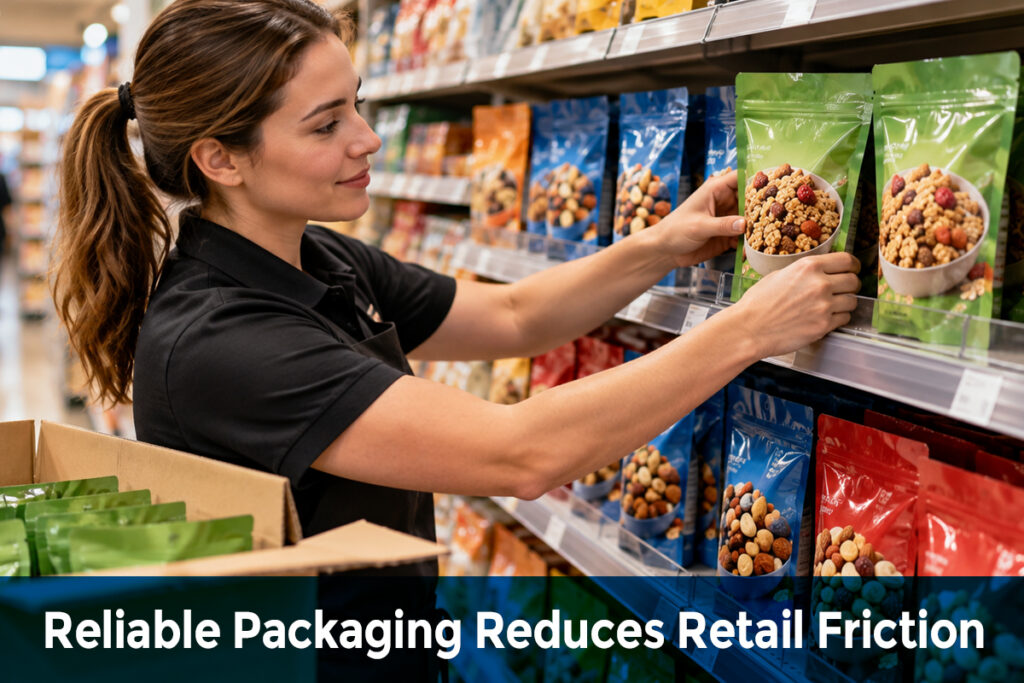
Packaging can look right in a presentation, pass internal approval, and perform well during production, yet still create problems once it reaches the retail environment. Cases are opened. Products are stocked, moved, faced, replenished, handled by shoppers, and transported between backrooms and shelves. Over time, that real-world handling reveals whether the package performs as consistently as expected.
This is where retail packaging performance becomes useful as a practical measure. Rather than looking only at design, format, or material choice, retailers and brands can evaluate how reliably the package behaves throughout distribution, stocking, display, and use. The goal is not perfection. It is predictability.
A package that consistently arrives intact, holds its intended shape, fits the shelf as expected, and requires little correction is easier to manage at scale than one that behaves differently from shipment to shipment.
Table of Contents
Packaging Performance Begins After Production
A package may leave production in acceptable condition, but retail performance continues long after the sealing jaws stop moving. During distribution and store handling, packages are exposed to compression, movement, temperature changes, stacking, case packing, replenishment, and repeated consumer interaction. Those conditions can reveal weaknesses that are difficult to see during production alone. A pouch may seal correctly but lose its shape after being compressed in a case. A bag may look acceptable immediately after filling but become difficult to face consistently after repeated handling. A package that performs well in one shipment may arrive differently in another.
For retailers, the important question is not simply whether the package passed inspection. It is: Does it continue to behave as expected throughout the retail cycle? That is a much more useful measure of performance.
Shelf Condition Can Reveal Packaging Problems
The shelf itself provides valuable information. If products repeatedly lean, collapse, rotate, shift out of position, or lose their intended facing, the issue may be more than appearance. It may indicate that the package structure is not holding consistently under real retail conditions. Occasional movement is normal. The stronger signal is repetition. If store teams must repeatedly correct the same package, or if the same SKU regularly loses its intended shelf position, that behavior is worth examining.
Retail packaging performance can therefore be evaluated through simple questions:
- Does the package remain where it is placed?
- Does it maintain its intended footprint?
- Can multiple units be aligned consistently?
- Does the package behave similarly across different shipments?
These observations help move the discussion away from subjective judgments about whether packaging “looks good” and toward how reliably it performs.
Repeated Damage Patterns Matter More Than Individual Incidents
A damaged package does not automatically indicate a packaging problem. Products are dropped. Cases are mishandled. Distribution environments are not perfectly controlled.
Patterns are more informative. If retailers repeatedly see crushed packs, seal damage, punctures, deformation, or leakage involving the same product, the issue deserves closer attention. Where the damage occurs can also provide useful clues. Damage concentrated in the same area of the package may indicate a structural weakness. Problems that appear mainly after case packing may suggest that the package is not responding well to compression. Failures that become visible only after extended shelf time may point to a different performance issue.
The value comes from connecting isolated incidents. A single damaged unit may be noise. The same type of damage appearing repeatedly across stores, shipments, or production lots becomes performance data.
Store Labor Is an Overlooked Packaging Metric
Packaging can also affect how much work is required to keep a product retail-ready. Store teams routinely replenish shelves, rotate inventory, straighten facings, remove damaged products, and maintain category presentation. When packaging behaves predictably, those activities are straightforward. When it does not, additional touches begin to accumulate.
One package may need to be repositioned several times during the day. Another may need additional support to remain upright. Damaged units may need to be removed, replaced, or marked down. None of these tasks is dramatic on its own. At scale, however, small interventions can add unnecessary labor. This makes store handling an important part of retail packaging performance. If one package consistently requires more attention than comparable products in the category, that difference should not be dismissed simply because the product still sells. The package may be creating operational friction that is easy to overlook when evaluation focuses only on sales performance.
Consistency Across Shipments Is Critical
A retailer does not experience packaging as one perfect production sample. It experiences thousands of units produced across different runs, rolls, shifts, and shipments. That makes consistency especially important. A package that performs well during one launch or qualification run but varies significantly over time creates uncertainty for retailers.
Changes in shape, seal appearance, alignment, rigidity, or overall structure may be small, but they affect how predictably the product can be stocked and displayed. For retail operations, consistent performance is often more valuable than unnecessary complexity.
Store teams should not have to adapt their handling approach depending on which shipment arrives. The package should behave as expected again and again.
This is where production repeatability and retail performance become connected. What looks like minor variation at the packaging line can become more noticeable when thousands of finished units enter distribution and retail.
Consumer Feedback Adds Another Layer
Retail performance does not stop at checkout. Consumer complaints and returns can reveal issues that may not be obvious during shelf evaluation. Reports of packages opening unexpectedly, leaking, tearing incorrectly, failing to protect the product, or becoming difficult to store can provide useful information about how packaging performs after purchase.
The key is not to treat every complaint as proof of a packaging failure. As with store damage, patterns matter. If the same issue appears repeatedly, it may indicate that a package is technically meeting its initial requirements but not performing consistently through its full use cycle. Retailers and brands can use that information alongside store observations to build a more complete view of packaging performance.
Evaluate Packaging as a System
No single measure can define retail packaging performance. Shelf condition alone does not tell the full story. Neither do damage rates, store labor, returns, or consumer feedback. The better approach is to look at how the package performs across the complete retail system. That includes:
- distribution,
- case handling,
- shelf placement,
- replenishment,
- repeated store handling,
- consumer interaction, and
- post-purchase use.
A package that performs consistently across those stages reduces uncertainty. It becomes easier to stock, easier to maintain, and easier to manage across multiple locations. That does not mean packaging alone determines retail success. Pricing, demand, placement, promotion, and availability remain critical. Packaging simply needs to do its part reliably.
Final Thought: Reliable Packaging Reduces Retail Friction
The best indicator of retail packaging performance may be how little attention the package requires.
It arrives as expected. It survives normal distribution. It fits the shelf. Store teams can replenish it without special handling. Consumers use it without recurring problems.
When those conditions are consistent, packaging becomes a stable part of the retail system rather than another variable that needs to be managed.
That is the practical value of evaluating packaging performance after launch.
Instead of asking only whether the package looks right or meets its original specification, retailers and brands can ask a more useful question:
Does this package continue to perform predictably in the conditions where it is actually used?
When the answer is yes, packaging supports retail operations quietly and consistently, which is often exactly what good packaging should do.