
What Makes the Vertobagger Hornet Suitable for Fine, Airborne Powders in Animal Feed Packaging?
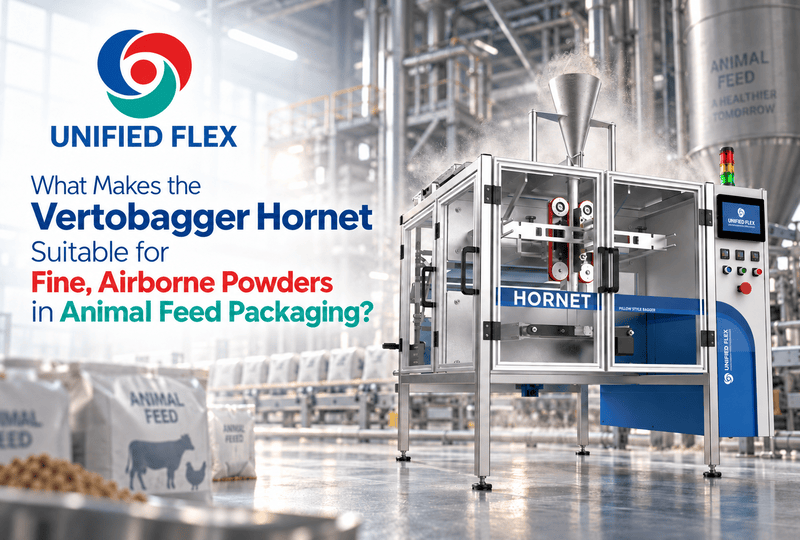
By Unified Flex Editorial Team | Reviewed by Packaging Engineering Specialists | August 2026
Fine, airborne powders are difficult to package because they dust, trap air, compress, and migrate toward the seal zone. For engineers, operations managers, and business owners, a reliable animal feed bagging machine must do more than fill bags; it must maintain consistent dosing, pouch formation, and sealing under variable powder conditions.
The Unified Flex Vertobagger Hornet is engineered to provide that level of control for demanding medicated feed and fine powder applications.
Fine Animal Feed Powders Create a Different Packaging Environment
Fine feed powders introduce several variables simultaneously.
Airborne fines may migrate toward the seal area. Compressible material can change its behavior as hopper conditions vary. Entrained air can influence pouch closure. Product disturbance immediately before sealing may re-suspend settled particles. Small changes in film tracking or forming geometry can then magnify those problems.
For an operations team, the consequences can include:
- Inconsistent package weights
- Powder contamination in the seal zone
- Intermittent seal failures
- Increased product giveaway or scrap
- Frequent operator adjustments
- Longer cleaning and restart cycles
- Reduced confidence in repeatability between batches
That is why equipment selection should focus on mechanical consistency and process stability, not speed alone. The same principle applies when evaluating a pet food packaging machine for powdered supplements, nutraceutical blends, or other fine pet nutrition products where dust and flow variability must be controlled.
How the Vertobagger Hornet Controls Packaging Variability
The Vertobagger Hornet is an automatic powder filling machine designed to control the mechanical variables that influence package consistency, including forming geometry, film movement, sealing motion, and machine synchronization.
Stable Pouch Forming
Pouch geometry has a direct effect on filling and sealing performance. If forming alignment changes during production, the bag may present differently at the fill and seal stations.
The Vertobagger Hornet uses a one-piece, self-aligning forming collar assembly with convenient back-seal alignment. This helps maintain consistent pouch geometry throughout the run and reduces the need for repeated operator correction.
For engineering teams, stable forming provides a more predictable foundation for downstream sealing performance.
Servo-Controlled Film Handling
Fine powder applications are sensitive to even small variations in film movement.
The Hornet uses servo-controlled pulling belts, encoder-based bag length measurement, and photo-sensor print mark registration to support repeatable film indexing.
Consistent film positioning helps prevent cycle-to-cycle variation from changing where the pouch is formed or where powder may accumulate relative to the seal area.
Repeatable Horizontal Sealing
Seal performance depends on more than temperature. Jaw timing, motion, dwell, pouch presentation, and contamination near the seal all influence final seal quality.
The Hornet uses servo-controlled horizontal seal activation supported by digital temperature controllers. This provides repeatable sealing motion and consistent operating conditions across production cycles.
For fine, dusty animal feed powders, this repeatability helps maintain a wider and more stable operating window.
How Does Controlled Motion Reduce Powder Disturbance?
Fine, airborne powders can be re-suspended by vibration or abrupt movement immediately before sealing. Once disturbed, fines can migrate toward the seal zone and increase the risk of inconsistent closure.
Synchronized Servo-Driven Motion
The Vertobagger Hornet uses servo-driven film handling and sealing systems within a PLC-controlled architecture to maintain synchronized machine movement.
Controlled motion helps reduce unnecessary mechanical disturbance as the pouch moves from filling to sealing.
Maintaining Product Stability Before Sealing
Keeping the powder settled before closure helps limit fine-particle migration toward the sealing surfaces.
For operations managers, this can mean more predictable sealing performance over longer production runs and less reliance on repeated manual adjustments as throughput increases.
Why Does Filler Integration Matter for Fine Animal Feed Powders?
The bagging machine and filling system must work as a coordinated process. A vertical form fill seal machine cannot compensate for unstable product delivery if the selected filler does not match the powder’s physical characteristics.
Matching the Filler to Powder Behavior
Unified Flex can configure the Vertobagger Hornet to integrate with auger fillers, volumetric cup fillers, combination scales, piston fillers, and continuous pumps depending on the application.
For fine medicated powders, filler selection may depend on:
- Bulk density
- Compressibility
- Flow behavior
- Dust generation
- Target fill weight
- Hopper conditions
Supporting Repeatable Product Delivery
For cohesive or compressible powders, auger filling may be evaluated to provide controlled product delivery into the pouch.
Matching the filler to the powder helps create a more stable dosing process before the package reaches the sealing station, which is essential for a reliable animal feed bagging machine.
How Do Cleaning and Changeovers Affect Packaging Consistency?
When the Vertobagger Hornet is used as a pet food packaging machine for powdered supplements or nutrition products, it must return to a controlled and repeatable setup after cleaning, maintenance, or package-size changes.
Accessible Machine Design
The Vertobagger Hornet provides 360-degree machine access, quick belt changeovers, tool-less forming collar changeover, and accessible routine wear components.
These features help simplify inspection, cleaning, and scheduled maintenance.
Returning to a Stable Production Setup
Quick and repeatable component changeovers can help operators restore the machine to a known operating condition after sanitation or format changes.
For facilities handling medicated and non-medicated products, easier access can also support structured cleaning procedures and cross-contamination control practices.
How Does the Hornet Balance Throughput With Process Stability?
The Vertobagger Hornet can operate at up to 80 bags per minute, although actual speed depends on product fill time, bag dimensions, film properties, powder behavior, and application requirements.
Sustainable Throughput Over Maximum Speed
For fine animal feed powders, maximum cycle rate should not be the only production target.
Sustainable throughput depends on maintaining stable dosing, consistent pouch formation, controlled film handling, predictable sealing, and limited powder disturbance throughout the run.
Reducing Rejects and Operator Intervention
A line operating at a stable production rate with fewer rejects, less product loss, and fewer manual adjustments can generate more usable output than a system pushed continuously toward its maximum rated speed.
For business owners and operations managers, this distinction is important when evaluating the total return on packaging automation.
Why Is Product Testing Important Before the Machine Reaches Production?
Fine powders can behave differently depending on formulation, bulk density, compressibility, moisture, dust characteristics, and handling conditions. Because of this, final packaging parameters should not be based on equipment specifications alone.
Unified Flex evaluates powder packaging applications around the actual production requirements, including:
- Product characteristics
- Filling method
- Target fill weight
- Pouch dimensions
- Film structure
- Seal performance
- Production-rate expectations
Validate the Process With the Actual Powder
Testing with the real product gives engineering teams an opportunity to evaluate weight consistency, powder movement, film handling, sealing behavior, and achievable throughput under defined operating conditions.
For medicated feed powders, this provides a stronger technical basis for establishing operating parameters before full-scale production.
Rather than assuming how an animal feed bagging machine will perform, the process can be evaluated against the actual material and packaging requirements that the production team will face every day.
Closing Perspective
Packaging fine, airborne animal feed powders reliably is not about maximizing speed; it is about maintaining process control as normal variability appears cycle after cycle. The Vertobagger Hornet is engineered around that principle, combining stable forming, servo-controlled film and sealing motion, controlled product handling, and efficient changeovers.
For manufacturers of medicated feed antibiotic powders and related additives, this level of control can help reduce operator intervention, improve production consistency, and support more predictable output over extended runs.
Want to see how Hornet performs with your specific powder’s flow characteristics?
Speak with a Unified Flex packaging engineer to schedule a sample run and structured validation.