
Packaging Line Efficiency: When Stable Settings Hide Process Drift
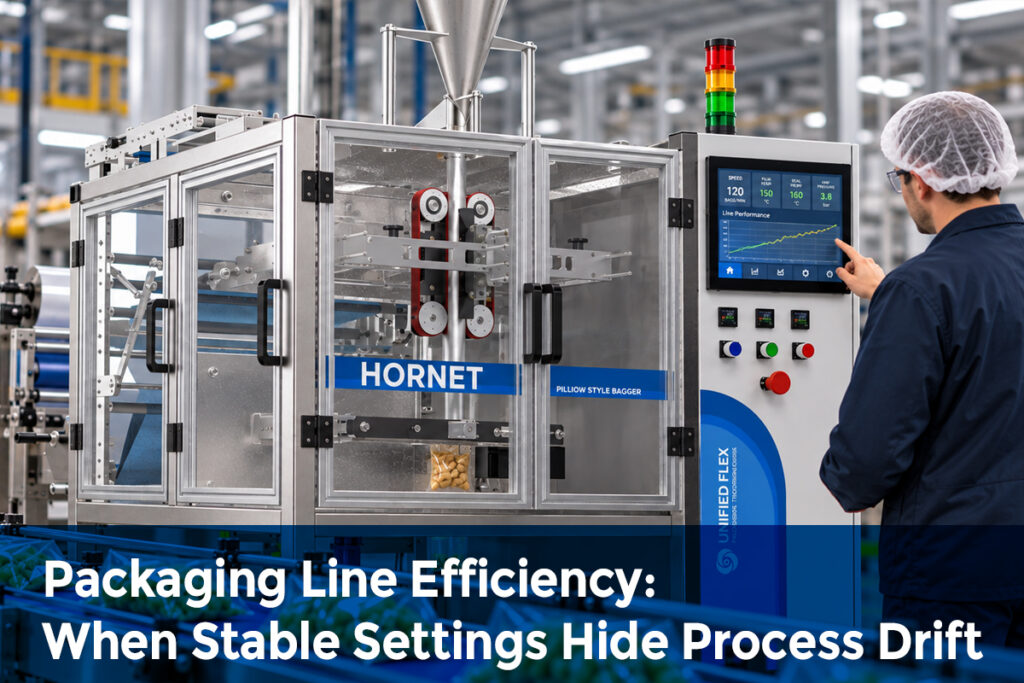
A packaging line can stay within its established operating parameters and still become progressively less efficient. Seal temperature may remain at the validated setpoint. Pressure may be unchanged. The filler may continue running the same recipe. The packaging material has already been qualified, and finished packages still meet specification. Yet the line no longer behaves the way it once did.
A restart takes longer to stabilize. A roll change requires more correction. A speed increase that previously caused no issue now produces a short burst of rejects. Operators begin making small adjustments throughout the shift simply to maintain the same output. No single variable is obviously out of range, so the process can appear healthy when viewed through setpoints alone. For packaging engineers, this is an important distinction. A machine can still be operating according to its programmed conditions while the physical process response has changed.
The engineering question is therefore not only whether the settings are correct. It is whether those settings still produce the same stable, repeatable process they produced when the application was qualified.
Table of Contents
Setpoints Do Not Describe the Entire Process
Packaging equipment is controlled through measurable variables, but package quality is created by the interaction of several physical conditions.
Consider sealing. Temperature is important, but seal formation also depends on contact time, pressure distribution, jaw condition, film presentation, seal-area contamination, and material response. A temperature controller can hold the same setpoint while the actual sealing condition changes because one of the other factors has shifted.
The same principle applies to web handling. A tension setting can remain unchanged while roll condition, machine friction, forming resistance, or material behavior changes. A filler can continue running the same programmed cycle while the product behaves differently because of aeration, temperature, viscosity, bulk density, or replenishment conditions.
This means stable setpoints do not necessarily equal stable process conditions. Packaging engineers therefore need to distinguish between commanded conditions and process response. If the machine uses the same recipe but requires more intervention to produce the same acceptable package, that difference is meaningful. The settings may not have changed, but the relationship between those settings and the physical process has.
A Narrowing Operating Window Is an Early Warning
One of the more useful signs of declining process robustness is not a parameter moving outside specification. It is a reduction in the range over which the line can operate reliably. Suppose a package was previously capable of running consistently between 60 and 80 packages per minute.
Months later, the machine can still reach 80 packages per minute, but intermittent defects begin appearing above 73 or 74. The operator can technically enter the original speed, but reliable production now requires a narrower operating range. The same condition can appear in sealing.
A package may originally tolerate normal production variation across a reasonable temperature range. Later, acceptable seals occur only near one specific setting, and small movement above or below that value produces inconsistent results. The nominal setpoint has not necessarily become wrong. What has changed is the usable operating window around it.
This matters because normal production conditions never remain perfectly constant. Product behavior changes. Material varies within specification. machine components wear. Ambient conditions and production rates shift. A process with a broad operating window can absorb those changes. A process operating close to the edge cannot.
The narrowing window often becomes visible through additional corrections, reduced achievable speed, more frequent rejects, or increasing dependence on specific operating conditions.
Steady-State Performance Can Hide Deterioration
A packaging line is usually easiest to run once everything has stabilized. The web path is established. Product flow is consistent. Temperatures have equilibrated. Filling and sealing are repeating at a constant rate. Under those conditions, even a process with limited tolerance may appear completely stable.
That is why steady-state data alone can give an incomplete view of packaging line efficiency. Commercial production contains repeated disturbances. Machines stop and restart. Rolls are changed. Product is replenished. Speed changes occur. Minor interruptions disturb the operating condition. These events force the process to move from one state to another. A process that is genuinely robust should return to acceptable production in a reasonably repeatable way. This makes transient behavior particularly valuable for engineering analysis. Consider two five-minute stops. After the first stop, the line returns to acceptable production after four package cycles. After the second, the line restarts at the same programmed settings, but 18 packages are rejected before the process stabilizes. The downtime report may record both events as five minutes. From a production-efficiency standpoint, they are not equivalent. The second event carries a larger recovery penalty through material loss, rejected output, and additional stabilization time.
Use Transitions as Repeatable Diagnostic Events
Restarts, roll changes, and controlled speed changes can therefore serve as useful reference points. Instead of recording only that the event occurred, engineers can compare how the process responds each time. For a recurring SKU, useful measures might include:
- cycles from restart to acceptable output,
- rejected packages generated immediately after restart,
- time from roll change to full-rate production,
- material consumed during stabilization,
- number of operator corrections following a transition, and
- highest sustained production speed before a new defect pattern appears.
The absolute value is not the most important part. Ten recovery cycles may be normal for one application and excessive for another.
The value comes from historical comparison. If a product normally returns to acceptable production within five cycles and begins requiring 12 or 15 under otherwise comparable conditions, the process has changed. That change may be visible long before a major machine fault develops. This is also why averages can hide useful information.
A monthly reject rate may remain almost unchanged while the distribution of those rejects shifts. If more of them are now concentrated around restarts, roll changes, or speed transitions, the total percentage alone does not show what has changed in the process.
Distinguish Correction From Compensation
Another useful indicator is the gradual movement of settings away from their previous baseline. Adjusting a packaging process is normal. The important question is what the adjustment represents. A correction addresses a known condition. A compensation allows the line to continue running without necessarily explaining why the original condition no longer works.
For example, increasing seal temperature may restore acceptable package integrity. That does not automatically mean temperature was the root cause. If the same product, film structure, format, and production rate previously ran reliably at a lower temperature, the new requirement is evidence that something else may have changed. Jaw condition, contact uniformity, contamination, timing, or film behavior could all influence the result. The same applies when operators repeatedly reduce speed to maintain fill performance, modify timing to control product interference, or reposition the web to maintain package presentation.
The adjustment may be effective. But if settings continue moving away from the original baseline to maintain the same output, engineers should treat that setpoint migration as diagnostic information rather than simply accepting the new value.
Avoid Troubleshooting the Variable Closest to the Defect
Packaging systems are coupled processes, which makes one-variable troubleshooting risky. A defect visible at the seal is not necessarily caused only by the sealing system. Product contamination, film presentation, jaw condition, alignment, timing, and material behavior can all affect the seal interface. Similarly, apparent web instability may involve unwind behavior, forming resistance, material properties, mechanical condition, or downstream forces. This becomes especially important with intermittent defects. A single variable may never move far enough to create the problem on its own. Instead, several small changes can overlap until the process crosses its practical operating boundary.
The conditions surrounding the defect therefore become useful clues. If rejects appear mainly after restarts, investigate what changes during restart. If they occur only at higher speeds, focus on the process relationships affected by speed. If instability follows specific rolls or material lots, material-related variables become more relevant. This approach narrows the investigation based on when the process changes, rather than automatically adjusting the parameter closest to the visible symptom.
Build the Baseline Around Process Behavior
A useful production baseline should contain more than recipe values. For recurring applications, packaging engineers can establish what normal process response looks like. That may include recovery cycles, transition rejects, stable speed range, stabilization time, and frequency of manual adjustment. Over repeated runs, these values form a practical response profile for the application.
The goal is not to create unnecessary reporting. It is to make gradual deterioration visible. One unusual restart may be random. A steady increase in recovery cycles across comparable runs is different. One correction after a roll change may be insignificant. Repeated intervention after every roll change on a process that previously required none is a trend worth investigating. The most meaningful baseline is generally tied to the same SKU, package configuration, and production line rather than a plant-wide average. That gives engineers a reference for determining whether the process is still behaving as expected.
Packaging Line Efficiency Is About Repeatable Response
A packaging line is not efficient simply because it can reach its target speed. It also has to maintain acceptable production through the normal disturbances that occur during commercial operation. A line that reaches 80 packages per minute but repeatedly falls out of stable operation is different from a line that reaches 80 and remains there through routine stops, material changes, and production transitions. The difference is not nominal speed. It is process response.
Longer recovery, narrowing operating windows, setpoint migration, increasing adjustment frequency, and rejects concentrated around transitions can all indicate that the process is changing before a conventional failure becomes obvious.
Those signals do not identify the root cause by themselves. They show packaging engineers where deeper investigation is justified. The key question is therefore not only: Are the parameters still within range?
It is: Does the process still respond to normal production variation the way it did when that operating range was established?
If the answer is no, packaging line efficiency may already be declining even though the machine still appears to be under control.
Looking to improve packaging line performance for your application?